
Florida E-Scooter Accident Claims After a Driver Turns
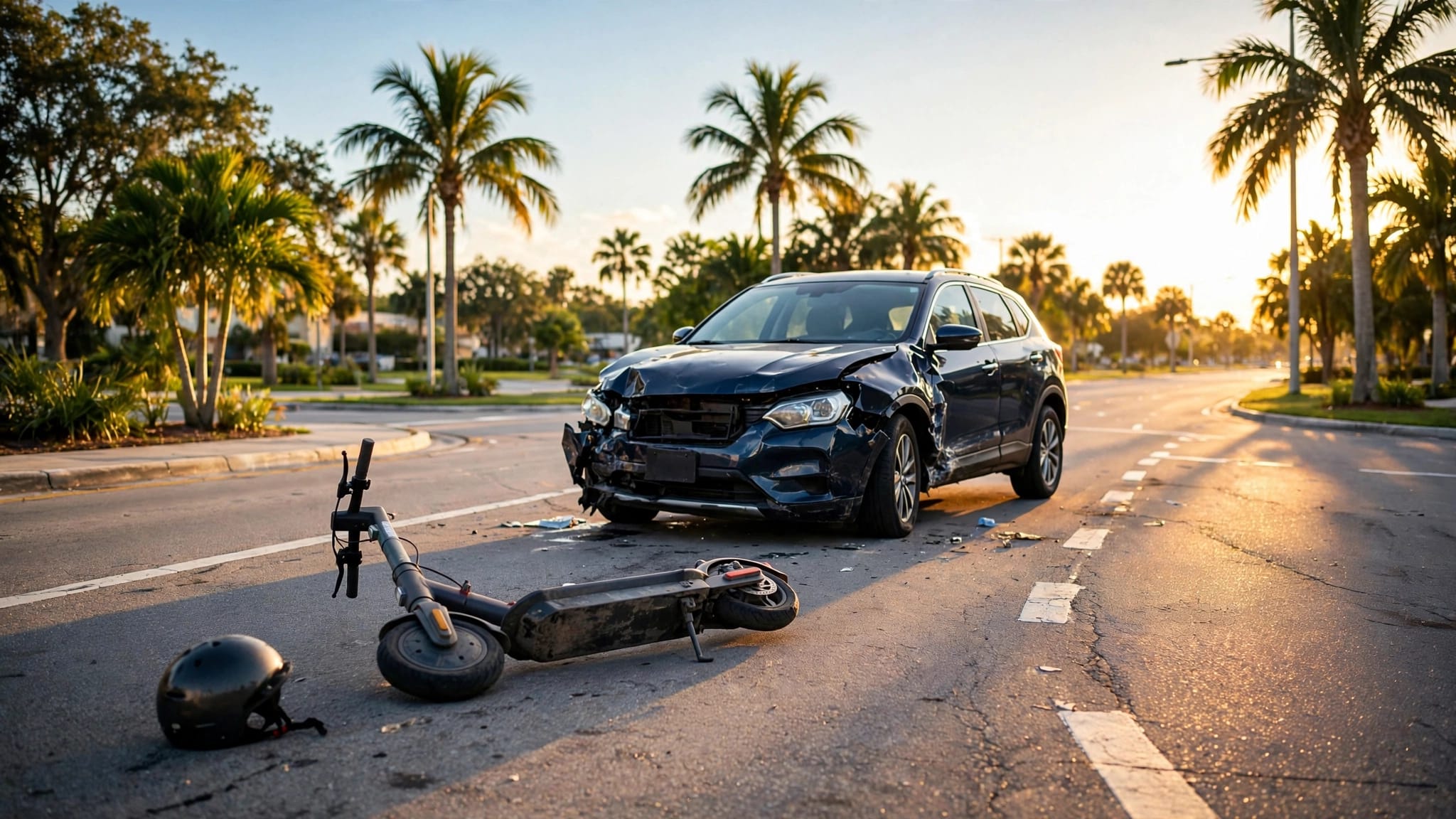
A driver who turns across your lawful path can be liable for your injuries. A Florida e-scooter accident claim requires evidence of the turning movement, your location, and the harm that followed.
Fatal crashes have increased attention on young riders, devices capable of traveling at high velocities, and local enforcement. However, a safety violation doesn’t automatically decide a civil claim. Start with the collision evidence and the rules governing the device you rode.
Key Takeaways for Injured Riders
- A turning driver may owe you the right of way, but traffic controls and your position matter.
- Florida distinguishes legal electric bicycles and motorized scooters from electric motorcycles that fall outside the statutory bicycle categories.
- Preserve recordings, the scooter, and protective equipment before evidence disappears.
- Shared fault, insurance coverage, and filing deadlines require separate analysis.
What Florida’s Fatal Scooter Crashes Show
Two widely reported deaths explain the pressure for stronger rules. Neither account, by itself, establishes liability in a turning-driver case.
Colton Remsburg’s death in Orlando
FOX 35’s May 21, 2026 report described the May 10 crash in which Colton Remsburg, 13, died after a pickup truck struck him while he rode an e-scooter on Moss Park Road in Orlando.
His mother, Ashley LaChance, called for banning e-bikes and e-scooters for children 14 and younger. As fallbacks, she supported helmet requirements, limits on how fast devices may travel, and fines. Those demands were proposed policy responses, not findings about the pickup driver’s civil responsibility.
The Lake Asbury collision
In separate Clay County coverage, FHP said a 14-year-old was stopped in the westbound lane of Sandridge Road, west of Verbena Parkway, late at night. His motorized scooter had no lights.
A sedan driven by a 16-year-old struck him. A 17-year-old then rear-ended that sedan. The rider, who wasn’t wearing a helmet, was thrown from the scooter and was killed at the scene.
Reports described the road as dark with few streetlights. FHP’s investigation remained open when those reports appeared. Because teenage drivers were involved, our discussion of claims involving minor drivers explains related liability and coverage issues.
Who Is Responsible When a Driver Turns Across You?
Florida law and the specific turning sequence determine which right-of-way rule applies. A driver’s statement that they “didn’t see” you doesn’t settle responsibility.
Left turns across approaching riders
Under Florida’s left-turn yielding rule, a driver turning left must yield to approaching traffic close enough to create an immediate hazard.
A claim may turn on your speed, the distance between you, and when the driver began turning. Our guide to motorcycle left-turn crash claims discusses similar timing evidence, although scooter classification and insurance rules differ.
Right turns across bike lanes or crossings
A driver turning right may cross your route through a bike lane, sidewalk crossing, or driveway entrance. Investigators need to determine whether you approached alongside the vehicle, entered a crossing, or faced a conflicting signal.
A turn signal doesn’t give a driver priority over someone already alongside.
You also have duties. For example, entering a crossing against a signal may affect fault. The evidence must establish the actual sequence.
Device Classification Changes the Applicable Rules
The product name on a sales listing doesn’t establish its legal category. Its equipment and motor capability matter.
Legal e-bikes and motorized scooters
Florida’s e-bike definition requires operable pedals, a seat or saddle, and a motor under 750 watts. Class 1 and Class 2 motor assistance cuts off at 20 mph; Class 3 pedal assistance cuts off at 28 mph.
A statutory motorized scooter has no more than three wheels and cannot propel itself faster than 20 mph on level ground. Under Florida’s motorized-scooter statute, qualifying scooters generally receive bicycle rights and duties, subject to exceptions and local regulation.
High-speed devices fall outside those definitions
Sergeant Greg Rittger described devices sold at local motorcycle dealerships and students using them at 45 to 50 mph without licenses.
Parents shouldn’t infer that every legal e-bike requires a license or tags. Devices exceeding statutory limits may fall into another category, with different requirements, or lack authorization for road use.
What Orange County Rules and State Proposals Change
Local enforcement changed after the early reports. Proposed statewide requirements need to remain separate from adopted law.
Orange County moved beyond the draft stage
The Sheriff’s Office initially drafted an ordinance allowing county citations resembling parking tickets. Officials also discussed fully impounding devices when riders repeatedly ignored rules, with the draft headed to the Board of County Commissioners.
Commissioners approved a micromobility ordinance September 29, 2026. The county’s adopted micromobility rules describe default limits of 10 mph on sidewalks and shared-use paths, and 20 mph on roadways and bicycle facilities, unless signs or city rules provide otherwise.
Violations are noncriminal civil infractions. Impoundment is available in specified circumstances, including speeding or dangerous operation.
Kendall’s proposal concerns classification and rider qualifications
Representative Kim Kendall criticized treating devices capable of 70 mph as bicycles. Working with St. Johns County Sheriff Robert Hardwick, she described a three-category approach separating electric motorcycles, Class 3 e-bikes, and Class 1 and Class 2 e-bikes.
Reported proposals included permit requirements, a minimum age of 16, and helmets for affected riders. Her earlier description included education without penalties. By June 2026, she discussed a possible July 1, 2027 effective date if legislation passed. Those proposed qualifications aren’t established statewide requirements merely because lawmakers discussed them.
Preserve Evidence Before Repairs or Deletion
Medical care comes first. Once you’re safe, preserving evidence helps answer disputes that emerge after the initial report.
Document the turning movement and roadway
Call 911 when someone is injured. Photograph vehicle positions, impact damage, traffic controls, bike-lane markings, and obstructions when you can do so safely. Get witness contact information and retain original recordings.
Nearby businesses may overwrite surveillance footage. An attorney can request preservation of recordings and relevant vehicle data before repairs or salvage alter the evidence.
A missing police report doesn’t automatically defeat a claim. Our guidance on claims without a police report discusses other supporting records.
Keep the scooter and helmet intact
Don’t repair, discard, clean, or modify damaged equipment before its evidentiary value receives attention. Photograph the helmet’s exterior, interior, straps, and visible damage. Keep purchase records and the scooter’s model information.
Tell medical providers how the crash happened and describe every symptom accurately. Bills, work restrictions, and wage records connect the collision to your financial losses. In insurance communications, stay truthful without guessing about how quickly you were traveling, the distance, or your reaction time.
Speed, Helmets, and Battery Damage Need Separate Attention
Orange County Fire Rescue Division Chief William Farhat reported 41 injury incidents since December 1 and 144 incidents overall, including fires. Those local figures aren’t a statewide e-scooter death count.
Farhat also warned that children jumping on battery-powered decks can crack battery casings and trigger sudden lithium-ion fires. After a collision, damaged batteries create a separate safety concern. Don’t charge damaged equipment or handle a hot, smoking, or swollen battery; move away and call emergency services.
First responders warned that ordinary bicycle helmets may provide inadequate protection at high motorized speeds and recommended heavier, appropriately rated headgear. In a claim, helmet nonuse and injury severity require their own evidence. They don’t replace the investigation into why the driver crossed your path.
Insurance and Compensation After a Florida E-Scooter Accident
Proving driver negligence and locating insurance are different tasks. Serious injuries can exceed available policy limits.
Identify potentially available coverage
The driver’s bodily injury liability coverage, if available, may pay an injury claim. Depending on ownership and work duties, a vehicle owner or employer may also bear responsibility.
Your uninsured or underinsured motorist coverage may apply, but policy definitions, exclusions, and device classification matter. Don’t assume automobile PIP always covers a scooter rider or that motorcycle exclusions automatically control.
Where PIP applies, initial qualifying treatment generally must begin within 14 days. That insurance deadline is separate from the need for prompt medical care.
Connect each claimed loss to the collision
Recoverable losses may include medical bills, supported future treatment, lost earnings, reduced earning capacity, and scooter damage. Pain and suffering may also be available, subject to applicable motor-vehicle injury-threshold rules.
Under Florida’s comparative-fault statute, your percentage of fault generally reduces damages. In covered negligence actions, being more than 50% responsible bars recovery.
An adjuster’s proposed percentage isn’t a court finding. Allegations about how quickly you were traveling, lighting, or an unsafe crossing need evidence connecting that conduct to the harm.
Frequently Asked Questions
Can I pursue a claim if the car never touched me?
Yes. A driver who turns across your route may cause a crash even if you avoid contact and fall. However, you still need evidence connecting the driver’s maneuver to your injuries.
Preserve video, witness accounts, roadway marks, and the scooter’s final position. If the driver leaves or remains unidentified, available insurance depends on policy language and the facts.
Can I ride an electric scooter on Florida roads without a license?
A device meeting Florida’s statutory motorized-scooter definition doesn’t require a driver’s license or ordinary motor-vehicle registration. State law generally gives its operator bicycle rights and duties.
However, local restrictions still apply. A device that exceeds the statutory limits doesn’t receive that exemption merely because its seller calls it an e-scooter.
How long do I have to file a lawsuit?
Florida’s negligence filing-deadline statute generally provides two years for recent negligence claims. Different defendants, claim types, and circumstances can change the applicable deadline.
Settlement discussions and an open insurance file generally don’t pause that period. Insurance notice duties and evidence-preservation needs can arise much earlier.
Protect the Evidence Behind Your Claim
A turning-driver claim depends on proof of the collision sequence, the applicable riding rules, and documented injuries. A device label, traffic citation, or insurer’s accusation doesn’t answer every liability question.
At Avard Law Offices, we offer free consultations for personal injury claims. Bring available photographs, recordings, medical records, and insurance correspondence so we can discuss the evidence, coverage, and deadlines affecting your options.