
Florida Playground Injury Claims: Records That Matter
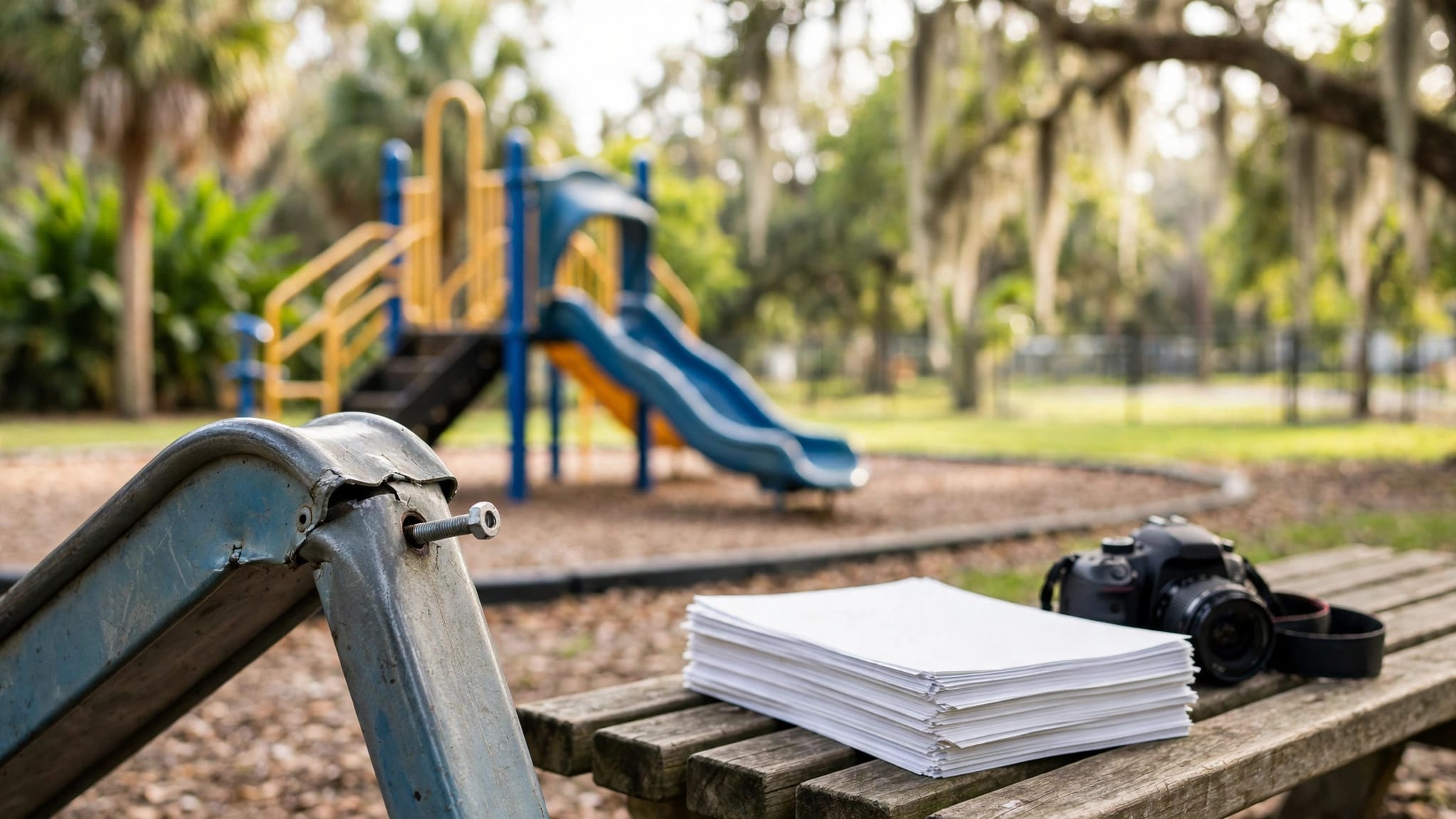
A playground can look safe even when its maintenance records describe a problem that never received a repair. After your child suffers an injury, photographs show the scene, but inspection logs and supervision records may explain why it happened.
Florida playground injury claims require evidence connecting a safety failure to the child’s injuries. Preserving records early matters because equipment can change and surveillance footage can disappear.
Start with the equipment involved, who controlled it, and whether anyone had responsibility for supervising your child.
Key Takeaways for Parents
- Inspection logs, repair orders, and earlier complaints can show whether a responsible party knew about a playground hazard.
- Supervision duties differ between a public park, a school, and a child-care program.
- An injury report or completed checklist doesn’t decide liability. Medical records, photographs, video, and witness accounts must support the claim.
What Florida Playground Injury Claims Must Prove
Identify who owed your child a duty
A negligence claim requires proof of a duty of care, a failure to meet that duty, causation, and damages. An injury alone doesn’t establish that someone acted negligently.
Responsibility may involve a property owner, school, child-care operator, maintenance contractor, or equipment manufacturer. However, ownership doesn’t always establish who inspected the equipment or controlled its use. Contracts and maintenance agreements can identify those roles.
Your child’s reason for entering the property also matters. If the child entered without permission, our explanation of Florida attractive nuisance claims addresses circumstances in which dangerous property conditions can create duties toward children.
Connect the safety failure to the injury
The evidence must explain how the alleged failure caused harm. A loose platform connection, missing protective barrier, or inadequate fall surface needs a connection to the accident.
Similarly, a supervision claim requires more than showing that an adult looked away. The investigation must establish what intervention reasonable supervision required and whether it could have prevented the injury.
Medical records then document the diagnosis, treatment, and effects. Accurate descriptions of the accident help connect the injury to the equipment or conduct involved.
Equipment Inspection Records: Look Beyond Checked Boxes
Match the inspection to the exact equipment
An inspection covering an entire recreation property may reveal little about the slide, swing, or climbing platform involved. Useful records identify the equipment, inspection date, inspector, findings, and recommended action.
Compare the checklist with photographs and witness accounts. Did it address loose fasteners, damaged connections, missing barriers, exposed sharp edges, or worn components? Did it cover the surface beneath the equipment?
The timing matters too. A report from months earlier answers different questions than a documented inspection shortly before the injury. Neither establishes the equipment’s condition at the accident without supporting evidence.
Follow reported defects through repair completion
A maintenance request proves that someone reported a concern. It doesn’t establish that workers corrected the problem.
Trace the request through repair tickets, contractor notes, invoices, replacement-part records, and completion photographs. Also review whether anyone restricted access while repairs remained unfinished.
A work order marked “closed” may record an administrative update rather than a completed repair. The underlying technician notes can explain the difference.
Earlier complaints and similar incidents may establish notice. However, they should involve the same equipment or a genuinely related hazard.
As with trampoline park injury claims, internal maintenance records can reveal recurring defects that a single inspection missed. A contractor’s invoice may also identify a different component than the one the operator intended to repair.
What Playground Safety Guidance Adds to a Claim
The U.S. Consumer Product Safety Commission’s Public Playground Safety Handbook provides guidance on equipment hazards, protective surfacing, inspections, and maintenance.
The 2025 handbook recommends keeping maintenance inspection and repair records, manufacturer instructions, and signed, dated inspection forms. It also recommends recording reported accidents and injuries because those reports can reveal hazards or dangerous design features.
These materials give an investigation concrete reference points. For example, manufacturer instructions can explain which components required inspection and what maintenance the equipment needed.
Still, CPSC recommendations aren’t automatically binding Florida law. ASTM F1487-21 is also a voluntary consensus standard for public playground equipment unless incorporated into an applicable requirement or otherwise made binding.
A qualified expert can evaluate which guidance applies to the equipment and its installation. The analysis must connect any departure to the accident, rather than treating every difference as proof of negligence. The handbook doesn’t establish a statewide retention period for every playground’s records.
Supervision Records: Establish Who Was Responsible
Distinguish organized care from public recreation
A child-care center supervising enrolled children has different responsibilities than a city operating a public playground. Public access doesn’t automatically mean the park provides attendants to watch every child.
For a school, camp, or child-care program, identify who accepted responsibility for the child and what activity was underway. The child’s age, equipment, group size, and foreseeable behavior affect the supervision analysis.
Florida’s licensed child-care staffing requirements aren’t universal playground rules. A staffing ratio that applies to a regulated program doesn’t automatically govern a neighborhood park or every school activity.
Compare written plans with actual staffing
Relevant records may include attendance sheets, staff schedules, duty assignments, training materials, playground rules, and incident reports. These documents can identify which adults were present and where they were assigned.
Attendance records help establish how many children participated. Staff schedules show planned coverage, but video and witness accounts may reveal whether those employees actually supervised the area.
Training materials may address rough play, age-appropriate equipment, visibility, and emergency responses. Compare those instructions with what happened.
A staffing count alone doesn’t answer whether supervision was reasonable. Adults may have obstructed views or overlapping assignments. Conversely, adequate supervision cannot always prevent a sudden accident. The claim must identify a preventable failure and connect it to the injury. Internal policies are relevant evidence, but they don’t decide the legal standard by themselves.
Preserve Evidence Before the Playground Changes
Medical care comes first. Seek prompt evaluation after a significant fall, head injury, suspected fracture, or other serious symptoms.
When it’s safe, photograph the equipment and surrounding area. Capture close views of the suspected defect, wider views showing its location, and the surface beneath it. Include warning signs, barriers, equipment labels, and any visible damage.
Record the date, time, weather, witness names, and statements from employees or property representatives. Keep original photographs and video files. Preserve damaged clothing or personal items when they may help explain the accident.
Protect operator-held records
An attorney can send a preservation request identifying surveillance footage, inspection logs, repair records, prior complaints, staffing documents, and relevant communications. Video systems may overwrite footage, so delay can make useful evidence unavailable.
A preservation request doesn’t guarantee voluntary access to every private record. Litigation procedures may be necessary to obtain documents and testimony.
Keep an independent account of events
Request the incident report, but don’t treat it as the final account. Employees may write it during an emergency, before they have complete information.
Compare it with witness statements, medical records, and photographs. Also document changes to the equipment without entering restricted areas, moving components, or attempting your own inspection. An attorney can arrange appropriate examination and preservation of physical evidence.
Public Playgrounds and Comparative Fault Need Separate Review
Government ownership changes the claim process
A city park, county recreation area, or public school can involve Florida’s sovereign-immunity rules. Florida’s government liability statute establishes procedures and restrictions that differ from claims against private operators.
Covered personal-injury claims generally require written presentment within three years. The statute also generally provides a six-month investigation period before suit, subject to exceptions.
Required recipients depend on the government defendant. Notice to the Florida Department of Financial Services applies where the statute requires it; claims against municipalities and counties have an exception to that department-notice requirement.
Reporting an accident to a park employee doesn’t necessarily satisfy formal claim presentment. A maintenance complaint showing prior knowledge of a hazard is also different from legal notice of an injury claim.
Fault allegations require evidence
Under section 768.81, a claimant’s share of fault can reduce damages proportionately. In covered negligence cases, a claimant more than 50% responsible for their own harm generally cannot recover.
In a child’s case, age and capacity matter when evaluating conduct. An allegation that the child misused equipment doesn’t settle the issue.
Video, equipment instructions, warnings, and supervision evidence can help establish what occurred. Our attorneys can evaluate those facts alongside the defendant’s responsibilities and the applicable legal standards.
Document the Injury’s Lasting Effects
Equipment records explain the safety issue. Medical and financial records establish the harm for which compensation may be available.
Keep treatment records, imaging reports, therapy notes, prescriptions, and bills. School absences, activity restrictions, and follow-up recommendations can also help document changes in the child’s daily life.
Potential damages may include medical expenses, future treatment, rehabilitation, scarring, disability, and pain and suffering. The available recovery depends on the injury, supporting evidence, responsible parties, and applicable law.
Also preserve documentation of a parent’s missed work and caregiving demands. Those records can help an attorney assess the family’s losses, although not every expense or disruption is automatically recoverable.
Don’t assume early improvement establishes a complete recovery. Follow the child’s treating providers’ recommendations so the medical record accurately reflects ongoing symptoms and treatment needs.
Frequently Asked Questions
Does a recent inspection defeat a playground injury claim?
A recent inspection can support the operator’s position, but its scope and accuracy matter. A general checklist may not address the failed component or the condition beneath it.
Compare the report with photographs, repair records, video, and witness accounts. The central issue remains whether reasonable care required action that would have prevented the injury.
What if the operator has no inspection records?
Missing records don’t automatically prove negligence. Witness testimony, prior complaints, manufacturer instructions, photographs, and physical evidence may still establish what happened.
An attorney can investigate whether records never existed, weren’t retained, or remain with a contractor. That investigation should also address what inspections reasonable care required and whether the hazard would have been discoverable.
Protect the Records That Explain the Injury
Florida playground injury claims are strongest when equipment records, supervision evidence, and medical documentation support the same account. A clear timeline can show when a hazard appeared, who knew about it, and what happened before your child was hurt.
Don’t wait for an operator’s internal investigation before seeking legal advice. Our attorneys offer free consultations to review the circumstances and discuss the evidence needed to pursue a claim.