
Florida Workers’ Comp for Employer-Sponsored Event Injuries
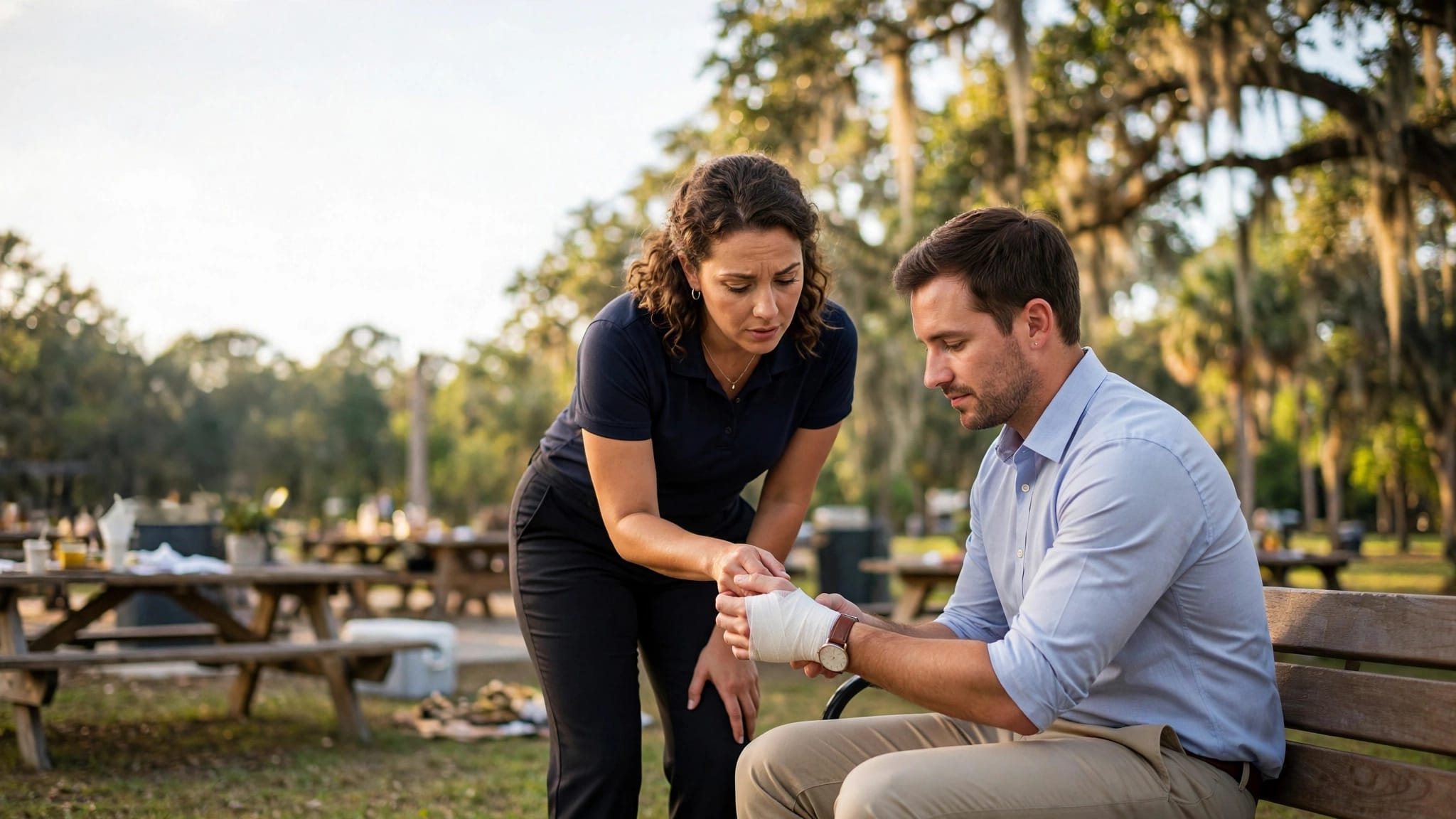
Florida workers’ comp may cover an injury at a company event, but employer sponsorship alone doesn’t establish coverage. For recreational or social activities, Florida generally requires both an express employment requirement and a substantial, direct employer benefit beyond ordinary health and morale improvements.
That distinction matters when you’re hurt at a holiday party, company picnic, or team-building outing. Your strongest evidence often concerns what your employer required and what you were doing when the accident happened.
Start with Florida’s legal test before accepting a manager’s answer about whether the injury qualifies.
Key Takeaways
- An employer paying for or organizing an event doesn’t automatically make an injury compensable.
- Recreational and social activities face a two-part statutory test, including a direct employer benefit beyond ordinary morale.
- Your assigned duties and the activity underway when you were injured matter more than the event’s label.
- Report the injury promptly, generally within 30 days, and preserve invitations, instructions, witness information, and medical records.
When Florida workers’ comp covers event injuries
Florida Statutes section 440.092 sets a specific standard for recreational and social activities. Both requirements below must be satisfied. Evidence supporting only one doesn’t establish coverage under this provision.
The activity must be expressly required
The statute requires the activity to be an expressly required incident of employment. A written instruction that employees must attend carries different weight than a general invitation.
Save emails, schedules, meeting notices, and messages about attendance. Also preserve any instructions describing consequences for missing the activity.
Social pressure doesn’t automatically satisfy this requirement. A supervisor’s enthusiasm or your concern about disappointing coworkers doesn’t, by itself, establish an express employment obligation. The actual directions matter.
The employer must receive a substantial direct benefit
The activity must also provide a substantial, direct benefit to the employer beyond the health and morale benefits common to recreation and social life.
General claims about teamwork, employee happiness, or company spirit don’t answer this part of the test. Look for evidence of actual business purposes and required work.
An agenda identifying assigned presentations, customer responsibilities, or other business duties can help explain the employer’s benefit. However, the existence of some business discussion doesn’t automatically establish that every recreational activity at the event qualifies.
Why the activity matters more than the event’s name
A single company gathering can include work assignments and optional recreation. Therefore, describing the entire occasion as a “company event” leaves an important question unanswered: what were you doing when you got hurt?
Holiday parties and recreational outings
Holiday celebrations, company picnics, sports outings, and similar gatherings often involve social or recreational activities. Employer payment, company branding, and management attendance may provide context, but none replaces the statutory requirements.
The same caution applies to a gathering held during paid hours or on company property. Those details belong in the claim record, yet neither automatically resolves coverage.
Preserve the invitation’s original wording. Language describing attendance as optional may become important, as may later instructions that contradict it. Keep both rather than relying on how someone describes the event afterward.
Assigned work during a gathering
Employees assigned to organize, supervise, present, or perform other work need an analysis of those duties. Participating as a guest and carrying out an employer’s instructions raise different coverage questions.
Document the assignment, who gave it, and whether it remained underway when the accident occurred. Job descriptions, setup schedules, and supervisor messages may help establish that connection.
The recreational-activity exclusion shouldn’t replace a careful examination of actual work duties. At the same time, an assignment earlier in the day doesn’t automatically establish coverage for unrelated recreation later.
Evidence that connects the accident to your job
The event invitation is only the beginning. A useful claim file connects the employer’s instructions, the activity, and the injury.
Keep the full agenda, attendance policy, relevant messages, and any record of assigned responsibilities. Save copies outside your work account so you can still access them during leave or after employment ends.
Also preserve photographs of the accident area and names of people who saw what happened. Witnesses who heard attendance instructions may matter even if they didn’t see the injury.
Preserve evidence of both the attendance requirement and the employer’s direct business benefit. Proving one doesn’t establish the other.
Write a dated account while the details remain clear. Identify the activity underway, the instructions you were following, and the body parts affected.
Medical records should accurately describe how the injury happened. Avoid guessing about a diagnosis or filling gaps in your memory. If an early report contains an error, identify it promptly rather than repeating it in later accounts.
Travel and personal detours raise separate questions
Coverage at an event doesn’t automatically establish coverage for the trip there or home. Florida generally excludes ordinary commuting injuries, although its statute recognizes a special-errand-or-mission exception.
Save travel instructions, transportation arrangements, and messages explaining any assignment connected to the trip. The reason for the travel matters, along with what you were doing when injured.
A personal deviation can also affect coverage. Section 440.092 generally excludes injuries during a deviation from employment unless a statutory exception applies, including an expressly approved deviation.
For employees in travel status, the statute requires active engagement in employment duties when the injury occurs. Being away from home for business doesn’t make every activity work-related.
Keep the timeline precise. Record when assigned duties ended, whether the employer approved any change in plans, and where the accident occurred. Avoid assuming that an entire evening shares one coverage status.
What to do after an employer-sponsored event injury
Don’t wait for the employer and insurer to agree about coverage before creating a record. Reporting the injury preserves information even when responsibility remains disputed.
Give prompt notice and keep proof
Under Florida’s injury-reporting statute, an employee generally must notify the employer within 30 days of the accident. Exceptions exist, but reporting promptly avoids relying on one.
Identify the date, location, activity, affected body parts, and witnesses. Explain any work assignment connected to the event. If you initially report verbally, follow up by email, text, or an incident report.
The employer generally has seven days after actual knowledge to report the injury to its carrier. That obligation is separate from your notice deadline. Our guidance on employer injury-reporting refusals addresses what happens when a supervisor won’t cooperate.
Document medical care and claim communications
Get medical attention for your injury and give an accurate account of the accident. Keep treatment records, bills, work restrictions, and appointment notices together.
Request the carrier’s name, claim number, adjuster’s contact information, and treatment instructions. Also retain messages saying the event wasn’t covered or directing you to another insurance plan.
If the employer withholds carrier information, Florida’s Employee Assistance and Ombudsman Office provides assistance at 1-800-342-1741.
A missing claim number doesn’t prevent you from preserving evidence. Record each contact, including the date, person involved, and response.
Benefits and coverage disputes require different evidence
If the injury qualifies, Florida workers’ compensation can provide medical care and qualifying disability benefits. However, establishing that an event injury is work-related doesn’t resolve every question about treatment, restrictions, or lost earnings.
Medical records must also connect the diagnosed condition to the accident. Work-status records help document how the injury affects your ability to perform your job. The state’s injured-worker FAQs explain benefits and common claim questions.
If the carrier denies coverage, obtain the stated reason in writing. A denial based on optional attendance requires different evidence than a dispute over medical causation.
We can review the event instructions, accident records, medical evidence, and carrier correspondence to identify the disputed issues. Our guidance on when to hire an attorney explains situations that warrant early legal help.
Addressing the stated reason directly is more useful than repeatedly describing the gathering as employer-sponsored.
Frequently Asked Questions
Does an off-site event automatically fall outside workers’ comp?
No. Holding the gathering away from the workplace doesn’t automatically defeat coverage. The activity’s employment connection and applicable statutory requirements still matter. Likewise, an event on company property isn’t automatically covered. Preserve evidence of your duties and attendance instructions regardless of location.
Can I receive compensation for pain and suffering?
Florida workers’ compensation doesn’t provide a separate pain-and-suffering award. Its benefits address medical care, disability, and other statutory categories. If an outside party caused the injury, a separate personal injury claim may involve different damages. That possibility requires its own liability analysis.
How long do I have to pursue disputed benefits?
Reporting the accident and filing a Petition for Benefits are separate steps. Florida generally provides a two-year filing period after you knew or should have known the injury arose from employment. Treatment and benefit payments can affect the calculation. An investigation or “under review” status doesn’t automatically extend deadlines.
Does my employer have the final say about coverage?
A manager’s statement doesn’t settle the legal question. The employer reports the injury, and the carrier evaluates the claim. Disputed benefits may require proceedings through Florida’s workers’ compensation system. Preserve the denial and supporting records rather than treating an informal refusal as the end of your options.
Protect Your Claim With the Right Event Records
An employer-sponsored event injury needs a clear record of the activity, your instructions, and the employer’s business benefit. Prompt reporting protects that record while the coverage question receives legal review.
At Avard Law Offices, we offer a free initial consultation for workers’ compensation matters. Bring the invitation, attendance messages, accident report, and medical records so we can assess the dispute and relevant deadlines.