
Florida Needle Stick Claims: Testing, Care, and Deadlines
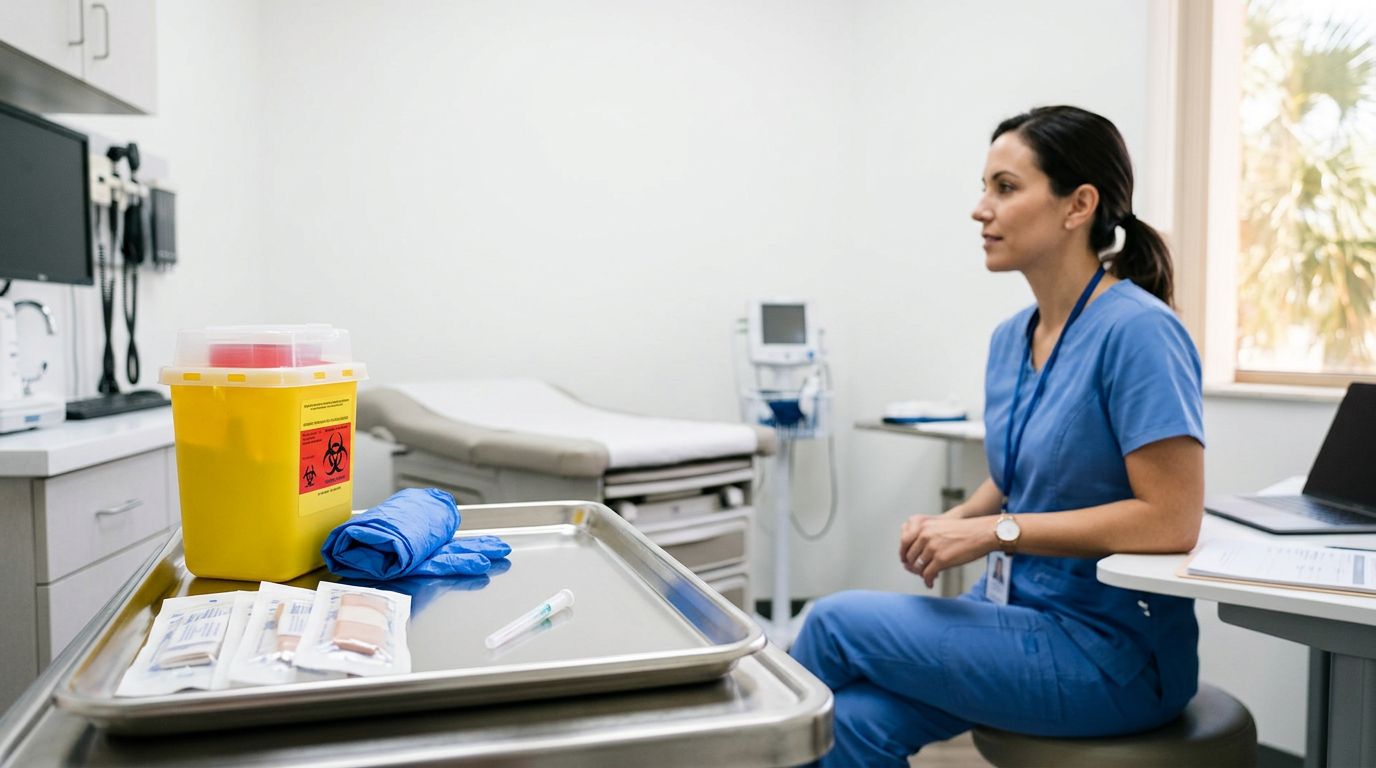
A needle stick can turn an ordinary shift into months of medical appointments, lab work, and uncertainty. Florida needle stick claims often begin before anyone knows whether an infection occurred.
You may have no visible injury beyond a puncture. Still, a contaminated needle or sharp can require urgent clinical evaluation, preventive medication, and scheduled follow-up testing. The actions you take during the first shift can affect both your health and your workers’ compensation claim.
Florida needle stick claims: act during the first shift
A work-related needle stick should be treated as an exposure incident, even if the wound seems minor. Healthcare workers face these risks most often, but the same problem can affect correctional staff, lab workers, first responders, housekeeping employees, tattoo artists, and others who handle sharps.
Report the injury immediately
Tell a supervisor, charge nurse, manager, or designated employee-health contact as soon as the exposure happens. Give clear facts: the time, location, job task, type of sharp, whether blood was visible, and how the puncture or cut occurred.
Florida’s Division of Workers’ Compensation says injured employees should report an injury as soon as possible and no later than 30 days. Waiting can give an insurer a reason to dispute the claim. Review the state’s injured worker reporting guidance if your employer has not explained the process.
Your employer should also document the incident. OSHA requires employers to record work-related contaminated needlestick and sharps injuries under its needlestick recordkeeping rule.
Get instructions for authorized medical care
Ask where the employer or workers’ compensation carrier wants you to receive care. In Florida, the employer or insurance carrier usually directs authorized treatment for a compensable workplace injury.
Don’t assume your family doctor, an urgent care clinic, or an emergency room will handle the claim correctly. Emergency treatment may be necessary, but non-emergency follow-up should go through the authorized provider whenever possible. Save the name of each person who gave you instructions, along with the time and date.
For a broader look at treatment, benefits, and reporting after an exposure, see this Florida needlestick workers’ compensation guide.
Follow-up testing begins with a baseline evaluation
The first medical visit has two purposes. It addresses immediate health concerns and creates a record of your condition at the time of exposure.
A provider should assess the type of exposure, the source material, your hepatitis B vaccination history, and any medications that could affect treatment choices. If the circumstances create a meaningful HIV risk, the provider must decide promptly whether post-exposure prophylaxis, often called PEP, is appropriate.
Source testing may shape the treatment plan
When the source person is known and testing is permitted, occupational health may arrange testing for HIV, hepatitis B, and hepatitis C. The exposed worker should not try to obtain records or confront the source person. Medical privacy rules control that process.
A known negative result can reduce the need for later testing. However, an unavailable source or an unknown test result does not end the claim. The treating provider will assess the risk based on the incident details and available medical information.
CDC occupational guidance calls for counseling, medical evaluation, and follow-up after an exposure to HIV-contaminated blood or body fluids. Its occupational exposure recommendations remain a useful reference for the basic clinical process.
Baseline tests document your starting point
Your initial visit may include HIV testing, hepatitis C antibody testing with follow-up RNA testing when needed, hepatitis B testing, and liver or kidney function tests. The exact panel depends on the exposure and your medical history.
Bring documentation of prior hepatitis B vaccination and any prior antibody results if you have them. Also tell the provider about prescriptions, allergies, pregnancy status, and immune-system conditions.
A normal baseline test does not answer whether the exposure caused an infection. It documents that the condition was not present at the start of the follow-up period.
That baseline record can matter in Florida needle stick claims when a carrier later questions whether testing or treatment relates to the workplace incident.
What follow-up testing may look like
Testing does not follow one identical calendar for every person. The source status, type of exposure, vaccination history, laboratory method, and use of PEP can all change the schedule.
The following timeline reflects common clinical steps after a bloodborne-pathogen exposure:
| Exposure concern | Initial evaluation | Possible follow-up |
|---|---|---|
| HIV | Baseline testing, source assessment, and PEP decision | Repeat testing under the provider’s protocol |
| Hepatitis C | Baseline anti-HCV testing, with RNA testing when indicated | HCV RNA at 3 to 6 weeks, then later antibody testing when CDC guidance applies |
| Hepatitis B | Vaccination and immunity review, plus source HBsAg testing when available | Testing or vaccination based on immunity and source results |
Hepatitis C has a defined CDC testing sequence
CDC recommends baseline testing as soon as possible after a potential exposure. If follow-up is indicated, CDC recommends an HCV RNA test at 3 to 6 weeks, followed by an anti-HCV test at 4 to 6 months. Its guidance for exposed healthcare personnel explains when each step applies.
Hepatitis C can cause few early symptoms, so skipping later appointments because you feel well is risky. Keep every lab order, result, and visit summary. Those records show that you followed the authorized treatment plan.
HIV and hepatitis B require quick clinical decisions
HIV PEP is time-sensitive. A clinician may prescribe it after a high-risk exposure, and treatment should begin as soon as possible when it is medically appropriate. Do not wait for a claims adjuster to decide whether you need urgent medical evaluation.
Hepatitis B follow-up often depends on whether you have documented immunity. A worker with confirmed immunity may need little or no further treatment. An unvaccinated or incompletely vaccinated worker may need vaccine doses or hepatitis B immune globulin, depending on the source and the provider’s assessment.
Follow the authorized physician’s schedule instead of relying on a general testing chart. Your own test type and exposure facts control the appropriate plan.
Medical benefits and lost-time benefits after an exposure
A needle stick claim can remain a medical-only case. You may need urgent evaluation, lab work, PEP, vaccinations, and follow-up appointments while continuing to work full-time.
Medical care can be covered before a diagnosis
Workers’ compensation may cover medically necessary, authorized care related to the exposure. That can include occupational-health visits, blood testing, follow-up testing, prescription medication, and specialist referrals when the authorized physician orders them.
A negative test result does not erase the fact that a workplace exposure occurred. It may limit future treatment, yet the initial evaluation and medically indicated follow-up can still be part of the injury claim.
Ask each provider to bill the workers’ compensation carrier. If you pay for a prescription, parking, or another expense yourself, keep the receipt and ask whether reimbursement is available.
Wage benefits depend on work restrictions
An employee may qualify for wage-loss benefits if the authorized doctor takes them off work or imposes restrictions the employer cannot accommodate. The carrier will look at medical restrictions, work status forms, average weekly wages, and available light-duty work.
Florida generally has a seven-day waiting period for temporary disability benefits. If disability lasts more than seven days, benefits may begin on the eighth day. If disability continues for more than 21 days, the first seven days may also become payable.
Keep copies of every work-status note. A vague verbal instruction from a supervisor is not a substitute for written restrictions from the authorized doctor.
Build a record that supports your claim
A clean paper trail helps prevent a straightforward exposure claim from becoming a dispute about dates, authorization, or what happened. You don’t need access to confidential source-patient information to protect your own case.
Keep documents outside the employer’s system
Maintain a personal file with copies of:
- The incident report, written notice, and emails sent to a supervisor or human resources.
- Medical visit summaries, lab orders, test results, prescriptions, and work-status forms.
- Your work schedule, missed shifts, mileage records, and out-of-pocket receipts.
- The names of witnesses and the people who directed you to medical care.
Write down a short account of the event while the details are fresh. Stick to observable facts. For example, identify the task you were performing and how the sharp contacted your skin.
Know the Florida reporting and filing deadlines
The 30-day notice rule is an outer limit, not a safe waiting period. Report the event the same day whenever possible, especially because prophylaxis and source testing may be time-sensitive.
The carrier’s 14-day period to pay or deny certain lost-time benefits does not extend your deadline to report. Many workers’ compensation disputes also involve longer filing deadlines, including the time to file a Petition for Benefits. Review the Florida workers’ comp reporting and filing deadlines before assuming a delayed test result leaves you without options.
When a carrier questions the needlestick claim
Florida needle stick claims can face resistance when the employer did not receive prompt notice, the source status is unknown, the worker treated outside the authorized network, or the carrier claims the testing was unnecessary.
A negative result does not rewrite the incident
Carriers sometimes focus on the absence of an infection diagnosis. However, the claim may still involve a documented workplace puncture and physician-directed testing. The relevant question is whether the exposure occurred during work and whether the authorized care was medically necessary.
Disputes also arise when an employee receives care at a personal clinic after an employer gives a different instruction. If access to authorized care was delayed, preserve call logs, emails, and messages showing your efforts to obtain direction.
Legal help can protect access to care
An attorney can review the incident report, medical authorization history, carrier correspondence, and testing records. Legal representation may be appropriate when a carrier denies the exposure, refuses follow-up testing, delays treatment, or ends benefits despite ongoing restrictions.
Workers dealing with these problems can review common Florida workers’ compensation claim denials before deciding how to respond. A prompt review is often more useful than waiting for a later lab result or a missed deadline.
Protect Your Health and Your Claim
A needlestick injury deserves immediate attention because early reporting supports both medical care and a workers’ compensation record. The strongest claims usually have a same-day report, authorized treatment, baseline testing, and complete follow-up documentation.
Keep every appointment and preserve every record. Fast reporting and consistent follow-up give you the clearest path to the care and benefits the workplace exposure may require.