
Florida T-bone Crash Claims: Intersection Camera Evidence
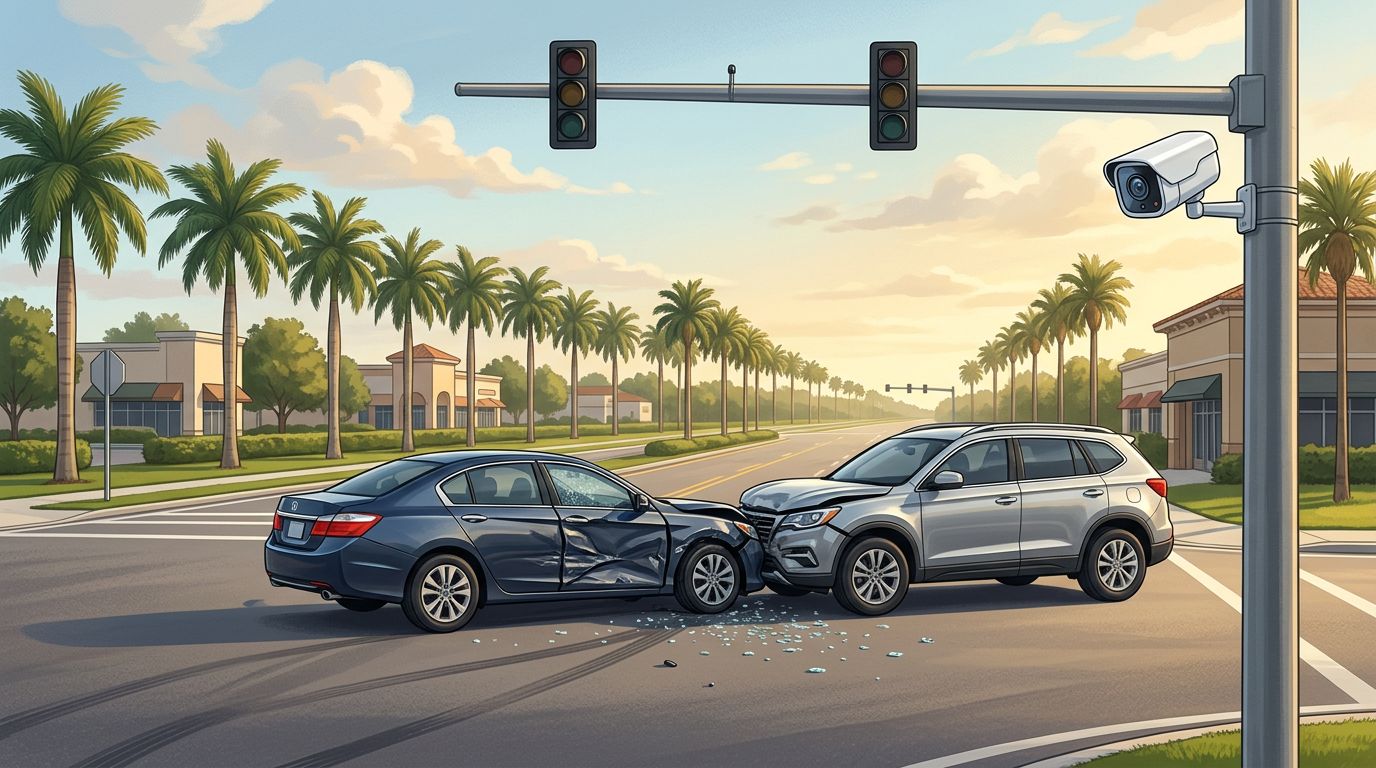
An intersection can give a driver only seconds to react, but the legal dispute after a T-bone crash may last for months. In Florida T-bone crash claims, intersection camera footage can show the traffic signal, vehicle positions, and impact sequence more clearly than damaged vehicles or conflicting memories.
After a side-impact collision, insurance companies may argue that both drivers shared fault. They may also question whether the crash caused the reported injuries. Finding and preserving video quickly can help establish what happened before the footage disappears.
Why Florida T-bone crash claims often turn on right of way
A T-bone crash occurs when the front of one vehicle strikes the side of another. These collisions commonly happen when one driver enters an intersection against a red light, fails to yield during a turn, rolls through a stop sign, or misjudges cross traffic.
The location of the damage may suggest how the vehicles collided, but it doesn’t automatically prove who caused the crash. For example, damage to the driver’s side door doesn’t establish that the other driver ran a red light. The struck vehicle may have entered the intersection unlawfully, or both vehicles may have moved at the same time.
Fault usually depends on the complete sequence:
- Which driver had the right of way?
- What color was each traffic signal?
- Did either driver stop before entering?
- Were the vehicles turning, changing lanes, or proceeding straight?
- How much time passed between the signal change and impact?
- Did a driver speed, use a phone, or fail to watch traffic?
Witness statements can answer some of these questions, but witnesses often see only one part of a busy intersection. A camera may capture the approach, signal phase, collision, and immediate aftermath in one continuous view.
Insurance adjusters also review the police report, vehicle damage, photographs, and statements made at the scene. A video that contradicts an inaccurate report or a disputed statement can change how the insurer evaluates liability.
What intersection camera evidence can show
Camera footage is strongest when it captures more than the moment of impact. A useful recording may show whether a vehicle stopped, entered on yellow, crossed after the light changed, or accelerated into the intersection.
Signals, lanes, and the seconds before impact
Depending on its position, a camera may establish:
- The traffic signal facing each driver
- The vehicles’ travel lanes and directions
- Whether a driver used a turn signal
- The timing of a turn or lane change
- The point of impact
- The movement of vehicles after the collision
- Whether someone fled or moved a vehicle before police arrived
Frame-by-frame review can help clarify the order of events. However, video usually can’t provide an exact speed unless the recording includes reliable reference points or other data. A camera angle can also hide a signal, create a distorted view, or make a vehicle appear closer than it was.
Red-light enforcement cameras require special care. Under Florida’s Mark Wandall Traffic Safety Act, these systems may capture a short clip or still images connected to an alleged red-light violation. They are not always continuous recordings of the entire intersection. A citation or camera image may support a liability argument, but it may not show the full crash mechanics or explain the injuries.
Florida Department of Transportation cameras present another issue. Some traffic cameras provide live feeds without retaining ordinary recordings. Other systems or agencies may save footage for a limited period. Availability depends on the camera, agency, location, and retention policy.
A camera recording is evidence, not an automatic verdict. Its value depends on what it shows, whether the file is authentic, and how it fits with the other facts.
Find and preserve the footage before it disappears
Video evidence can be overwritten without notice. Private security systems may record over older files within 24 to 72 hours. Some red-light systems retain footage for about 30 days, while police body-camera systems may keep recordings for a different period. These are general examples, not statewide guarantees.
Public cameras and records requests
Start with the agency that operates the camera or investigated the collision. That may include a city police department, county sheriff’s office, Florida Highway Patrol, a local traffic department, or FDOT.
A written public-records request under Chapter 119, Florida Statutes, should identify the crash with as much detail as possible. Include the date, approximate time, exact intersection, cross streets, direction of travel, nearby landmarks, and the responding agency.
Request more than a short edited clip. Ask for the original file, still images, timestamps, camera location, camera direction, and any related signal-phase records. Signal timing data and maintenance logs may help explain whether the traffic light operated properly.
The responding officer’s body camera may also record statements, vehicle positions, weather, and road conditions after impact. Those recordings can corroborate or contradict accounts given at the scene, as discussed in this overview of police body-camera evidence.
Private businesses and nearby homes
A gas station, bank, store, apartment complex, residence, or office may have a better camera angle than the government system. Doorbell cameras and private security systems sometimes capture the approach and impact when the intersection itself isn’t covered.
Ask the property owner or manager to preserve the recording immediately. A polite request may be enough to prevent deletion, but the owner may not release the file without a subpoena or other legal process. Don’t trespass, pressure an employee, or edit the video yourself.
When contacting a camera owner, provide:
- The date and approximate time of the collision.
- The exact area the camera may have covered.
- A request to preserve the original recording.
- Your contact information and the responding agency’s report number.
Keep copies of every request. If a personal injury lawyer handles the claim, the lawyer can send a formal preservation letter and pursue the recording through appropriate legal procedures.
How lawyers evaluate a Florida T-bone crash claim
A lawyer doesn’t rely on a video clip in isolation. The first step is usually to compare the footage with the crash report, photographs, vehicle damage, witness accounts, signal timing, and medical records.
Authentication matters. Someone must be able to explain where the recording came from, how the system created it, and whether it has been altered. The original file is more useful than a phone recording of a computer screen. Metadata, system logs, and a custodian’s testimony may help establish reliability.
Timing also matters. A camera clock may be several minutes fast or slow. Lawyers compare the timestamp with 911 calls, dispatch records, surveillance from other locations, and the time officers arrived. A recording that appears to show a green light may tell a different story after the clock is corrected.
The video must also connect to the injuries. It may show the force and direction of impact, but medical records must document the resulting condition. Prompt treatment, diagnostic imaging, physician opinions, and a consistent history can help connect the injury to the crash.
Florida applies a modified comparative negligence rule to many negligence claims. Under the current rule, an injured person who is 50% or less at fault may recover reduced damages, while a person found more than 50% at fault generally can’t recover damages in the claim. Review the Florida modified comparative negligence rule before making statements about fault or accepting a settlement.
Build the case around more than a camera clip
Strong Florida T-bone crash claims usually combine several types of evidence. Video may show the collision, while other records explain why it happened and what it caused.
Useful supporting evidence can include:
- The crash report and 911 dispatch records
- Statements from independent witnesses
- Photos of signals, signs, skid marks, debris, and vehicle damage
- Vehicle event data recorder information, when available
- Cellphone or distraction evidence obtained through lawful procedures
- Medical records, bills, and physician opinions
- Proof of missed work and reduced earning ability
- Accident reconstruction analysis in disputed cases
Preserve your own evidence as well. Save photographs in their original form, keep damaged property, record the names of witnesses, and avoid posting about the crash online. Don’t provide a recorded statement to the other driver’s insurer before understanding what the policy and medical evidence support.
An insurer may focus on visible damage while minimizing a concussion, spinal injury, nerve damage, or other condition that develops after the collision. Medical care and accurate documentation remain important even when video clearly shows the other driver’s error.
Compensation, PIP, and deadlines after a T-bone crash
Florida’s no-fault system generally directs an injured driver to personal injury protection, or PIP, coverage first. PIP may pay part of covered medical expenses and lost income, regardless of who caused the crash. To qualify, initial medical services generally must occur within 14 days.
PIP doesn’t resolve every loss. A person with a qualifying serious injury may pursue compensation from the at-fault driver for damages such as pain and suffering, future medical care, lost earning capacity, and other losses. Florida law requires proof of a statutory threshold before many non-economic damages are available. Learn more about the Florida serious injury threshold and the medical proof it requires.
Timing can affect the entire claim. For many negligence claims arising from crashes on or after March 24, 2023, Florida’s general lawsuit deadline is two years. Older crashes may involve the former four-year period, while wrongful death and claims involving government entities can follow different rules. The Florida car accident lawsuit deadline depends on the crash date, claim type, and parties involved.
Don’t wait for an adjuster to locate video. Footage may be gone before the insurance investigation begins. Early legal review can help identify public agencies, private camera owners, records requests, and preservation steps.
Conclusion
Intersection footage can provide the missing seconds in a Florida T-bone crash claim. It may show who entered first, which signal applied, and how the impact occurred, but lawyers still need to authenticate the recording and connect it to the injuries and financial losses.
Request potential footage quickly, preserve every related record, and avoid guessing about fault in statements to insurers. When a short recording holds the answer to a disputed intersection crash, prompt action may determine whether that evidence remains available.