
Florida Motorcycle Crash Claims: How Video Proves Fault
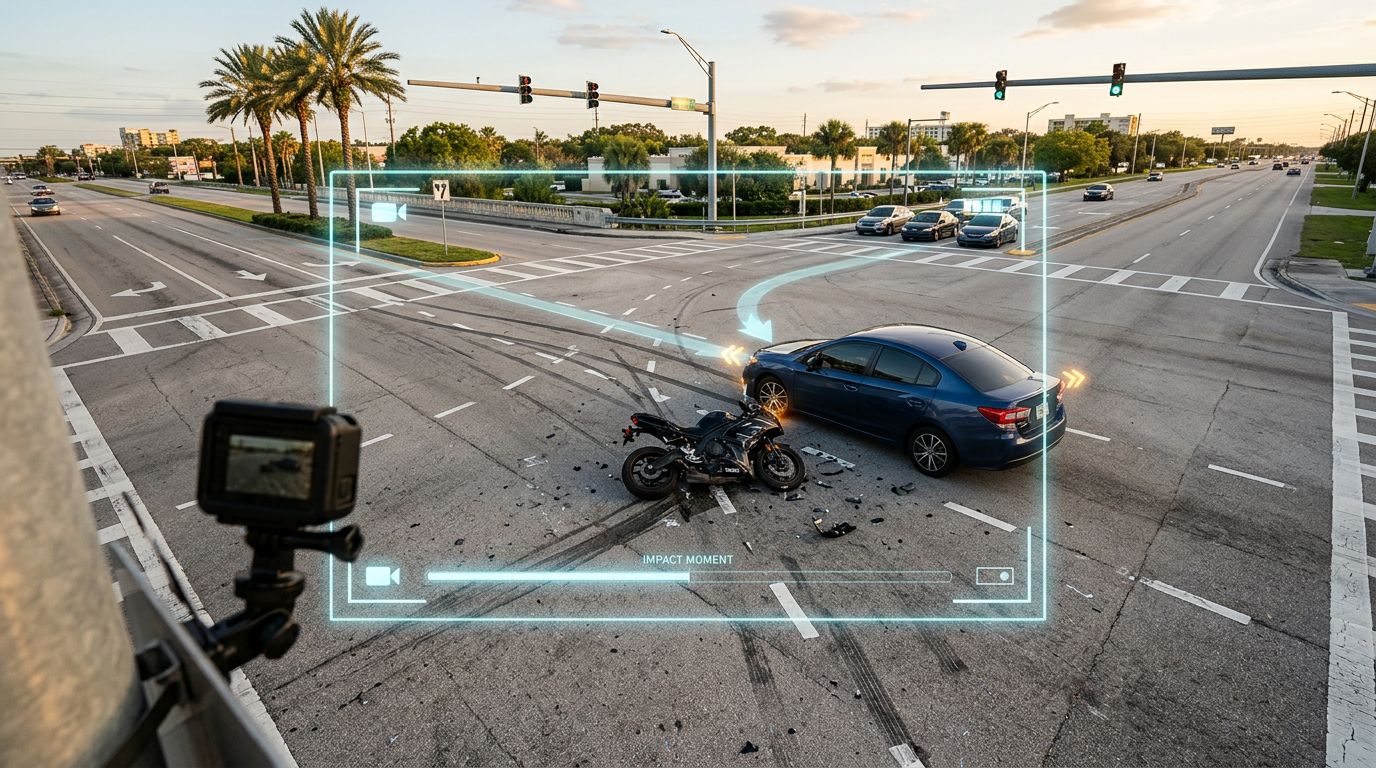
A lane change takes only seconds, but it can shape the outcome of Florida motorcycle crash claims. A helmet camera, dashcam, or nearby security recording may show what conflicting statements cannot: lane position, signaling, vehicle movement, and timing before impact.
After a rider suffers serious injuries, an insurer may argue that the motorcycle was speeding, hidden from view, or changing lanes improperly. Preserving camera evidence quickly can address those arguments and give investigators a clearer account of what happened.
Key Takeaways
- Video from a helmet camera, dashcam, traffic camera, or nearby security system can show lane position, signaling, vehicle movement, and timing before a motorcycle crash.
- Camera footage should be preserved quickly because many systems overwrite recordings within days or weeks. Keep the original file, preserve the surrounding minutes, and request nearby footage as soon as possible.
- Florida uses modified comparative negligence, so evidence of a rider’s conduct may affect recovery. A rider found more than 50% at fault generally cannot recover damages under the current rule.
- Video can support liability, but a complete claim also requires medical records, proof of financial losses, photographs, witness information, and other crash evidence.
- Florida Highway Patrol reports and accident reconstruction may help establish the sequence of events, but an accident report is not the final decision on civil liability.
Why Lane-Change Crashes Create Fault Disputes
Florida law requires a driver to remain within a lane when practical and confirm that a movement is safe before changing lanes. Drivers must also signal lane changes as required by the traffic code. The Florida statutory traffic rules provide the framework investigators use when examining unsafe merges and sideswipes.
A driver may cross into a motorcycle’s lane after missing a mirror check, overlooking a rider in a blind spot, or assuming the lane is clear. The driver may also signal too late, drift across the lane line, or accelerate into the motorcycle’s path. These facts may support a failure to yield or unsafe-lane-change claim.
The defense may tell a different story. An insurer could contend that the motorcyclist was traveling too fast, riding between lanes, or entered the driver’s path without warning. Florida’s lane-splitting rule can matter in those disputes. If video shows a rider traveling between lanes or rows of vehicles, the insurer may use that fact to argue comparative negligence.
Still, a rider’s mistake doesn’t automatically excuse an unsafe movement by the other driver. Fault depends on everyone’s conduct, the timing of each movement, and whether the collision would have occurred if the driver had acted reasonably.
The risk increases when the other vehicle is an SUV, van, or truck. These vehicles have larger blind spots and can strike a rider with a mirror, front corner, or side panel. A motorcycle can be knocked down, pinned, or forced beneath another vehicle. Unlike occupants in a passenger vehicle, riders have no steel frame, air bags, or seat belt to absorb the impact.
What Camera Evidence Can Show
Video can turn a general accusation into a provable sequence of events. Useful recordings may come from several sources:
- A helmet camera can show the rider’s speed, lane position, signals, traffic conditions, and the driver’s movement before impact.
- A dashcam in another vehicle may capture the lane change from a wider angle. It may show whether the car crossed the line or entered an occupied lane.
- A traffic or intersection camera may show the vehicles’ approach, signal timing, and positions before the crash.
- A business camera, residential doorbell, or parking-lot system may record the collision from the side.
- Police body-camera footage may contain statements made at the scene, visible vehicle damage, road conditions, and witness accounts.
A recording can answer several important questions. Did the driver use a turn signal before moving? Was the motorcycle already established in the lane? Did the car move gradually or cut across suddenly? How much space existed between the vehicles? Did the rider brake or swerve only after the car began moving?
The footage may also show the point of impact. Damage to a motorcycle’s front, side, or rear can help confirm whether the rider was passing, following, or occupying the lane. In some cases, video shows the rider forced into another lane or a fixed object while avoiding the collision.
Video doesn’t need to show the entire crash to have value. A few seconds before impact may establish the driver’s movement and the rider’s position. The original file still matters. A cropped clip can remove surrounding traffic that gives the event meaning.
Evidence can also affect different types of motorcycle claims. For related guidance, see rear-end collision video evidence and how it can clarify vehicle positions and impact timing.
A camera doesn’t need to capture a perfect view of the impact. It may prove fault by showing what each vehicle did in the seconds before contact.
Preserve the Recording Before It Disappears
Many camera systems overwrite old files. Some traffic systems may retain footage for only 24 to 72 hours. Business, residential, and roadside cameras may keep recordings for several days or weeks, often around 7 to 30 days. The exact retention period varies, so waiting for the final crash report can cost you important evidence.
If you have a recording, take these steps:
- Save the original file in its native format. Don’t apply filters, captions, speed changes, or edits.
- Make a secure backup, but keep the original memory card, camera, mount, and related equipment.
- Preserve the minutes before and after the collision, not only the impact clip.
- Write down the camera’s make, model, settings, time zone, and displayed time. Camera clocks are often inaccurate.
- Identify nearby cameras and request preservation as soon as possible. Provide the exact location, date, estimated time, direction of travel, and requested time window.
- Don’t post the footage publicly or send it through multiple editing applications. Give it to your attorney or insurer through a documented transfer.
A preservation request asks the camera owner or agency to keep potentially relevant footage. Documenting the request helps protect the evidence chain for later legal proceedings while the formal request proceeds. Government recordings may require a public-records request. A private business may need a subpoena or another legal request before releasing video.
Don’t assume a red-light camera recorded the crash. Many systems capture only a triggered violation image or a short clip, rather than continuous roadway footage. An attorney can help determine which agency, vendor, business, or property owner controls a recording.
How FHP and Accident Reconstruction Establish the Sequence
The Florida Highway Patrol may investigate a serious or fatal motorcycle accident, especially when it occurs on a highway or state road. Troopers document the scene, speak with drivers and witnesses, photograph damage, identify roadway conditions, and prepare a crash report. In a fatal crash, law enforcement may conduct a traffic homicide investigation as part of the broader collision investigation.
The crash report can include a diagram, citations, measurements, statements, and an initial assessment of contributing factors. However, it isn’t the final decision on civil liability. An insurance company, judge, or jury may examine additional evidence.
Accident reconstruction uses available evidence to establish speed, direction, timing, and impact forces. Investigators may compare:
- Video frames with lane markings, road measurements, and vehicle dimensions.
- Skid marks, tire marks, debris, gouges, and final resting positions.
- Damage patterns on the motorcycle and the other vehicle.
- Witness statements, 911 calls, traffic signal timing, weather, lighting, and visibility.
- Electronic data from a truck or other vehicle, when available, including braking, throttle, and speed information.
- Cell phone records when driver distraction is suspected.
A reconstruction can challenge an inaccurate driver statement. For example, a driver may claim the motorcycle suddenly entered the lane. Video and damage measurements may show that the motorcycle traveled in the lane first, while the larger vehicle moved across the lane line.
The same approach applies to left-turn accidents at intersections. A left-turning SUV or truck may claim the rider was too far away to see. Camera footage can show the rider’s position, the driver’s view, and whether the turn began before the motorcycle reached the intersection. Readers seeking more detail can review proving left-turn fault in Florida.
How Video Affects Insurance Claims and Compensation
Insurers evaluate liability, medical proof, and available coverage in claims involving severe injuries. Strong video can clarify fault, but it doesn’t replace medical records or proof of financial loss.
A serious motorcycle injury claim may include emergency care, surgery, physical therapy, medication, future treatment, lost income, reduced earning ability, motorcycle damage, scarring, and pain. These costs can create a financial burden, especially when treatment continues. Traumatic brain injuries, spinal injuries, fractures, nerve damage, and severe road rash may require long-term care.
Florida uses modified comparative negligence for most personal injury cases. If a rider is found partly responsible, the award can be reduced by that percentage. A claimant found more than 50% at fault generally can’t recover damages under the current rule. Footage showing a driver’s unsafe lane change can affect whether the claim succeeds and how much compensation remains available.
The video may also support a wrongful death claim after a fatal crash. In that situation, surviving family members and the personal representative may need evidence showing how the collision occurred, who caused it, and which losses followed. The family should preserve recordings, photographs, witness information, and law enforcement documents without waiting for an insurer to request them.
Don’t give a recorded statement that guesses about speed, distance, or lane position. If you don’t know what happened, say so. A mistaken statement can create problems even when the video later supports your account.
Safety Gear Helps, but It Doesn’t Decide Fault
Motorcycles are often described as having an invisibility problem because their narrow profile makes them harder to notice. This is especially true beside large vehicles or near intersections, where driver inattention, blind spots, glare, and visual clutter can all contribute.
The lack of external protection explains why a relatively short lane change can cause life-changing harm. Motorcycle safety gear can reduce injury severity, but it cannot eliminate collision forces. A full-face helmet can reduce exposure to head and facial injuries. Abrasion-resistant clothing, gloves, and over-the-ankle boots are protective gear that can reduce road rash and some impact injuries.
Rider training through the Motorcycle Safety Foundation teaches riders to scan traffic, maintain escape routes, manage speed, and use defensive driving skills. Those habits can reduce risk. Rider training and motorcycle safety gear can support road safety awareness, but neither transfers responsibility from a driver who made an unsafe lane change.
Frequently Asked Questions
What types of video can help prove fault in a Florida motorcycle crash?
Helmet-camera footage, dashcam recordings, traffic cameras, business security systems, and doorbell cameras may show the vehicles’ positions and movements before impact. Police body-camera footage may also document statements, vehicle damage, road conditions, and witness accounts.
How quickly should motorcycle crash video be preserved?
You should preserve the recording and request nearby footage as soon as possible because many camera systems overwrite files within 24 to 72 hours or a few weeks. Save the original file without edits and document the camera location, date, estimated time, and requested time window.
Can a rider still recover compensation if the rider was partly at fault?
Possibly. Florida’s modified comparative negligence rule may reduce an award by the rider’s percentage of fault, but a claimant found more than 50% at fault generally cannot recover damages.
What if the video does not show the actual impact?
Footage of the seconds before a crash may still show lane position, signaling, speed, and the driver’s movement. Investigators can compare that information with damage patterns, roadway evidence, witness statements, and other records to reconstruct what happened.
Does the Florida Highway Patrol crash report determine who is liable?
No. The report may contain a diagram, statements, measurements, citations, and an initial assessment of contributing factors, but it is not the final decision on civil liability. Insurers, judges, or juries may consider additional video and accident-reconstruction evidence.
Conclusion
Camera evidence can turn a disputed claim into a clear timeline. It may show lane positions, signal use, blind-spot movement, and evasive action that help establish what happened.
Preserve the original recording quickly, request nearby footage before systems overwrite it, and collect the crash report, medical records, photographs, and witness information. When a rider’s account conflicts with a driver’s statement, reliable video can clarify what happened before anyone had time to change the story.