
Florida Work Zone Claims: Records That Can Prove Fault
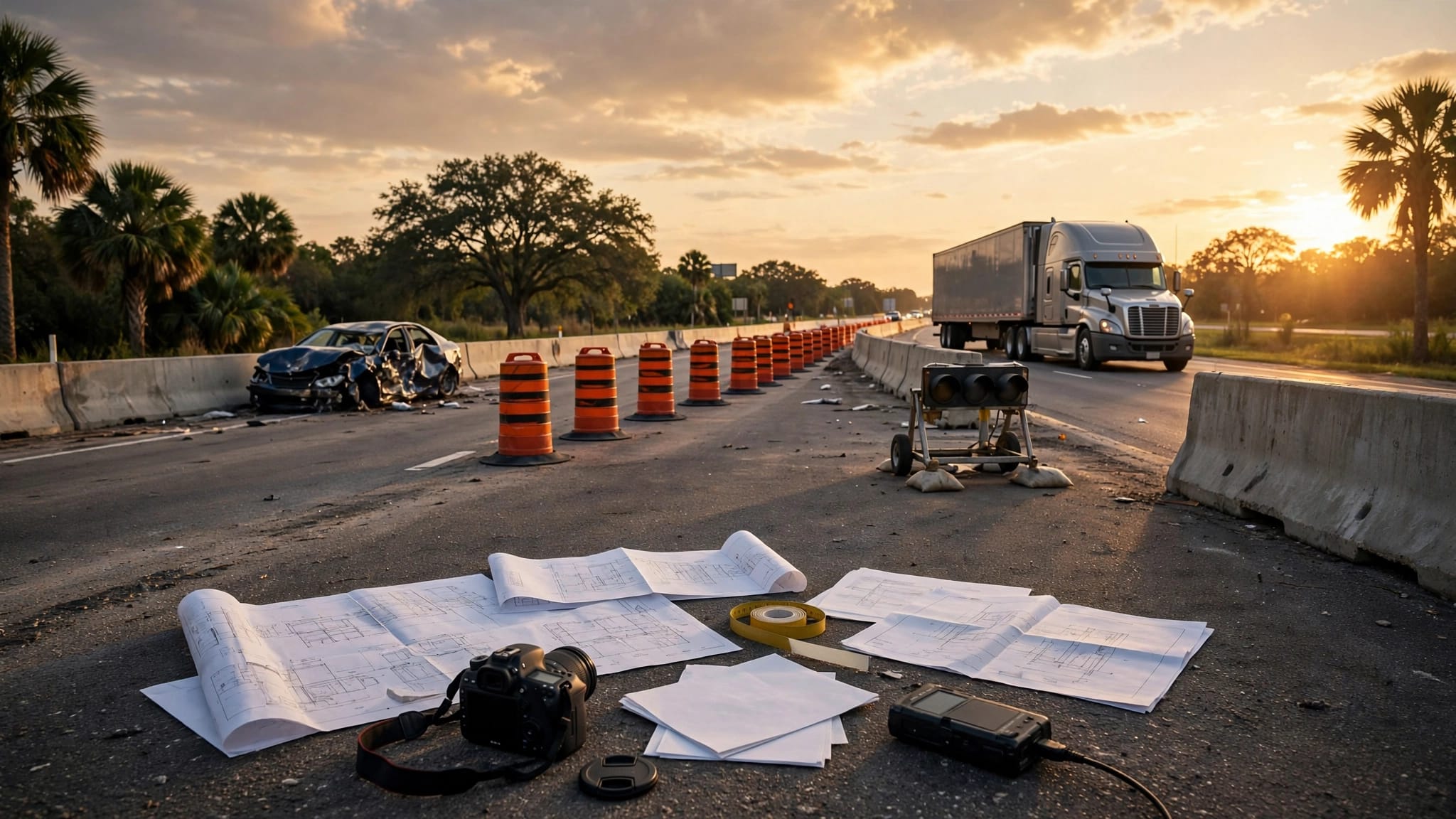
A work zone crash can turn an ordinary drive into a dispute involving more than the driver who hit you. Florida work zone claims often depend on evidence that changes quickly, including moved traffic barrels, overwritten electronic data, and construction records that may never appear in a standard crash report.
Narrowed shoulders, temporary signals, and trucks entering traffic create little room for error. When someone suffers a traumatic brain injury, spinal cord injury, or fatal harm, liability may involve drivers, builders, subcontractors, trucking entities, or public agencies.
Strong claims depend on early evidence preservation because moved traffic devices, overwritten data, and removed equipment can obscure fault.
Key Takeaways
- Florida work zone claims may involve drivers, road contractors, subcontractors, trucking companies, equipment providers, and public agencies, depending on who controlled or contributed to the dangerous condition.
- Critical evidence can disappear quickly, including traffic-control devices, photographs, video, electronic logging-device data, telematics, daily reports, and construction records. Prompt evidence-preservation requests can help prevent routine deletion or alteration.
- Traffic-control plans, inspection records, flagger assignments, lane-closure documents, project communications, and crash-history records may show whether the work zone matched its approved design.
- Comparative fault can reduce or bar recovery, while claims against public entities may involve sovereign-immunity rules, presuit notice requirements, damage limits, and separate filing deadlines.
- Damages may include medical treatment, future care, lost income, reduced earning capacity, household services, pain, disability, and losses arising from wrongful death.
Why work zone crashes cause severe injuries
Florida highway construction projects combine high speeds with unexpected changes in driving patterns, making construction zone accidents especially severe. A motorist may encounter a lane closure after a curve, slowed traffic behind a paving crew, or a merge beside concrete barriers. These collisions can cause a spinal cord injury and other serious harm.
According to FDOT, Florida recorded more than 16,012 work zone crashes in 2023, including 74 deaths and 294 serious injuries. The agency also offers temporary traffic control resources for personnel who set up and manage these areas.
Sudden traffic changes leave little margin
A proper work zone gives drivers enough warning and space to react. Signs, arrow boards, channelizing devices, tapers, flaggers, and temporary pavement markings all have a purpose.
Problems include inadequate signage, such as missing, obstructed, conflicting, or poorly placed warnings. Barrels may also drift from the approved layout, while flagger errors may involve an absent, improperly positioned, or inadequately trained flagger.
Driver conduct still matters
Many crashes begin with speeding in work zones, tailgating, distracted driving, or a failure to yield during a merge. Drivers of heavy vehicles face added risks because their loads require more stopping distance.
Yet another driver’s carelessness doesn’t end the inquiry or automatically resolve responsibility. If the work zone gave drivers inadequate warning or created an unsafe merge, a road contractor or public agency may share responsibility.
Who may be liable after a Florida work zone crash?
Liability in these cases may extend beyond the driver who caused the impact. The key question is who had a duty to prevent the condition or conduct that led to the crash.
An investigation may identify several defendants. Each may have different insurance coverage, records, and defenses.
Private companies can control the dangerous condition
A construction company may serve as the general contractor, while a road contractor or traffic-control subcontractor handles signs, flagging stations, equipment, or inspections. The assigned duties and actual control over the site help identify who prepared, approved, implemented, or inspected the traffic control plan. Subcontractor negligence may include flagger errors, such as improper placement, inadequate communication, or failure to follow the approved setup. An equipment company may also be responsible for a malfunctioning truck or defective arrow board.
When a commercial vehicle is involved, the motor carrier’s potential exposure may involve driver conduct, hiring, supervision, hours-of-service compliance, maintenance, or dispatch practices. Liability isn’t automatic; the evidence must connect a specific failure to the collision. A serious injury, including a spinal cord injury, can make careful allocation of responsibility especially important. These issues also affect commercial truck accident victims, whose claims may involve driver and carrier records.
Ordinary negligence doesn’t automatically support punitive damages. Any such claim depends on the facts and applicable Florida pleading and evidentiary requirements.
Government responsibility follows different rules
FDOT, a county, or a city may have designed the project, approved its plan, owned the road, or retained inspection duties. However, a public agency’s involvement doesn’t automatically establish legal liability. Sovereign immunity may protect the agency in some circumstances, subject to Florida law and applicable exceptions. The facts must show a duty the agency owed and a negligent act or omission.
A private contractor doesn’t receive the same protections merely because it worked on a public project. Its contract, assigned duties, actual control over the site, and compliance with project requirements still matter.
A government entity may have approved a plan, while a contractor may have installed it incorrectly. Those are separate factual questions with separate records.
Construction company records can reveal what went wrong
The crash report usually records the immediate event. It rarely explains whether the work zone matched its approved design at the moment of impact. Project records can fill that gap.
For Florida work zone claims, send an evidence preservation request promptly. Request the road contractor’s project files showing contract duties and maintenance-of-traffic records before routine deletion, software overwrites, or project closeout.
FDOT, counties, and municipalities may hold project plans, permits, inspection records, complaints, change orders, and contracts. They may also have crash-related communications and roadway-camera material. Access remains subject to Florida public-records laws, applicable exemptions, and retention schedules.
Traffic control plans and daily site documents
The approved traffic control plan can show how signs, barrels, barriers, flaggers, and lane shifts should have been arranged. Compare that layout with photographs, witness accounts, police observations, and video from the actual crash scene.
FDOT’s current work-zone standard plans include guidance for traffic control through work zones and temporary lane closures. Useful project records may include:
- Daily reports, field diaries, inspection logs, and photographs from the shift, which may reveal flagger errors or unrecorded changes.
- Lane closure permits, work schedules, utility coordination records, and project correspondence.
- Traffic-control subcontractor agreements, training records, and flagger assignments.
- Incident reports, complaints, change orders, and records of prior crashes or near misses.
A contractor’s daily report may list the crew’s arrival time and equipment used. It may also show when a closure began, whether a flagger was present, and when workers removed devices. Those details can test a defense that the setup complied with the plan.
Electronic records in truck collisions
When a commercial truck strikes stopped traffic or enters a closed lane, preserve the vehicle and its data quickly. The motor carrier controlling or possessing vehicle and driver records may hold ELD data. This electronic logging-device information can show driving time, rest periods, route history, and timing before the collision.
Federal rules require carriers to retain records of duty status and supporting documents for at least six months. The rule appears in 49 CFR Part 395. That period may not match the time needed to preserve evidence for a claim.
Other requested evidence should include dashcam footage, telematics, dispatch messages, GPS data, onboard video, inspection files, event-data-recorder downloads, and ELD data.
A written preservation demand to the motor carrier should identify the crash, vehicles, drivers, date, location, and record categories. It should request suspension of routine deletion or alteration, including software-based overwrites.
What to do in the first days after a crash
Medical treatment comes first after a work zone crash. Follow-up care also creates records that connect the collision to the injuries, symptoms, limitations, and financial loss that follow.
Still, families shouldn’t wait for a final diagnosis before protecting proof. Families should begin evidence preservation promptly because photographs, video, original metadata, and witness information can be lost. Roadway conditions can also change within days.
Document the scene without creating new risks
If it is safe and lawful, preserve photographs of signs, lane markings, barriers, debris, equipment, and sight lines. Include wider views showing how a driver approached the work zone, not only close-ups of vehicle damage. Don’t re-enter an unsafe work zone or interfere with an investigation.
Save the original photographs and video files, preserving their metadata. Avoid editing them or posting details about the crash on social media. Obtain names and contact information for witnesses, including nearby workers, motorists, and first responders.
Police reports, 911 recordings, body-camera footage, and roadway-camera video may also matter. Florida Highway Safety and Motor Vehicles is the official custodian of crash reports, but the report is only one piece of a larger evidence file.
Preserve medical and financial proof
Keep discharge papers, imaging results, prescriptions, therapy recommendations, receipts, and proof of missed work. Catastrophic injuries, including a spinal cord injury, may require future surgery, rehabilitation, mobility equipment, home modifications, or long-term care.
An injured construction worker may have both workers’ compensation benefits and a personal injury claim against an outside driver, trucking entity, road contractor, project participant, or equipment supplier. A construction company other than the worker’s employer may also be a potential third party, depending on its role and the facts. These paths can overlap but follow different rules.
If a trucking entity is involved, the motor carrier may possess relevant vehicle, driver, or insurance records. Dispatch records, onboard video, and ELD data should be preserved promptly because they may clarify events before the collision.
A fact-specific review of third-party workplace injury claims can help clarify whether a separate claim may exist beyond workers’ compensation.
Deadlines and comparative fault can change the value of a claim
A serious injury does not pause legal deadlines. Florida’s statute of limitations changed for many negligence actions arising on or after March 24, 2023. Claims arising before that date may follow prior rules.
Under the current Florida limitations statute, most negligence injury lawsuits have a two-year filing period. Wrongful death claims generally also have a two-year deadline, measured from the date of death, subject to exceptions. Claims involving death or other special circumstances may follow different timing rules. A spinal cord injury can have an uncertain medical outlook, but that uncertainty doesn’t pause the deadline.
Your percentage of fault matters
Florida’s comparative negligence framework requires the factfinder to assign percentages of fault, and damages can be reduced by a claimant’s share of responsibility. In an ordinary negligence action, a claimant found more than 50 percent at fault generally cannot recover, subject to applicable exceptions and the current statute.
That rule makes evidence of speed, braking, visibility, distraction, seat belt use, and lane position important. It also makes a full investigation important. A defense claim that you followed too closely should be tested against the actual traffic setup, warning distance, and conduct of every other party.
The current statutory framework appears in Chapter 768 of the Florida Statutes.
Public-entity claims require earlier action
Claims against FDOT, a county, city, or other state subdivision have added procedural barriers. Florida’s sovereign immunity statute generally requires written notice to the agency and the Department of Financial Services within three years after the claim accrues, subject to statutory exceptions. The statute generally provides up to 180 days for investigation before a lawsuit may proceed, unless the claim is denied sooner or another exception applies.
These notice requirements are separate from the statute of limitations for filing a lawsuit. The statute also generally limits recovery to $200,000 per person and $300,000 per incident without legislative approval of a claims bill. Review the current text of Florida’s sovereign-immunity law because notice deadlines, exceptions, and the presuit process can affect a case before a lawsuit is filed.
Damages should reflect the full harm
A settlement should account for more than the ambulance bill. A traumatic brain injury may require long-term medical care, rehabilitation, and support. A spinal cord injury can affect earning capacity and independence for years.
Economic damages may include medical care, future treatment, lost income, reduced ability to work, and necessary household services. Medical records, wage and tax evidence, and expert opinions can help establish these losses, including life-care or rehabilitation needs. Non-economic damages may address pain, disability, disfigurement, and loss of enjoyment of life, but available damages depend on the injury’s facts and applicable law.
When a crash causes death, the estate’s personal representative may pursue wrongful death claims for survivors and the estate. Survivor losses may include lost support and services, while estate losses may include medical expenses, funeral costs, and lost earnings. Punitive damages aren’t ordinary compensation and require facts that satisfy Florida’s heightened legal standard, not severe injuries alone. Families facing this loss should understand the Florida wrongful death filing deadline before evidence or legal rights expire.
Urban and rural work zones need different investigations
Urban projects often create repeated lane shifts, heavy commuter traffic, pedestrians, cyclists, and temporary signal patterns. Investigators should examine signal timing, access points, detour signs, congestion records, and nearby business or traffic-camera footage.
Rural highway construction may involve higher speeds, darkness, limited lighting, longer distances between advance warnings, and heavy commercial traffic. Investigators should review sight-distance measurements, lighting records, warning placement, truck route data, and roadway geometry. Expert testimony may help interpret this technical evidence.
In both settings, the question remains whether the work zone gave a reasonably attentive driver a fair chance to recognize and respond to the hazard.
Frequently Asked Questions
Who may be responsible for a Florida work zone crash?
Responsibility may extend beyond the driver who caused the impact. Depending on the evidence, a road contractor, traffic-control subcontractor, trucking company, equipment provider, or public agency may share liability for a dangerous condition or negligent conduct.
What records should be preserved after a work zone crash?
Important records may include traffic-control plans, daily reports, inspection logs, photographs, lane-closure permits, flagger assignments, project communications, dashcam footage, GPS data, dispatch messages, telematics, and electronic logging-device data. A written preservation demand can help suspend routine deletion and software-based overwrites.
How long do I have to bring a Florida work zone claim?
Many Florida negligence injury lawsuits arising on or after March 24, 2023, generally have a two-year filing period, although exceptions may apply. Claims involving public entities can also require earlier written notice and a presuit investigation period, so the applicable deadlines should be reviewed promptly.
Can I recover if I was partly at fault for the crash?
Possibly, but Florida’s comparative negligence rules may reduce damages by the claimant’s percentage of fault. In an ordinary negligence action, a claimant found more than 50 percent at fault generally cannot recover, subject to applicable exceptions and the current statute.
What damages may be available after a serious work zone injury?
Damages may include past and future medical care, rehabilitation, lost income, reduced earning capacity, household services, pain, disability, and loss of enjoyment of life. If the crash caused death, the estate and eligible survivors may have additional wrongful-death losses under Florida law.
A complete record builds a stronger claim
The difference between a routine collision case and a Florida work-zone case often lies in the records behind the roadwork. Project files can show what a construction company knew, while contracts can identify the road contractor’s assigned duties and potential responsibility, especially when a spinal cord injury involves long-term treatment or lost earning capacity.
Fast action protects those records and identifies every responsible party before deadlines close. Evidence can support a personal injury or wrongful-death case, but it doesn’t establish liability without fact-specific analysis.