
Florida Parking Lot Pothole Fall Claims: Records That Matter
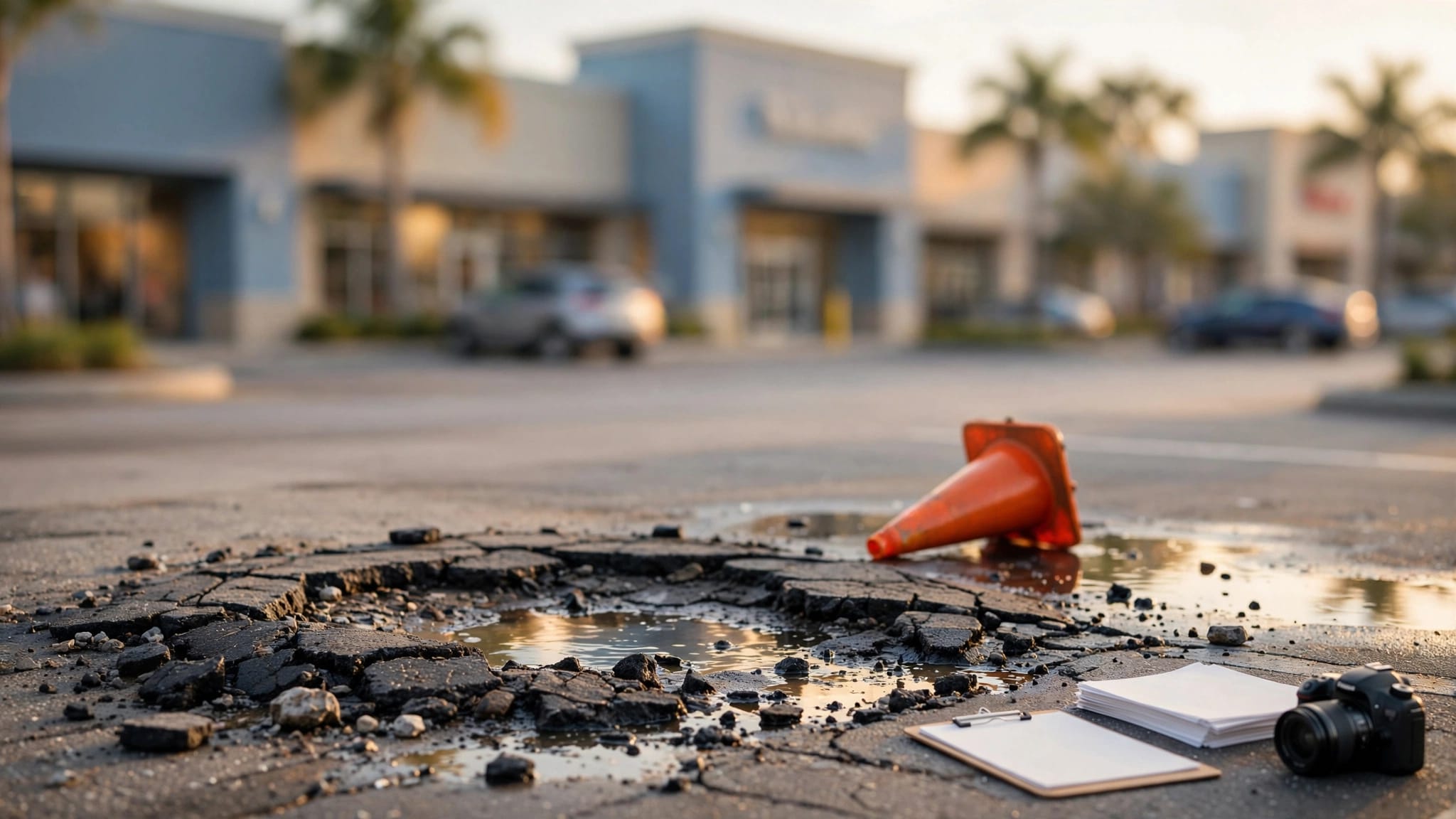
A pothole can turn a routine walk to a store, office, or medical appointment into a painful injury. In Florida, parking lot pothole claims often depend less on the size of the hole than on what the property owner or manager knew before the fall.
A repaired patch, a faded warning cone, or a maintenance log can change the facts quickly. Prompt action helps preserve the condition of the pavement, the records behind it, and proof of how the injury has affected your life.
Key Takeaways
- A pothole is usually a fixed pavement defect, so the central issue is often whether the party controlling the lot knew, or reasonably should have known, it needed repair.
- Maintenance schedules, inspection logs, work orders, invoices, complaint records, photographs, and surveillance video may show notice and delayed repairs.
- The correct defendant may be a property owner, tenant, property manager, maintenance contractor, or another entity that controlled the parking area.
- Florida’s modified comparative negligence rules can reduce compensation if you share fault. A person found more than 50% at fault generally cannot recover in a covered negligence case.
- Many negligence claims arising on or after March 24, 2023 have a two-year filing period. Public-property and workplace cases can follow additional rules.
Florida Parking Lot Pothole Claims Start With Control and Notice
A pothole fall claim requires more than proof that someone fell and got hurt. The injured person generally needs evidence that a responsible party had a duty to maintain the area reasonably safely, failed to meet that duty, and caused documented losses.
The party named on a building sign may not control the parking lot. A shopping center owner may hire a property manager, while a tenant handles only its storefront. Lease terms, maintenance agreements, invoices, and repair communications can identify who had responsibility.
A pothole is different from a temporary spill
Florida Statutes section 768.0755 addresses falls caused by transitory foreign substances in business establishments, such as liquid or debris. Its 2025 published text requires proof that the business had actual or constructive knowledge of the temporary condition. You can review the wording in the Florida Senate’s 2025 statute text.
A pavement hole is usually a fixed surface defect, not a temporary substance. That distinction matters because pothole cases often focus on the length of time the defect existed, prior repair efforts, and routine inspection practices. The facts, not the label an insurer selects, should drive the legal analysis.
The lot’s condition must connect to the fall
Photographs should show the pothole’s depth, width, broken edges, standing water, lighting, and nearby markings. Take wider photographs too. They establish where the defect sat in relation to the entrance, parking spaces, curbs, crosswalks, and pedestrian routes.
Medical records should also identify the mechanism of injury accurately. A same-day report stating that a foot caught in a pothole can be far more useful than a later record that only says “ankle pain.”
For a closer discussion of the elements involved, review Florida premises liability duty of care.
Maintenance Records Can Show What Happened Before the Fall
Maintenance records don’t automatically establish negligence. However, they can reveal whether the lot received reasonable inspections, whether someone reported the defect, and whether a repair was delayed despite a known danger.
Parking lots deteriorate over time because of rainfall, heavy vehicles, drainage failures, tree roots, and repeated patching. A contractor’s record may show that a small crack became a larger hole over several months.
Inspection logs and recurring-condition evidence
A property manager may keep daily, weekly, or monthly inspection sheets. Look for entries covering the area where the fall occurred, including blank forms that appear completed without detail. Logs may also show whether an employee documented loose asphalt, pooling water, crumbling pavement, or a need for cones.
Prior customer complaints can carry weight as well. Emails, online service requests, incident reports, or tenant messages may establish actual notice. Repeated complaints about the same traffic lane or walkway can also support an argument that the problem was foreseeable.
A maintenance log that says an area was inspected is only useful if it identifies when the inspection occurred, who performed it, and what the person actually observed.
Work orders, vendor invoices, and repair histories
Work orders may identify the date a manager requested repairs, the vendor assigned to the job, and the area described as damaged. An invoice can show that a contractor patched the hole after the fall, although a later repair alone doesn’t prove fault.
Repair histories may also expose an older problem. For example, invoices for repeated asphalt patches near the same entrance may show a surface that kept failing. Records about drainage work matter when rainwater hid a depression or accelerated pavement damage.
Florida slip and fall cleaning logs explains why routine records can become important evidence when a property manager disputes notice.
Preserve the Evidence Before Repairs Erase It
Parking lots change fast after someone reports an injury. A business may fill the pothole, repaint a walkway, replace damaged asphalt, or remove a cone within days. Those actions may be sensible safety measures, but they can make it harder to document the condition that caused the fall.
Ask a companion to photograph the location before leaving if you need emergency care. If you return later, do not put yourself at risk trying to recreate the incident.
Report the fall with location details
Notify the business, property manager, or security office as soon as practical. Request an incident report, but don’t sign a statement that contains errors or guesses about what happened.
Describe the location precisely. “Near the north entrance, beside the fourth accessible parking space” is more useful than “in the parking lot.” Include the time, weather, lighting, footwear, direction of travel, and any employee who saw the fall.
Witnesses can disappear quickly in a busy lot. Get their names and phone numbers if they are willing to provide them.
Request video and retain your own records
Surveillance video may capture the fall, the pothole, earlier pedestrian traffic, inspection activity, or a warning device that was missing. Many systems overwrite recordings on a short cycle, so a prompt written preservation request can matter.
Keep original photographs and videos. Avoid filters, edits, or annotations that alter the image. Save shoes, torn clothing, medical discharge papers, prescription receipts, physical therapy records, work restrictions, and pay records.
Evidence for Florida parking lot trip and fall claims often includes both scene proof and medical documentation that links the defect to the injury.
Private Lots, Public Property, and Work-Related Falls
The owner of a grocery store, restaurant, office complex, or mall parking lot may have insurance coverage for injury claims. Yet ownership and control still need investigation. A landlord, commercial tenant, management company, and asphalt contractor can each have different obligations.
Publicly operated property requires an early review because the claim process differs from an ordinary private-business case.
Claims involving commercial property
A private business may argue that the pothole was open and obvious, that it appeared recently, or that the injured person was distracted. Maintenance records, witness accounts, lighting evidence, and the defect’s appearance can answer those arguments.
Florida’s broader negligence rules also affect how fault is assessed. The Florida Senate’s Chapter 768 materials include the statutory framework for comparative fault and premises-related claims.
A person who looked down at a phone may still have a case. However, any assigned percentage of fault can reduce the damages award. Clear evidence about poor lighting, water-filled holes, faded paint, or a lack of alternate walking paths becomes important.
Government lots need separate procedures
A fall at a city park, county building, public school, courthouse, or government-operated facility can involve Florida’s sovereign-immunity law under section 768.28. That statute includes special notice procedures, an investigation period, and limits that don’t apply in the same way to private businesses.
Do not wait for a government agency’s internal review before seeking advice. Written notice generally must go to the appropriate agency and the Florida Department of Financial Services before a lawsuit can begin, and the agency has an investigation period.
A work commute may create another claim path
Employees injured in an employer-controlled parking area may have a workers’ compensation claim. Coverage can depend on whether the employer owned, leased, maintained, or controlled the lot and whether the fall occurred in the course of employment.
Florida workers’ comp parking lot injuries discusses the factors that can affect coverage after a fall while arriving at work, leaving work, or crossing a job-site lot.
Damages, Shared Fault, and Filing Deadlines
A successful claim must show losses caused by the fall. Documentation is as important as proof of the pavement defect. Insurance companies often challenge injury severity when treatment gaps, lost wages, or future care needs aren’t supported by records.
Document every loss tied to the injury
Medical bills, imaging, prescriptions, physical therapy, mobility devices, and future treatment recommendations can support economic losses. Pay stubs, tax records, and employer statements can show missed income or reduced earning ability.
Pain, disability, scarring, sleep problems, and loss of normal activities may also matter. Keep a dated record of symptoms and daily limitations, but make it factual. Note missed shifts, cancelled appointments, difficulty driving, and help needed with household tasks.
More detail about Florida slip and fall damages can help you understand how medical care and lost income fit into a premises claim.
The filing deadline should be reviewed early
For many Florida negligence actions accruing on or after March 24, 2023, the general deadline to file suit is two years. The correct calculation can differ based on the injury date, legal theory, defendant, and other facts.
An open insurance claim, settlement discussions, or a promise to investigate doesn’t automatically pause the filing deadline. A minor’s age also does not automatically extend every deadline until adulthood.
Waiting can cost more than time in court. Video may be overwritten, employees may leave, and the hole may be repaired without a complete record of its earlier condition.
Frequently Asked Questions
Can a repaired pothole still support a claim?
Yes. A post-fall repair does not end the inquiry. Photographs, work orders, invoices, prior complaints, incident reports, and witness testimony may still show how long the defect existed and whether someone had notice before the fall.
The repair itself does not automatically prove liability. It may, however, help identify the party responsible for maintenance.
What if the pothole was filled with rainwater?
Rainwater can make a pavement hole harder to see, especially at night or in poor lighting. Preserve photographs of the water, weather conditions, drainage patterns, and any nearby lighting fixtures.
The case may involve both the pothole and the property’s drainage or inspection practices. A wet surface should not distract from the underlying fixed defect.
Should I give the insurer a recorded statement?
Be truthful, but avoid guessing about measurements, lighting, warning signs, or how long the pothole existed. A rushed statement can create inconsistencies before you have photographs, records, or a full medical diagnosis.
You can report the basic facts of the injury while seeking legal guidance before agreeing to detailed recorded questioning.
Protecting a Florida Pothole Fall Claim
The strongest parking lot pothole claims connect a documented pavement defect with reliable proof of notice, control, injury, and financial loss. Maintenance records often provide the timeline that a photograph alone cannot show.
Early action protects the evidence before repairs, overwritten video, and fading memories change the case. A careful review can also identify whether a private business, public entity, employer, or maintenance company had responsibility for the lot.