
Florida Walkway Injury Claims: Beach Maintenance Records
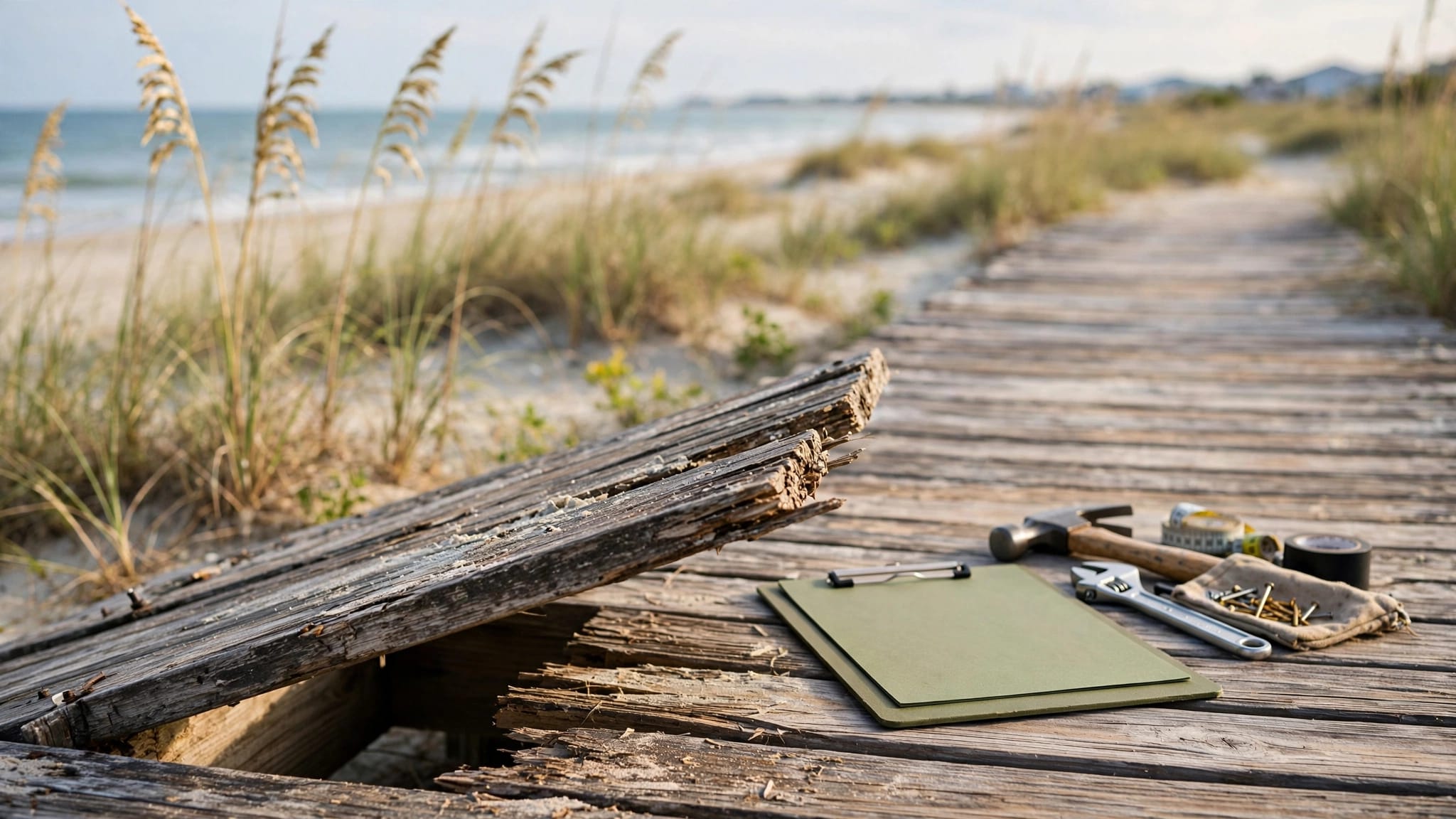
A repaired boardwalk can hide the evidence you need after a serious fall. A Florida walkway injury claim often depends on records showing what the responsible party knew before the fall.
Inspection logs, complaints, and repair orders can explain why a loose plank or damaged ramp remained open. But those records need to connect the hazard to your injury.
Start by identifying who controlled the walkway, then trace its maintenance history while the evidence remains available.
What a Florida walkway injury claim must establish
A fall alone doesn’t establish liability. Your claim must connect a duty of care, an unsafe condition, a failure to act reasonably, and resulting harm.
Identify who controlled the beach access
A beachfront walkway may belong to a municipality, county, hotel, condominium association, or private property owner. A contractor may handle maintenance without owning the structure.
The beach’s public accessibility doesn’t settle who maintained the route where you fell. Property records, maintenance agreements, leases, and service contracts can help identify responsibility.
Under Florida premises liability rules, control and your reason for entering the property affect the duty owed. Identify the exact segment involved, including stairs, ramps, landings, or transitions between surfaces.
Separate a structural defect from a temporary substance
Broken boards, protruding fasteners, and uneven concrete require a different investigation than water or loose sand on a business’s walkway.
For slips involving a transitory foreign substance in a business establishment, Florida Statutes section 768.0755 requires proof of actual or constructive knowledge.
Constructive knowledge can involve how long the condition existed or whether it occurred regularly. That statute doesn’t automatically govern a fall caused by a fixed defect, such as a broken plank.
Inspection records help establish notice
Inspection records matter because they can show whether someone identified a hazard or should have discovered it through reasonable care.
Match the inspection to the precise location
Ask for inspection logs, condition assessments, employee checklists, and photographs covering the affected walkway. A general report about an entire beach park may say little about one damaged landing.
Look for the inspection date, time, employee name, route, findings, and follow-up instructions. Then compare those details with photographs and witness accounts.
A checked box doesn’t establish that someone examined the defect. Likewise, a missing entry doesn’t automatically prove that no inspection occurred. The record’s scope and reliability matter as much as its existence.
Look for earlier complaints and recurring conditions
Visitor complaints, staff emails, maintenance requests, and earlier incident reports may document the same condition before your injury. However, a complaint about another access point may have little relevance.
For recurring sand accumulation or drainage problems, earlier reports may help explain whether the hazard was foreseeable. For deteriorated boards, repeated replacement requests may establish a longer history.
As with Florida slip and fall inspection logs, maintenance paperwork becomes stronger evidence when it matches video, photographs, and employee testimony.
Repair records show what happened after a warning
A work order can document a reported problem. It doesn’t necessarily prove that someone corrected it before pedestrians used the walkway again.
Trace the work order through completion
Request repair tickets, contractor notes, invoices, material records, and photographs of completed work. Relevant communications may explain a delay or show that workers repaired a different section.
Compare the reported location with the repair location. Also check whether a completion entry describes an actual inspection or only an administrative update.
Temporary measures deserve attention too. A cone, barrier, or closure may appear in a record, but photographs and video can show whether it remained in place when you approached.
Review repairs without treating them as an admission
A repair after an injury doesn’t automatically establish earlier negligence. Courts also apply evidentiary limits to subsequent safety measures.
Still, repair files can help identify the responsible parties, the affected materials, and the walkway’s condition. An attorney can evaluate which documents are discoverable and admissible.
A repair ticket marked “closed” needs to be matched to the actual work, the correct location, and any inspection before reopening.
Keep the full timeline, including the original complaint and any earlier attempts to fix the same problem.
How to request public and private maintenance records
The route for obtaining records depends on who holds them. A public beach boardwalk and a hotel walkway require different approaches.
Request existing records from the public agency
Chapter 119 of the Florida Statutes generally allows inspection and copying of public records, subject to exemptions and applicable fees.
Contact the agency’s records custodian. Identify the beach access name, street address, walkway segment, injury date, and relevant date range.
Request existing inspection reports, complaints, work orders, maintenance contracts, dated photographs, and related communications. Ask for electronic copies when available and a cost estimate before extensive work begins.
The agency doesn’t have to create a new report answering your questions. Also, some responsive records may require redaction or qualify for an exemption.
Preserve private records and identify contractor files
A private hotel or condominium association isn’t automatically required to release its maintenance file under public-records law. Voluntary requests, attorney communications, and formal litigation discovery may be necessary.
Ask a public agency about records relating to its maintenance contractor too. Whether contractor-held materials are public records depends on the contract, the services, and applicable law.
Separate a request for copies from a request to preserve evidence. Receiving some documents doesn’t confirm that the holder has protected video, original electronic records, or damaged materials against loss.
Preserve the walkway’s condition before repairs
Get medical help first. If you can’t safely document the scene, ask a companion to photograph it without delaying treatment.
Take wide photographs showing the access route, nearby landmarks, lighting, and warnings. Then capture close views of the defect. Keep original files with their date information intact.
Report the injury to the manager, security office, or responsible agency. Include the precise location, time, weather, direction of travel, and witness contacts. Don’t guess how long the defect existed or sign an inaccurate account.
A written preservation request can identify surveillance footage, inspection files, complaints, repair records, and the damaged board or hardware. Request relevant footage before the fall too, because it may show inspections or earlier warnings. Keep proof of delivery.
Many camera systems overwrite footage within days or weeks. Don’t rely solely on verbal assurances that recordings will be saved.
Avard Law’s Florida fall evidence checklist covers additional materials worth retaining. Don’t remove boards, fasteners, or other property yourself.
Fault allegations need evidence, not assumptions
An insurer may argue that you ignored a warning, left the designated route, wore unsuitable shoes, or failed to watch your step. Those allegations should be tested against the actual conditions.
Photographs can show whether shadows concealed a height difference. Witnesses may describe a missing barrier. Video may establish where you walked and whether the defect was visible.
Under Florida’s comparative fault statute, shared fault generally reduces damages in covered negligence actions. A claimant found more than 50% responsible for their own harm generally cannot recover.
A Florida walkway injury claim also needs proof of its medical and financial consequences. Keep treatment records, imaging results, therapy notes, work restrictions, bills, and wage documentation.
Describe how you fell and your symptoms accurately to medical providers. Maintenance records cannot replace evidence connecting the incident to your injuries.
Check deadlines before the records arrive
Don’t wait for a complete maintenance file before seeking legal advice. Records requests and insurance negotiations don’t automatically pause a lawsuit deadline.
Many recent Florida negligence claims have a two-year filing period. The applicable deadline depends on the claim, injury date, defendant, and any exceptions.
Claims against government entities require separate attention. Florida Statutes section 768.28 addresses sovereign immunity, written claim presentment, and other restrictions affecting state and local government claims.
A public-records request doesn’t substitute for required claim notice. Likewise, a presentment deadline isn’t necessarily the deadline to file suit.
An attorney should review the applicable statutory version, required recipients, waiting requirements, and filing dates early. Government ownership can also raise immunity questions beyond whether maintenance staff knew about the hazard.
Key Takeaways
- Inspection findings and earlier complaints can help establish notice, but they must concern the location and condition involved.
- Repair records need to show what workers actually did, when they finished, and whether pedestrians could safely return.
- Public-records access differs from obtaining a private property’s maintenance file.
- Preserve photographs, video, witness details, and medical documentation without waiting for an insurer’s decision.
Frequently Asked Questions
Does a recent inspection defeat my claim?
A recent inspection is evidence, not an automatic defense. Its value depends on what the inspector examined, what the record says, and whether other evidence supports it. A general checklist may not resolve a dispute about one broken board. Conversely, a detailed inspection can support the property owner’s account.
What if no inspection or repair records exist?
The absence of records doesn’t automatically prove negligence. Witnesses, photographs, complaints, contracts, and physical evidence may still establish what happened. An attorney can investigate whether records were never created, weren’t retained, or remain with another party. The inquiry should also address whether reasonable care required different action.
Can I pursue a claim on a public boardwalk?
Possibly, but public ownership changes the analysis. Government claims may involve immunity defenses, notice requirements, and recovery restrictions. Identify the responsible agency early. Don’t assume that reporting the injury to a park employee satisfies legal presentment requirements or that requesting maintenance records protects your filing deadline.
Build the Claim Around a Verified Timeline
The strongest maintenance evidence connects the hazard, prior notice, repair decisions, and your injury. A verified timeline gives isolated documents meaning.
Preserve the scene promptly and review responsibility and deadlines while records remain available. Avard Law Offices’ Florida slip and fall attorneys can assess those issues.
A repaired walkway may look safe today. Your claim depends on reliable evidence of its condition when you fell.