
Florida Truck Jackknife Claims: Skid Marks and Event Data
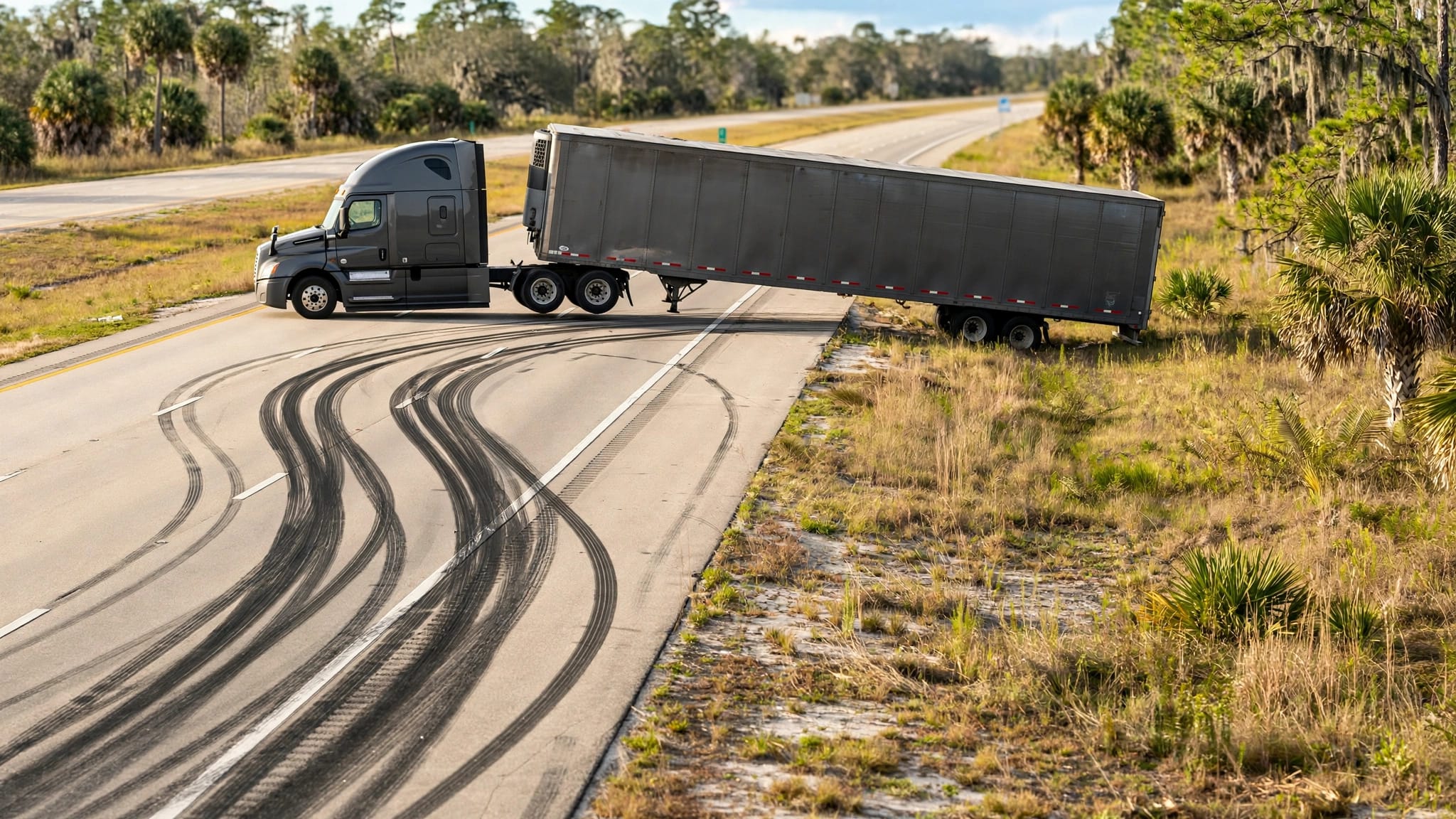
Florida truck jackknife claims depend on evidence showing why the truck lost control and how that failure caused your injuries. Skid marks and onboard records can help establish the sequence, but neither settles fault alone.
After a serious crash, the trucking company may control the trailer, electronic records, and maintenance history. Meanwhile, roadway marks can fade, recordings can disappear, and repairs can change the wreckage.
Early preservation gives your claim a stronger factual foundation, starting with the relationship between the scene evidence and the truck’s recorded activity.
Key Takeaways
- Photograph tire marks, lane markings, debris, and vehicle positions only when it’s safe.
- Preserve original recordings and arrange documentation before repairs or disposal change the vehicles.
- Truck engine data, crash-event data, and electronic driving logs answer different questions.
- Florida’s shared-fault rule can reduce or bar recovery, and insurance negotiations don’t stop the filing deadline.
Why a Jackknife Requires a Wider Investigation
A jackknife occurs when a tractor and trailer fold sharply at their coupling after losing directional control. That description identifies the vehicle movement, not its cause.
The investigation must connect the loss of control to negligent conduct or another legally actionable failure.
Driver conduct and operating conditions
Speed, braking, steering, following distance, and wet pavement may all matter. However, investigators must examine their relationship to the truck’s movement before drawing conclusions.
A sudden maneuver by another vehicle may also affect the sequence. In a pileup, our guidance on Florida multi-vehicle crash claims addresses why identifying the first collision matters.
Equipment and company records
Brake condition, tire condition, cargo distribution, and maintenance history may explain why the truck became unstable. Loading documents can also identify who handled the freight.
The driver isn’t always the only potentially responsible party. The motor carrier, maintenance contractor, or cargo handler may have a role, depending on the evidence.
Our discussion of truck driver qualification files explains records that may show what a carrier knew before assigning the driver.
What Skid Marks Can Tell Investigators
Roadway marks can help trace vehicle movement before, during, and after a jackknife. Their usefulness depends on identifying which tire produced each mark and when it formed.
Document the whole scene
If conditions permit, photograph marks in relation to lane lines, shoulders, debris, and final vehicle positions. Wide views establish location; closer images preserve texture and interruptions.
Also capture standing water, pavement changes, road curves, and visible damage. Keep original files because their timestamps and image quality may help establish the sequence.
Don’t enter active traffic or approach unstable wreckage to gather evidence. Investigators can obtain measurements and additional documentation after responders secure the scene.
Distinguish braking marks from sideways scuffing
A reconstruction specialist can assess whether a mark reflects braking, sideways tire movement, or another contact. Curved marks may help trace rotation as the tractor or trailer changes direction.
However, a dark mark doesn’t establish speed by itself. Calculations require appropriate measurements and assumptions about traction, grade, vehicle movement, and braking.
The absence of obvious skid marks doesn’t establish that the driver never braked. Anti-lock braking and surface conditions can affect visible marking.
Marks left after impact must also be separated from marks created before the collision.
Truck Event Data and Driving Logs Are Different
“Black box” is a broad label. A useful investigation identifies the actual devices, available records, and event associated with each download.
ECM and EDR records
An electronic control module, or ECM, manages engine functions and may retain event information. Depending on the system, available fields can include vehicle speed, engine speed, throttle position, and brake-switch status.
An event data recorder, or EDR, stores certain vehicle information associated with a crash event. NHTSA’s event data recorder guidance describes its use in crash investigations.
Investigators must associate the retrieved information with the correct vehicle and event. A rapid-deceleration record could relate to an earlier event rather than the collision under investigation.
Brake-switch status also requires careful interpretation. It indicates switch activity, not a direct measurement of braking force at every wheel.
ELD records address driving time
An electronic logging device, or ELD, primarily documents driving time and duty status. FMCSA explains that electronic logging devices synchronize with the engine to record driving time.
Those records can help evaluate hours-of-service compliance and the driver’s work timeline. However, a long shift alone doesn’t prove that fatigue caused the jackknife.
Dispatch messages, fuel receipts, and other supporting records can help test the timeline. ELD information and crash-event data should answer separate questions before investigators combine them.
Match Electronic Records to the Physical Sequence
The strongest reconstruction compares independent evidence rather than treating a download as the complete explanation.
Investigators can compare recorded speed changes with tire marks, vehicle damage, camera footage, and witness observations. They should also evaluate clock differences between devices before aligning events.
A camera timestamp may not match the truck’s recorded time. Without accounting for that difference, an apparent contradiction may reflect clock settings rather than conflicting evidence.
Likewise, recorded speed requires interpretation of the system’s measurement method and calibration. Damage patterns and roadway evidence help test whether the proposed movement fits the collision.
A brake-switch entry can show when the switch activated. It doesn’t establish how much braking force reached the road.
A Florida Traffic Crash Report can identify witnesses, describe conditions, and include a diagram. Still, the report alone doesn’t decide civil liability. Compare its narrative with the original recordings and physical evidence.
Preserve the Truck, Trailer, and Original Records
Preservation should address both physical components and digital information. Protecting one category while allowing the other to disappear can leave major gaps.
Identify the custodians and evidence
An attorney’s preservation request can identify the crash date, location, vehicles, and relevant records. Potential recipients include the carrier, vehicle owner, insurer, towing company, and recording-system provider.
The request can cover the tractor and trailer, ECM information, onboard video, ELD records, maintenance files, dispatch communications, and cargo documents.
Preserve your damaged vehicle as well. Avoid authorizing disposal or repairs before its condition has been documented and inspection needs addressed.
Meanwhile, address storage charges promptly while counsel arranges access. Evidence preservation doesn’t remove the practical costs of storing wreckage.
Retention periods aren’t a safe waiting period
Under FMCSA’s ELD record-retention requirements, carriers must retain ELD duty-status records and backup data for six months.
That period doesn’t establish how long unrelated video or engine-event information remains available. Different systems and records have different storage limits.
A retrieval record should identify the vehicle, equipment, download method, and person who obtained the data. Keeping original exports and documenting subsequent handling helps address disputes about authenticity or alteration.
Florida Fault Rules and Filing Deadlines
Florida truck jackknife claims require proof of fault, causation, and damages. The truck’s folded position doesn’t replace that proof.
Shared fault can change recovery
Under Florida’s comparative-fault statute, your share of responsibility generally reduces recoverable damages in a covered negligence action.
A person found more than 50% at fault for their own harm generally cannot recover in that action. A 20% fault allocation generally reduces damages by 20%.
An insurer may allege speeding, distraction, an unsafe lane change, or delayed braking. Each theory needs evidence connecting your conduct to the collision.
Stay truthful in insurance communications, but don’t guess about speed, distance, or reaction time. Discuss another insurer’s recorded-statement request with counsel while following your own policy’s cooperation requirements.
Negotiations don’t pause the lawsuit deadline
For negligence claims accruing after March 24, 2023, Florida’s statute of limitations generally provides two years to file suit.
Different claim types, defendants, or accrual facts can affect the applicable deadline. An open insurance claim or ongoing settlement discussion doesn’t automatically extend it.
Evidence preservation and filing deadlines operate separately. A preservation request doesn’t file a lawsuit, and timely filing doesn’t recover evidence already lost.
Document the Injuries and Financial Losses
Proving how the jackknife happened is only part of the claim. Medical and financial records establish the losses connected to the collision.
Seek prompt treatment and accurately describe your symptoms, prior conditions, and how the impact occurred. Follow-up records can document work restrictions, continuing symptoms, and future care needs.
Also retain bills, prescriptions, receipts, and wage records. Lost-income claims need support beyond a statement that you couldn’t work.
For serious injuries, medical opinions may address future treatment and lasting limitations. Keep this evidence alongside the liability records so the claim addresses both responsibility and compensation.
Don’t sign a settlement release before understanding which claims it ends and whether it accounts for continuing losses.
Frequently Asked Questions
Can I pursue a claim without visible skid marks?
Yes. Original video, witness accounts, vehicle damage, roadway debris, and available electronic records can help establish the sequence. A lack of visible marks doesn’t resolve whether braking occurred or who caused the crash. The investigation should use all available evidence.
Can an attorney obtain data controlled by the trucking company?
An attorney can request preservation and seek relevant records through available legal procedures. The process depends on who controls the vehicle and information. Access, retrieval methods, and expert involvement require attention before anyone handles electronic components or performs a download.
What should I bring to a consultation?
Bring the crash report or report number, original photos and video, witness contacts, insurance correspondence, and available medical records. Include towing information and vehicle locations. Work restrictions, pay records, and settlement offers also help. You don’t need a complete evidence file before seeking legal help.
Build the Claim Around Preserved Evidence
A jackknife claim is stronger when roadway marks, vehicle records, and injury documentation support a consistent sequence. Preserving evidence early gives investigators more to work with before repairs, disposal, or routine data loss create gaps.
We offer free consultations for Florida truck accident cases. Bring the records you have so our attorneys can assess preservation needs, fault issues, and filing deadlines.