
Florida Motorcycle Pothole Crashes: Proving Neglect
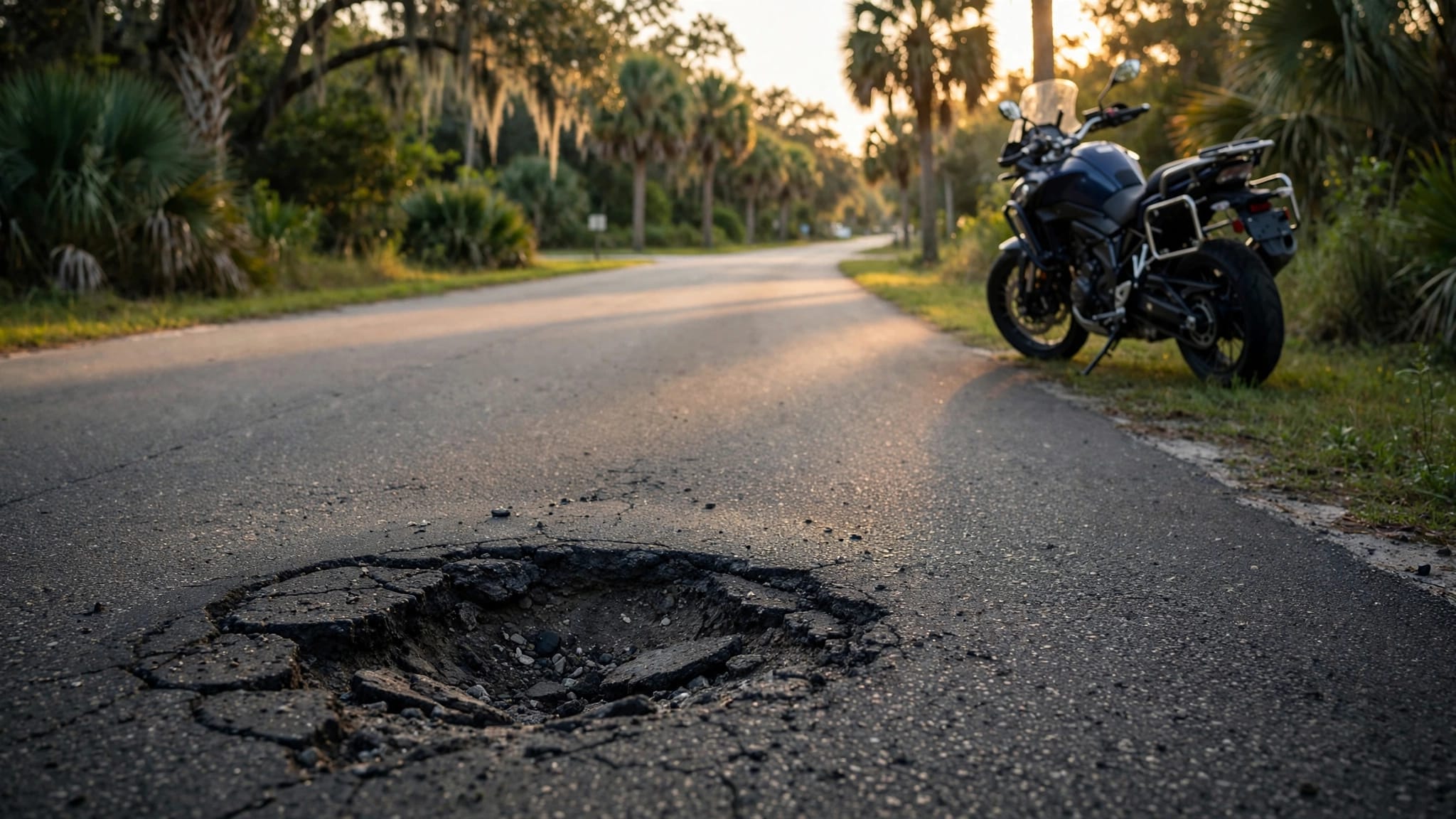
Florida motorcycle pothole crashes may support an injury claim when evidence links a dangerous road defect to negligent maintenance. A biker’s claim depends on identifying who controlled the roadway, what they knew, and how the defect caused the injuries.
A pothole photograph alone rarely proves maintenance neglect. The inquiry must connect crash evidence with the road’s inspection, complaint, and repair history.
Key Takeaways
- A report must support a pothole explanation before anyone treats it as an established cause.
- Road ownership, maintenance responsibility, prior complaints, and repair records help identify the responsible parties.
- Government claims involve special notice requirements, deadlines, immunity defenses, and compensation limits.
What the Florida Crash Reports Actually Say
Two fatal Florida motorcycle incidents illustrate why the reported sequence matters. Neither account identifies a pothole as the cause.
Shad Road: A Fatal Collision With a Concrete Pole
According to a Jacksonville police news release, two motorcyclists were traveling eastbound in the 5500 block of Shad Road. At about 1:45 a.m., one rider left the roadway and struck a concrete pole near Florida Mining Boulevard.
The motorcyclist, described as a man in his late 20s, died at the scene. Those facts establish the location and reported collision sequence. They don’t establish why he left the roadway or support attributing the event to defective pavement.
Winterbrook: A Curve, a Curb, and a Pedestrian
A Florida Highway Patrol report described a fatal incident around 5:30 p.m. on Sunday, February 11, 2024. It happened at the gated Winterbrook subdivision entrance northeast of Orlando.
A 63-year-old riding a 2009 Harley-Davidson failed to negotiate a curve, ran off the roadway, and hit a curb. The rider was thrown into a 23-year-old woman walking on the sidewalk. She suffered minor injuries and wasn’t taken to a hospital.
The rider died at the scene. Investigators hadn’t determined whether striking the pedestrian or another injury related to the incident caused his death. The investigation remained open at the time of reporting, and the account didn’t identify a pothole.
Other Reports Don’t Establish a Florida Pothole Cause
Traffic-safety reporting and online discussions can raise useful questions. However, neither substitutes for evidence about the road where your incident occurred.
FGCU’s South Bridge Loop Safety Changes
A Fox 4 report described Florida Gulf Coast University’s conversion of South Bridge Loop to one-way traffic. The area included five dorms, a dining hall, a large parking garage, and a fitness center, with increasing pedestrian crossings.
The report also covered a motorcycle crash on the loop in which the operator survived. Campus police urged drivers to stop speeding, while crews expected to finish the traffic project that week.
Those details describe road-management concerns. They don’t establish a pothole-related incident or prove the motorcycle operator was speeding.
The Nashville Pothole Debate
A Harley-Davidson forum thread discussed a motorcyclist’s death blamed on a pothole. One participant said another rider struck the same hole without falling.
Posters described massive Nashville-area potholes, criticized years of neglect before I-440 resurfacing, and questioned infrastructure spending. Others emphasized riders’ responsibility to recognize and avoid hazards, including sand, gravel, oil, fallen trees, and deer.
These are anecdotal arguments about an incident outside Florida. A second rider’s different outcome doesn’t establish whether the first rider acted reasonably or whether maintenance neglect caused the incident.
Proving Neglect in Florida Motorcycle Pothole Crashes
A successful claim connects duty, unreasonable maintenance, causation, and documented losses. Identifying a damaged section of pavement starts that investigation.
Identify Who Controlled the Road
Responsibility may belong to a city, county, the Florida Department of Transportation, a private community, or a maintenance contractor. A road’s location inside city limits doesn’t automatically make the city responsible.
Maintenance agreements, resurfacing contracts, inspection assignments, and work orders can identify who controlled the affected pavement. Our guidance on Florida road debris accident claims addresses similar questions about roadway responsibility.
For state-maintained roads, FDOT’s claims information provides a route for presenting claims. Submitting paperwork doesn’t establish negligence or guarantee payment.
Establish Notice and a Causal Connection
Prior complaints, inspection findings, recurring repairs, and records of deterioration may show that the responsible party knew about the defect. They may also support an argument that reasonable inspections should have revealed it.
The timeline matters. A newly formed hole presents different notice questions than a documented defect left unrepaired.
Next, connect the pothole to the motorcycle’s movement. Wheel damage, pavement marks, footage, and witness observations can help distinguish a pothole impact from a mechanical failure or another cause. A reconstruction specialist may assess that sequence when the evidence requires technical analysis.
Preserve Evidence Before Repairs Change the Scene
Medical care comes first. Once it’s safe, preserve both the roadway condition and the motorcycle’s physical evidence.
Document the Defect and the Approach
Record the precise location, direction of travel, lane, lighting, and weather. Photograph wide views showing the approach and close views showing the defect, without entering moving traffic.
Measurements can help establish the hole’s dimensions, but nobody should risk another collision to obtain them. Also document water, loose pavement, warning signs, or temporary patches.
Request complaints, inspection logs, work orders, and repair history covering the period before the incident. Our discussion of records supporting pothole injury claims explains why a photograph needs a maintenance timeline.
Protect Recordings and Damaged Equipment
Save original helmet-camera and dashcam files, including the approach before impact. Nearby recording systems may overwrite footage, so prompt preservation requests matter.
Keep the motorcycle, damaged wheel, helmet, and protective clothing available for assessment before repairs or disposal. Meanwhile, address storage costs so preservation doesn’t create avoidable expenses.
Obtain witness contact information and distinguish firsthand observations from assumptions. Florida’s crash-record access guidance explains the available records channels. A report can support the evidence review without resolving every disputed fact.
Government Road Claims Have Separate Procedural Rules
Claims against public entities require more than proof of poor pavement. Sovereign immunity affects which claims can proceed and how much the government must pay.
Written Notice Isn’t the Same as Reporting a Pothole
Under Florida Statute section 768.28, most covered claims require written notice to the appropriate agency within three years after accrual. When a rider dies, wrongful-death notice generally must be provided within two years.
Notice must also reach the Florida Department of Financial Services unless an exception applies. Claims against municipalities, counties, and the Florida Space Authority are exceptions to that separate department-notice requirement.
A pothole complaint made before the incident may help prove notice of danger, but it doesn’t replace the formal notice required to pursue a government claim.
The state’s claims process also includes an investigation period. Ordinary claims generally involve six months unless denied earlier; wrongful-death claims have a 90-day review period.
Lawsuit Deadlines and Immunity Need Separate Analysis
Section 768.28 generally provides four years for covered government tort actions. Wrongful death follows the applicable wrongful-death limitations period, generally two years. Many recent negligence claims against private defendants also have a two-year filing period.
These periods aren’t interchangeable. Settlement discussions, records requests, and a pending review don’t automatically pause them.
Immunity also depends on the challenged conduct. A claim about neglected operational maintenance can raise different issues than a challenge to discretionary road-design decisions. Even proven negligence remains subject to applicable government-payment restrictions.
Address Rider Fault and Document Every Loss
An agency or insurer may argue that speed, visibility, braking, or evasive movement caused the crash. Those allegations require evidence.
Shared Fault Can Affect Recovery
Florida’s modified comparative negligence rules generally bar recovery in covered negligence cases when the claimant bears more than 50% of the fault. A smaller assigned share generally reduces damages proportionally.
Video, sight lines, road conditions, and physical damage can challenge unsupported blame. Our explanation of Florida comparative negligence rules addresses how disputed percentages affect a claim.
An experienced rider can still encounter a dangerous pothole despite reasonable care. Experience alone neither proves negligence nor defeats it.
Losses Require Their Own Evidence
Preserve medical records, bills, wage records, and documentation of functional limitations. Supported damages may include future care, reduced earning capacity, motorcycle damage, and pain and suffering.
Tell treating providers how the event happened and describe symptoms accurately. Consistent treatment records help connect the injuries to the event.
The amount of harm and the amount recoverable are separate questions. Government-payment limits and available coverage can restrict compensation even when substantial losses are well documented.
Frequently Asked Questions
Can I Have a Claim Without a Police Finding About a Pothole?
A missing pothole reference doesn’t automatically defeat a claim. Photographs, original footage, witnesses, motorcycle damage, and maintenance records may establish facts the officer didn’t observe. However, those materials must support the claimed connection between the defect and the incident.
Does Another Rider Avoiding an Incident Prove I Was at Fault?
Another rider’s outcome doesn’t decide your case. Differences in approach, position, visibility, motorcycle condition, and impact can matter. The case review must assess your actual conduct and the defect’s role rather than assume identical outcomes were possible.
Protecting a Florida Motorcycle Pothole Claim
Proving maintenance neglect requires a reliable timeline connecting road control, hazard notice, the crash, and your losses. Early evidence preservation protects that connection before repairs, overwritten recordings, and missing equipment weaken it.
We offer free initial consultations for personal injury matters. A prompt legal review can identify responsible parties and address government notice requirements while the evidence remains available.