
Florida Motorcycle Right-Hook Crashes: Who Must Yield?
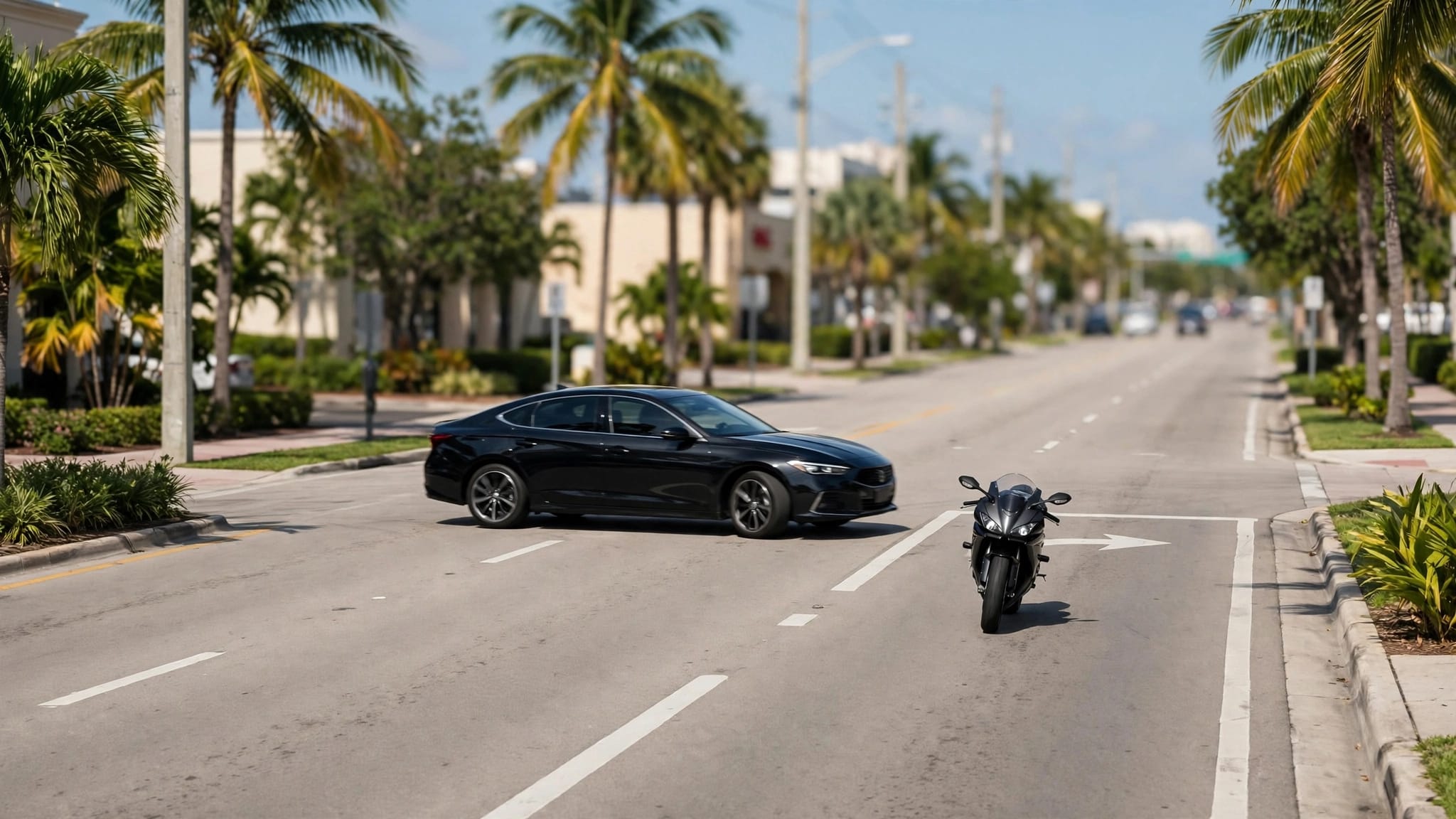
A driver turning right must wait until the movement can be made safely, including when a motorcycle occupies the turning path. In a Florida motorcycle right-hook crash, a turn signal doesn’t give the driver permission to cut across the rider’s lane.
However, liability also depends on the motorcycle’s position, the roadway markings, and whether either person’s conduct contributed to the collision. The turning sequence often determines which driver breached a duty and what evidence an injured rider needs.
Start with the turning driver’s obligations, then examine how both vehicles approached the conflict.
Who Must Yield in a Florida Motorcycle Right-Hook Crash?
A right-hook crash occurs when a vehicle turns right across a motorcycle’s path while both travel in the same direction. It can happen at an intersection, business entrance, or driveway.
The turning driver’s safety and signaling duties
Under section 316.155 of Florida’s traffic statutes, drivers cannot turn or move sideways until they can do so with reasonable safety. They must also signal when another vehicle may be affected.
A turn signal must operate continuously during at least the final 100 feet before the turn. However, signaling doesn’t excuse an unsafe movement.
At intersections, section 316.151 generally requires drivers to approach and make right turns near the roadway’s right-hand curb or edge, unless traffic-control devices direct otherwise. That positioning rule doesn’t authorize a driver to cross an occupied lane.
A motorcycle’s right to its lane
Section 316.209 gives motorcycles full use of a traffic lane. A driver cannot treat the space beside a motorcycle as an available passing or turning lane.
Therefore, a driver who overtakes a motorcycle and immediately turns across its path may be responsible for the resulting collision. The investigation should establish whether the rider occupied the lane before the driver began turning.
A driver’s statement that the motorcycle was in a blind spot doesn’t resolve whether the turn was reasonably safe.
How Lane Position Changes the Fault Analysis
The phrase “right-hook” describes the movement, but it doesn’t establish exactly where either vehicle traveled. Lane markings and vehicle positions can change the analysis.
The motorcycle was in a separate travel lane
When a driver turns across an adjacent travel lane, the investigation should determine whether that lane permitted the rider to continue straight. Arrows, signs, and intersection design can establish the permitted movements.
On roads with designated right-turn lanes, the relevant questions include when the driver entered the lane and whether the motorcycle was already there. An unsafe lane change may begin the collision sequence before the actual turn.
Photographs showing the approach to the intersection can be as important as photographs of the impact area.
The rider was beside the car within one lane
Florida generally prohibits a motorcyclist from passing another vehicle within the same lane and from riding between traffic lanes or adjacent rows of vehicles.
If an insurer alleges lane splitting, establish the actual lane boundaries and the motorcycle’s position. Riding near a lane edge doesn’t, by itself, prove the rider was operating between lanes.
An unlawful maneuver can affect responsibility when it contributed to the harm. However, the analysis must also address the driver’s movement, visibility, and opportunity to avoid turning across the rider.
Evidence That Reconstructs the Right Turn
A useful investigation builds a timeline: where the motorcycle traveled, when the driver moved right, and how much time remained to react.
Preserve recordings and witness information
Dashcam, helmet-camera, and nearby business footage may show whether the driver passed the motorcycle before turning. Recordings can also establish signal timing and whether the rider maintained a consistent lane position.
Preserve original files rather than relying only on edited clips. Identify nearby cameras promptly because their owners may overwrite recordings.
Independent witnesses may clarify whether the driver merged gradually, turned abruptly, or approached from the wrong lane. Their contact information matters even when they didn’t see the final impact.
Compare physical evidence with each account
Vehicle damage, roadway marks, debris, and final resting positions can support or contradict the drivers’ descriptions. However, damage location alone rarely establishes the entire sequence.
Preserve the motorcycle and riding equipment before repairs or disposal eliminate useful evidence. An attorney may seek inspections or preservation of electronic vehicle data when available.
Our discussion of motorcycle left-turn crash claims addresses a different turning movement, but it also explains why timing, visibility, and physical evidence matter when accounts conflict.
How Shared Fault Affects Your Recovery
Florida uses modified comparative negligence in most injury cases. Under section 768.81, an injured person’s percentage of responsibility generally reduces recoverable damages.
A rider assigned 20% of the fault generally faces a 20% reduction. A person found more than 50% responsible for their own harm generally cannot recover damages in a covered negligence action. Exactly 50% doesn’t trigger that bar, although it reduces recovery by half.
Insurers may allege speeding, an improper pass, distraction, or delayed braking. Each allegation should identify conduct that actually contributed to the collision or injuries.
Our explanation of Florida comparative negligence addresses why disputed percentages deserve attention before settlement.
An insurer’s proposed fault percentage isn’t a court finding. The evidence behind that percentage can determine whether compensation remains available.
Be truthful in insurance communications, but don’t guess about speed, distance, or reaction time. Separate what you personally observed from information you learned afterward.
Before giving another driver’s insurer a recorded statement, discuss the request with counsel. Continue meeting your own policy’s notice and cooperation obligations.
Medical Bills, Insurance, and Other Losses
Proving an unsafe turn and identifying money available to pay a claim are separate tasks. A strong liability case still requires an insurance analysis and documentation of losses.
Motorcycle injuries don’t automatically qualify for PIP
Florida’s ordinary personal injury protection system generally applies to qualifying four-wheel motor vehicles. A two-wheel motorcycle doesn’t meet that definition.
The car driver’s fault therefore doesn’t automatically provide PIP benefits to the rider. Owning an insured car also doesn’t make that car’s PIP available for motorcycle injuries.
Our guide to Florida motorcycle PIP coverage explains this distinction. Potential payment sources may include the driver’s bodily injury liability insurance, applicable uninsured or underinsured motorist coverage, health insurance, or optional medical-payments coverage.
Document treatment and financial harm
Seek appropriate medical care and accurately describe the impact, symptoms, and prior conditions. Treatment records should distinguish crash-related injuries from earlier problems.
Keep medical bills, prescriptions, work restrictions, and wage records. Motorcycle repairs, towing charges, and other related expenses also require documentation.
An injury claim may include supported future care costs, reduced earning capacity, pain, disability, and loss of enjoyment of life, depending on the injuries and applicable law. Before accepting a settlement, consider whether ongoing treatment needs and work limitations are understood.
Deadlines and Legal Help After the Crash
For most Florida negligence claims arising after March 24, 2023, the general lawsuit filing period is two years. Different claim types, defendants, and circumstances can change the applicable deadline.
Settlement discussions and an open insurance file generally don’t pause that period. Insurance notice duties and evidence-preservation needs may also arise much earlier.
When a crash causes injury, Florida law requires immediate notification to law enforcement. Reporting the collision to an insurer doesn’t replace that obligation.
Bring available photographs, original recordings, the crash report, insurance documents, medical records, and insurer correspondence to an attorney consultation. Also identify where the damaged motorcycle is stored and who may hold additional footage.
You don’t need a complete file before seeking help. At Avard Law Offices, we offer free case evaluations for personal injury claims. A consultation can address disputed fault, available coverage, urgent evidence requests, and the consequences of signing a release.
Ask how fees and litigation expenses work before representation begins.
Key Takeaways for Injured Riders
- A driver must make a right turn safely; activating a turn signal doesn’t authorize crossing a motorcycle’s path.
- Full lane use protects motorcyclists, but lane position and prohibited passing can affect fault.
- Original recordings, vehicle evidence, and independent witnesses can challenge an unsupported account of the turn.
- Shared fault affects compensation, while insurance coverage and filing deadlines require separate attention.
Protect evidence early because a disputed turn may take only seconds, while the records explaining it can disappear long before settlement discussions finish.
Frequently Asked Questions
Is the right-turning driver always at fault?
No. An unsafe right turn can support liability, but the rider’s conduct also matters. Speed, lane position, prohibited passing, and roadway directions can affect responsibility. The conclusion should follow the evidence rather than the label attached to the crash. A traffic citation doesn’t automatically decide civil liability either.
Can I bring a claim if there was no physical contact?
Potentially. A driver may cause a rider to brake, swerve, or fall without striking the motorcycle. The claim still requires proof that negligent driving caused the injuries. Video, witnesses, roadway evidence, and a consistent medical history can be especially important when vehicle damage doesn’t connect the parties.
Does helmet use determine who caused the right-hook crash?
Helmet use and collision responsibility are separate questions. An insurer alleging that helmet nonuse worsened an injury needs evidence connecting that conduct to the particular harm. Our discussion of helmet evidence in motorcycle claims explains why injury-specific medical evidence matters alongside the investigation into the turn.
Protect Your Claim With the Turning Sequence
A Florida motorcycle right-hook claim depends on whether the driver could safely turn and how each person’s conduct affected the crash. A signal, blind-spot explanation, or initial insurance decision doesn’t settle those questions.
Protect your health and preserve the evidence of the turn. Early legal review can help address disputed fault and available coverage before a release ends your claim.