
Florida Intersection Crash Claims When Drivers Dispute Movements
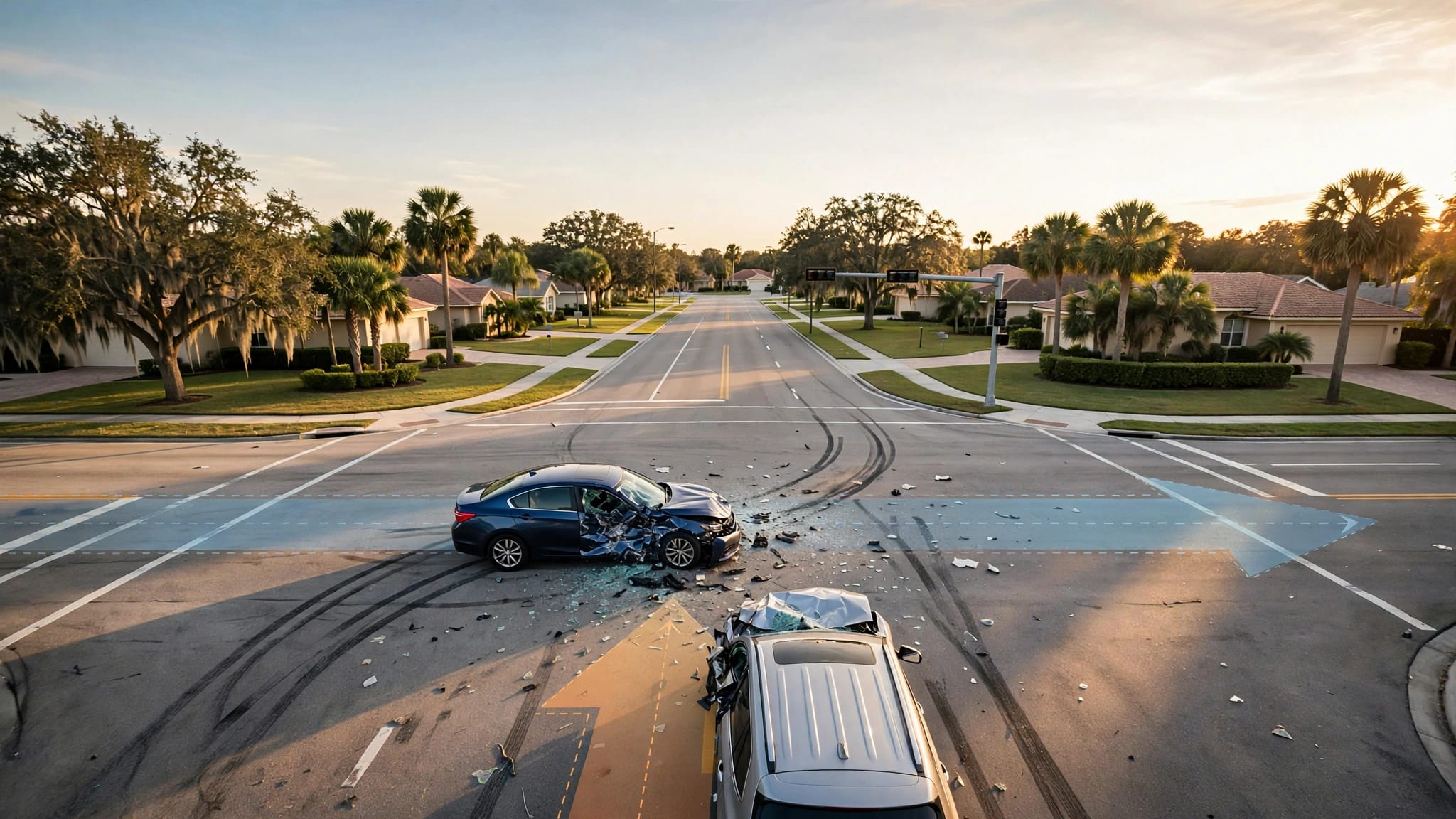
A crash at an intersection can turn into a dispute within minutes. You may remember having the green light or arriving first, while the other driver tells police and insurers the opposite.
Florida intersection crash claims often depend on evidence that shows each vehicle’s movement, not on who speaks more confidently at the scene. A clear record can protect your right to seek compensation when the other driver shifts blame.
The steps taken in the first days can preserve footage, witness accounts, and physical proof before those details disappear.
Why Intersection Collisions Turn Into Movement Disputes
Intersection crashes happen quickly, and each driver may see only part of the sequence. One driver may say they entered on green. The other may insist they turned after yielding or stopped before proceeding.
Side-impact damage can support an account, but it rarely answers every question alone. A T-bone collision may involve a red-light violation, a left turn across traffic, a driver who entered late on yellow, or two drivers who misread the signal phase.
A green light does not end the inquiry
A green signal permits movement, but it does not remove every duty of care. Under Florida’s traffic-signal law, drivers turning right or left must yield to vehicles and pedestrians lawfully in the intersection or crosswalk.
Therefore, “I had a green light” is an important fact, not a complete liability analysis. The evidence must still show where each vehicle was, when it entered, and whether a turning driver had a safe gap.
Initial statements often contain gaps
After an impact, people may feel shaken, injured, or unsure of distances and timing. A driver might guess at speed, say they “thought” the light was yellow, or assume the other vehicle appeared suddenly.
Stay truthful, but don’t fill gaps with estimates. If you do not know a distance, speed, or signal phase, say so. A guess can conflict with video, vehicle damage, or witness testimony later.
A driver’s accusation at the scene is not a legal finding of fault. The claim depends on evidence that connects each movement to the collision.
Florida Right-of-Way Rules That May Apply
Traffic laws provide a starting point for a disputed intersection claim. However, the physical evidence must show how the rule applies to the actual crash.
Vehicles already in the intersection
Florida law requires a driver approaching an intersection to yield to a vehicle that has already entered from a different highway. When two vehicles enter at about the same time, the driver on the left generally yields to the driver on the right under Florida Statute section 316.121.
That rule matters in four-way-stop disputes and intersections without signals. Arrival order, stopping position, and each driver’s speed may determine who had the right of way.
For a closer look at proof in these cases, see this Florida four-way stop accident claims guide.
Stop signs and yield signs
A driver facing a stop sign must stop at the marked line. If there is no line, the driver must stop before the crosswalk or at the nearest point with a view of approaching traffic. After stopping, that driver must yield to traffic already in the intersection or close enough to create an immediate hazard under Florida’s stop and yield sign requirements.
Photos of the stop line, faded markings, obstructed signs, and sight lines can matter. Those details may show whether a driver had a fair view before entering.
Left turns and turns on red
A left-turning driver often faces a strong duty to yield to oncoming traffic. Yet the oncoming driver’s speed, signal, lane, and visibility can still be disputed.
A right turn on red creates similar questions. Evidence may show whether the driver stopped completely, yielded to traffic, obeyed a “No Turn on Red” sign, or turned into a crosswalk. A Florida turn-on-red crash evidence guide explains the records that can clarify those facts.
Evidence That Can Show Who Moved First
Strong Florida intersection crash claims draw from several sources that point to the same sequence. One piece of evidence may be incomplete, while a consistent group of records can make the movement of both vehicles much clearer.
Video and signal timing records
Dashcam footage, nearby business cameras, residential doorbell cameras, and intersection recordings may capture the approach, signal phase, braking, turn, and impact. The original video file is more useful than a short clip posted online.
Signal timing information can also matter at a protected-permissive left-turn intersection. It may show when a green arrow ended, when a flashing yellow arrow appeared, and whether opposing traffic still had a green signal.
Footage can be overwritten quickly. Florida T-bone crash claims and camera evidence can help explain why prompt preservation requests matter after a side-impact crash.
Scene photos and vehicle damage
Take wide photographs of the intersection when it is safe. Include traffic lights, turn arrows, lane markings, signs, sight obstructions, skid marks, debris, and the final resting positions of the vehicles.
Then photograph each damaged area closely. Crushed panels, paint transfer, broken glass, airbag deployment, and wheel damage may help show the angle and force of impact. Damage patterns do not decide fault by themselves, but they can support a reconstruction analysis when accounts conflict.
A Florida left-turn accident proof checklist offers useful examples of the scene details that can disappear after vehicles are moved or repaired.
Witnesses and the crash report
Neutral witnesses can be especially helpful if they saw the light, watched a driver roll through a stop sign, or observed who entered first. Ask for names, phone numbers, and email addresses while memories are fresh.
The Florida Highway Safety and Motor Vehicles crash report may identify witnesses, record vehicle positions, include a diagram, and document the officer’s observations. Still, the report is not the final decision on civil liability. Officers often arrive after impact and may not have access to video or a complete account.
What to Do After a Disputed Intersection Crash
Your health comes first. Seek medical attention promptly, follow the treatment plan, and keep discharge papers, imaging results, prescriptions, referrals, invoices, and work restrictions.
Prompt care also creates records that connect the collision to your injuries. Delays and missed appointments may give an insurer room to argue that the crash did not cause your symptoms or losses.
Preserve records before they vanish
Save original photos and video files. Do not edit them, add filters, or rely only on files shared through social media. Keep copies of texts, emails, call logs, repair estimates, towing records, and correspondence with insurers.
If the vehicle has not been repaired, photograph it thoroughly before work begins. In some cases, electronic vehicle data, dashcam files, or physical damage may require inspection. Legal counsel can request preservation of evidence held by a business, another driver, or an insurer.
Keep insurer communications factual
Report the collision to your own insurer as required by your policy. However, be cautious with the other driver’s insurer. A recorded statement can lock in an estimate about speed, distance, braking, lighting, or fault before the evidence is available.
Describe what you personally saw and did. Do not adopt an adjuster’s wording or agree that you “could have avoided” the crash without seeing the full record. Early settlement offers can also arrive before treatment, future care needs, and lost income are known.
Shared Fault, PIP, and Injury Compensation
A disputed movement claim can involve more than one alleged mistake. The other insurer may claim you sped up, used a phone, failed to brake, changed lanes, or had time to avoid the collision.
Florida’s comparative-fault law can reduce damages by the percentage of responsibility assigned to an injured person in ordinary negligence cases, subject to statutory rules and exceptions. For example, a $100,000 damages finding reduced by 20% fault would leave $80,000 before other claim issues.
Evidence must support a fault percentage
An insurer cannot fairly turn missing information into a blame percentage. It should point to evidence of speed, lane position, braking, distraction, visibility, or another action that contributed to the wreck.
A driver with the right of way may still face a shared-fault allegation. Yet the carrier must support that allegation with facts, rather than relying on a broad claim that the driver should have avoided the impact.
PIP does not settle liability
Florida’s no-fault system may provide Personal Injury Protection benefits through your own auto policy for covered injuries, without waiting for a fault decision. Florida’s PIP statute identifies a $10,000 coverage limit, subject to the statute’s terms and conditions.
PIP benefits do not decide who caused the crash. A separate claim against a negligent driver may seek losses that go beyond available no-fault benefits, depending on the injuries, insurance coverage, and legal requirements.
Deadlines Can Run While Insurers Debate Fault
Do not let negotiations or an open insurance claim create false confidence about deadlines. Florida statutes set different time limits depending on the claim, the crash date, the type of injury, and the people or entities involved.
Ordinary negligence and wrongful-death cases have different filing periods under Florida law. A claim involving a government entity, a commercial vehicle, a minor, or another unusual fact pattern may require additional review.
Preserve the claim before evidence fades
A lawyer can review the report, request available video, contact witnesses, assess vehicle damage, and identify every available insurance policy. Early work also helps correct obvious factual errors before they become the insurer’s preferred version of events.
For red-light allegations, this Florida red-light accident proof checklist explains the importance of preserving footage, reports, medical records, and scene evidence quickly.
Key Takeaways
- Florida intersection crash claims depend on the movement of both vehicles, the applicable traffic control, and evidence of what happened before impact.
- A green light, police report, citation, or driver accusation can matter, but none automatically decides civil liability.
- Video, witnesses, roadway photographs, vehicle damage, and signal records can help resolve competing accounts.
- Prompt medical care supports your health and documents the connection between the collision and your injuries.
- Shared-fault arguments should rest on evidence, because a percentage of fault can reduce the compensation available in an injury claim.
- Preserve evidence early and review deadlines before an insurer’s investigation controls the narrative.
Frequently Asked Questions
Can a police report prove the other driver caused the crash?
A report can be useful, especially when it identifies witnesses, records a citation, or includes an officer’s diagram and observations. However, it does not conclusively establish civil fault. Video, photographs, signal records, damage patterns, and witness accounts may add facts the officer did not have at the scene.
What if both drivers say they had a green light?
Both accounts require investigation. A camera may show whether one driver entered after the signal changed, made an unprotected turn, or was already in the intersection when the light changed. Signal timing records, lane markings, vehicle damage, and credible witness testimony can also help establish the sequence.
Should I give the other driver’s insurer a recorded statement?
You should always be honest, but you do not need to speculate about details you do not know. The other insurer is evaluating its insured’s potential responsibility. Before giving a detailed recorded statement about a disputed crash, consider speaking with an attorney who can review the evidence and protect your interests.
A Clear Record Matters When Movements Are Disputed
Intersection claims are decided by more than a driver’s memory of a few seconds before impact. The most persuasive case connects traffic rules, physical evidence, video, witness accounts, and medical records into one accurate timeline.
When drivers dispute their movements, proof matters more than accusation. Preserving it early can make the difference between an unsupported blame claim and a fair evaluation of what happened.