
Florida Merge Crash Claims: How to Prove Unsafe Entry
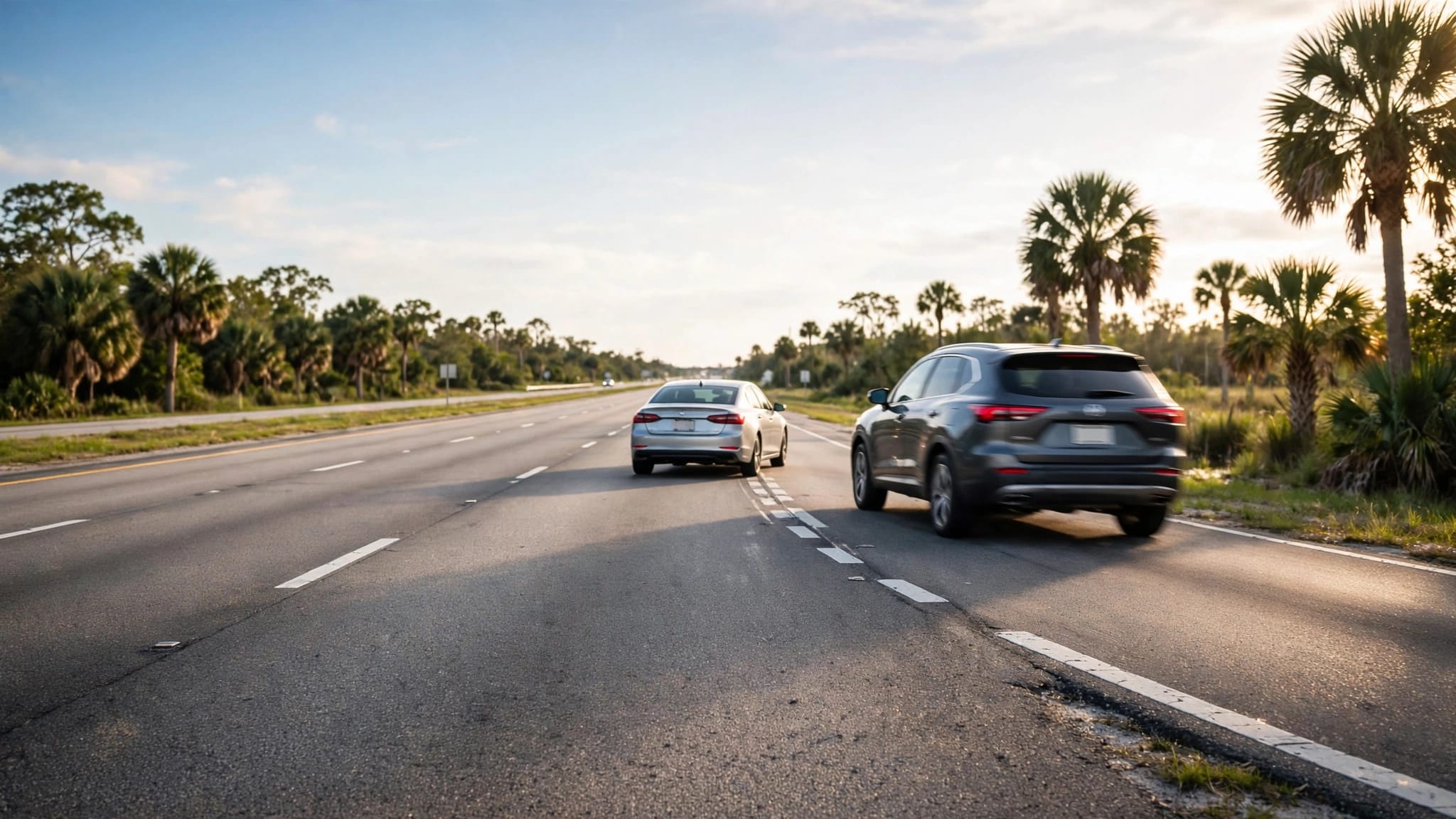
A car enters your lane from an on-ramp, and moments later both drivers say the other caused the collision. In a Florida merge crash, the point of impact alone rarely tells the full story. Lane position, timing, and the available gap can show whether the entering driver moved safely or left you no room to react.
If you’re injured, preserving that evidence matters as much as describing what happened. The first step is identifying which movement caused the vehicles to meet.
What Florida law requires during a highway merge
Florida doesn’t assign fault automatically to the driver entering a highway. The applicable rule depends on how the vehicles moved and where the entry occurred.
A lane change must be safe before it begins
Under section 316.089 of the Florida Statutes, a driver must remain within a lane as nearly as practicable and must first determine that a move into another lane can be made safely. Section 316.155 also addresses moving right or left on a highway. It requires reasonable safety and an appropriate signal when another vehicle may be affected.
Those provisions appear in Florida’s highway traffic laws. A signal can warn nearby traffic, but it doesn’t make an unsafe gap safe. The evidence still needs to show where each vehicle was when the entering driver began moving over.
A driveway entry follows a different rule
An entrance from a private road or driveway isn’t the same as a freeway on-ramp merge. Section 316.125 addresses drivers entering from a driveway, private road, alley, or building. It requires them to yield to highway traffic close enough to pose an immediate hazard.
That rule shouldn’t be applied to every ramp collision. First identify the roadway and the vehicle’s path. Then connect the correct traffic duty to what the driver did. In a disputed case, proving negligence in a Florida car accident claim also requires showing that the conduct caused the collision and resulting losses.
How the merge unfolded matters more than a label
An insurer may describe a collision as a “merge accident” before anyone has established who changed lanes. That description can hide an important difference: an entering car may have crossed into an occupied through lane, or a through-lane driver may have moved right toward the ramp.
Photographs of lane markings help establish the path. Look for the start and end of the acceleration lane, any solid lines, the location of an exit lane, and the point where the vehicles contacted. The length of an available merging area may matter when a driver claims there was no chance to adjust speed.
The timing matters too. A scrape beginning at one vehicle’s front corner may support a different account than contact centered along its side. Damage doesn’t determine fault on its own, but it can test each driver’s description alongside photographs, video, and witness accounts.
A vehicle’s final resting place may show where it stopped, not where the unsafe movement began.
Evidence that can prove an unsafe entry
The strongest claim connects the roadway layout to a clear timeline: where both vehicles traveled, when one moved sideways, and what the other driver could reasonably see or do.
Preserve the scene and independent accounts
If it’s safe, photograph the vehicles before they move. Take wider images showing both travel lanes, the ramp, signs, markings, debris, and any sight obstruction. Then photograph each vehicle’s damage and license plate. Record the location precisely, including the highway, travel direction, exit number, or nearby cross street.
Get contact information from witnesses who weren’t in either vehicle. Ask what they saw without suggesting an answer. A witness who noticed the entering car cross a lane line may help establish timing; someone who saw the through-lane car change lanes may point to a different account.
Dashcam footage and nearby business video can be useful, but recordings may be overwritten. Keep original files rather than relying on social media clips. For a broader list of records to protect, see evidence needed to support a car accident claim.
Protect the vehicles and electronic records
Don’t assume repair photographs capture everything. When fault is contested, ask about preserving the damaged vehicles before repairs, salvage, or disposal. An inspection may clarify the contact points and direction of force.
Some vehicles also store event data around a collision, potentially including speed, braking, or throttle activity. The available information varies by vehicle and event. Retrieving it generally requires the right equipment and access, so prompt preservation matters. An attorney can seek preservation of relevant data or footage held by another driver, an insurer, or a business.
What a Florida crash report can establish
A police report can identify the drivers, witnesses, vehicle locations, reported damage, citations, and an officer’s diagram. It’s a useful starting point, especially if the officer photographed the scene or recorded an account before the vehicles left.
Still, the report isn’t a final decision about civil fault. Check the travel directions, lane labels, vehicle numbers, and diagram against your photographs. If a material detail is wrong, preserve the records that show the discrepancy. A missing citation doesn’t prove the merge was safe, and a citation doesn’t establish every element of an injury claim.
Florida restricts public access to crash reports for 60 days after filing, although certain people can obtain them during that period. Florida’s crash-report statute explains those restrictions. Eligible requesters can use the state crash-report purchasing portal to obtain an available report. If no officer prepared one, preserve other evidence and check whether a separate reporting duty applies.
When the insurer says both drivers share fault
The driver already in a lane can still face an allegation of speeding, distraction, or an unsafe lane change. An adjuster’s assertion isn’t proof. Each claimed mistake should be compared with the roadway, vehicle damage, witness accounts, and available recordings.
Florida’s fault percentage has consequences
Under Florida’s comparative-fault statute, an injured person’s share of fault generally reduces damages in a covered negligence action. A person found more than 50% at fault for their own harm generally cannot recover damages in that action.
For example, a 20% fault finding would generally reduce $100,000 in established damages to $80,000, before other claim issues. That’s why a vague allegation that you “could have avoided” the entering vehicle needs examination. Florida’s 51% fault rule makes the evidence behind each proposed percentage important.
Don’t guess to fill gaps in the timeline
If you don’t know your exact speed or the distance between vehicles, say so. An estimate made soon after impact may conflict with footage or vehicle data reviewed later.
Be accurate with your own insurer, and follow your policy’s notice requirements. If the other driver’s insurer requests a detailed recorded statement while liability remains disputed, consider getting legal advice first. A careful account should distinguish what you saw from what you later learned.
Document injuries while the fault dispute continues
You don’t need to wait for an insurer’s liability decision before getting medical care. Tell providers how the collision happened and report symptoms accurately, including those that appeared later.
PIP benefits have a separate treatment deadline
Florida personal injury protection, or PIP, may pay certain medical and disability benefits without first resolving who caused the crash. Under Florida’s PIP statute, initial services and care generally must begin within 14 days to qualify for medical benefits. Other limits and coverage requirements also apply.
PIP doesn’t settle a claim against a negligent driver. A claim for pain and suffering after a vehicle collision may require proof that an injury meets Florida’s legal threshold. Medical records are important to that question and to showing whether the merge crash caused the harm.
Keep a record of financial and daily losses
Save discharge papers, imaging results, prescriptions, therapy notes, bills, and work restrictions. Pay records can show missed income. Receipts document expenses that may otherwise be forgotten.
Also note specific changes in daily life, such as difficulty driving, sleeping, lifting, or completing job duties. Describe them plainly and consistently to treating providers. A dated record is more useful than trying to reconstruct months of symptoms when settlement discussions begin.
Protect the claim before evidence disappears
Prompt action gives you a better chance of keeping the facts together. Once you’ve addressed immediate safety and medical needs, save original photos and video, witness details, insurer correspondence, and repair information in one place.
Ask about nearby camera footage quickly. A highway camera, dashcam, or business camera may have captured part of the approach even if it missed the impact. Don’t rely on a recording still being available weeks later. If the vehicles remain in storage, find out who controls access before either one is repaired or released.
Keep the crash date on your calendar as well. For many Florida negligence claims arising from crashes on or after March 24, 2023, the general lawsuit filing period is two years. The correct deadline depends on the facts and claim type. An open insurance claim or ongoing negotiations don’t automatically stop the clock. Review the Florida car accident lawsuit deadline well before it approaches.
When an attorney can help with a disputed merge
Legal help can be useful when the drivers give conflicting accounts, video needs to be requested, a vehicle faces disposal, or the insurer assigns you fault without explaining its evidence. Injuries requiring ongoing treatment also make an early settlement offer harder to evaluate.
An attorney can compare the traffic rule with the actual roadway, seek preservation of available records, review coverage, and organize proof of injury-related losses. Bring what you have, even if the report contains an error or a witness’s name is incomplete. A consistent account supported by original records gives the dispute a firmer basis than either driver’s accusation.
Key Takeaways
- A Florida merge crash requires proof of each vehicle’s movement; entering traffic isn’t automatically at fault.
- Lane markings, original video, witnesses, damage, and vehicle data may clarify whether the entry was safe.
- A crash report helps establish basic facts, but it doesn’t decide civil liability.
- Shared fault can reduce or bar recovery, while treatment and lawsuit deadlines continue to run.
Frequently Asked Questions
Is the merging driver always responsible for the collision?
No. Florida’s safe-movement rules matter, but fault depends on what both drivers did. For example, evidence may show an entering driver moved into an occupied lane. It may instead show that a through-lane driver changed lanes toward the ramp or contributed through another unsafe action.
The roadway layout, timing, and independent proof help distinguish those accounts. An insurer’s first fault assessment can change when additional evidence becomes available.
Can I pursue a claim without video of the merge?
Yes. Video can be valuable, but photographs, witness statements, vehicle damage, the crash report, and preserved vehicle data may also help establish what happened. Medical and financial records then help connect the collision to your losses.
Collect the available evidence promptly rather than waiting to find a perfect recording. If a camera may exist, ask its owner to preserve footage before the system overwrites it.
Conclusion
When drivers disagree about a highway merge, the answer lies in how the vehicles moved, not simply where they stopped. Roadway markings, early photographs, independent accounts, and preserved records can show whether an entry was unsafe.
Get medical care promptly and protect the evidence while it’s available. Those steps give an injured person a clearer basis for challenging an unsupported fault decision.