
Florida Tire Blowout Claims: Preserve the Failed Tire
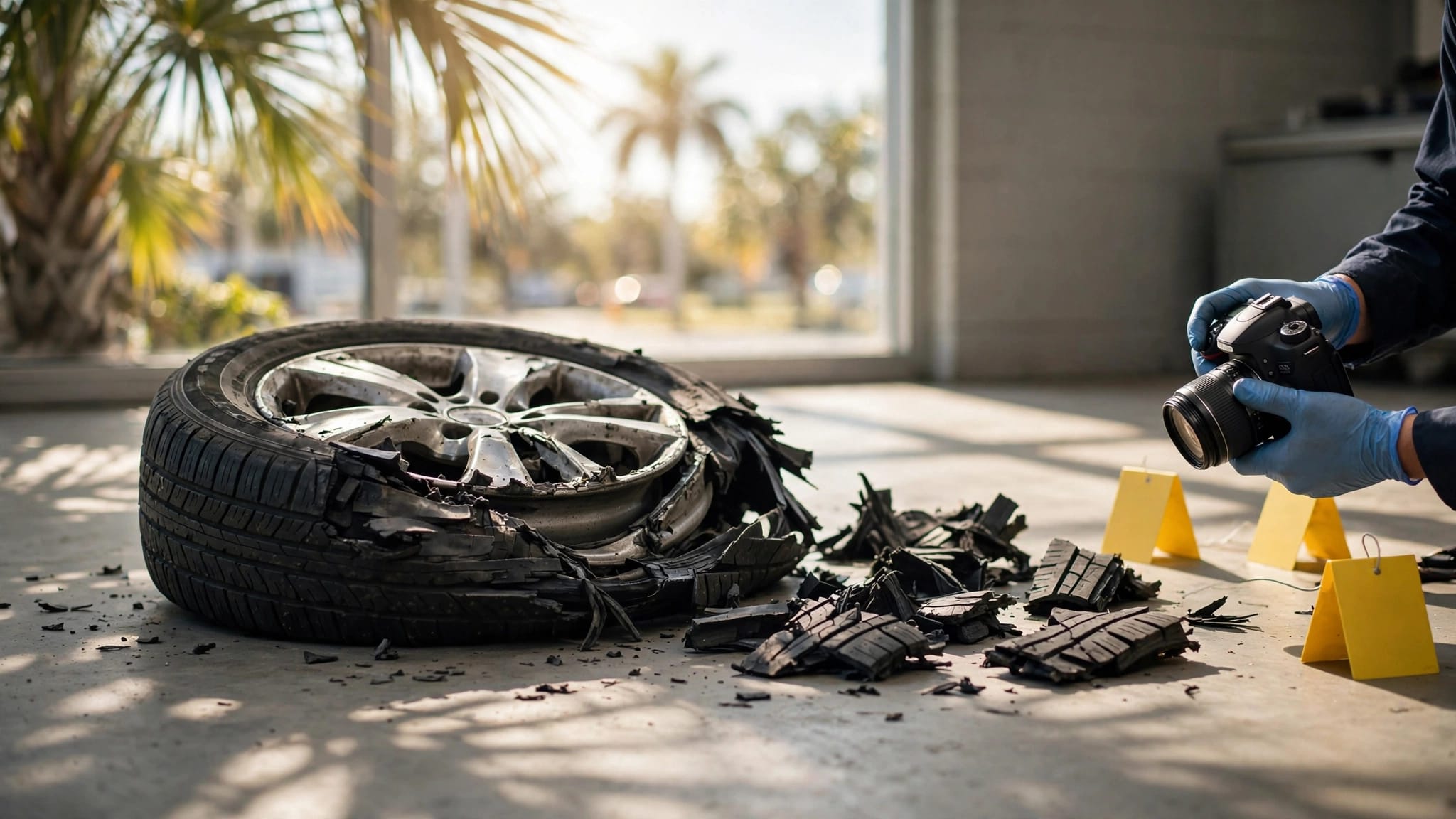
The failed tire can disappear before you leave the hospital, taking important crash evidence with it. Florida tire blowout claims often depend on whether investigators can examine the tire, wheel, and damage before repairs or salvage change them.
Your immediate priorities are medical care and safety, followed by preserving the evidence that may explain the failure. Start by finding the vehicle and identifying who controls it.
Key takeaways
- Keep the failed tire, wheel, detached tread, and other available fragments together with a documented handling history.
- Ask custodians in writing to preserve the evidence before repairs, disposal, or a return to the manufacturer.
- A blowout alone doesn’t prove a defect; maintenance records and expert examination help establish the cause.
- Confirm filing deadlines promptly because negligence and products-liability claims can follow different rules.
Why Florida tire blowout claims need the failed tire
A crash photograph may show shredded rubber without explaining why the tire failed. Physical examination can help distinguish a failure that caused the collision from damage the collision caused.
Several causes can produce similar damage
A tire can fail because of underinflation, excessive loading, impact damage, deterioration, an improper repair, or a product defect. Different causes may leave overlapping damage, particularly after the vehicle rolls over or strikes another object.
The National Highway Traffic Safety Administration’s tire safety guidance explains the importance of inflation, load limits, tire condition, and aging. Those factors also deserve attention during a crash investigation.
An investigator needs more than the remaining tread. The sidewalls, bead area where the tire meets the wheel, interior surfaces, and wheel condition may contain useful evidence.
The sequence determines responsibility
The investigation must address whether the tire failed before impact and contributed to the crash. A damaged tire found afterward doesn’t establish that sequence.
Witness observations, dashcam recordings, roadway marks, and vehicle damage can help connect the failure to the loss of control. Preserve factual observations, such as a warning light or vibration, without guessing about the mechanical cause.
Secure the tire before repairs or salvage
Find out where the vehicle went after towing. Record the custodian’s name, contact information, storage address, and any scheduled repair or salvage activity.
Send a clear written preservation request
Promptly ask the tow yard, repair shop, insurer, or salvage operator to hold the failed tire, wheel, vehicle, and available fragments. Identify the vehicle using its VIN and claim number when available.
Request that nobody discard, clean, cut, repair, dismount, or otherwise alter the tire assembly before an inspection plan is arranged. Also ask the custodian to retain photographs and handling records.
Keep copies of your messages and request written confirmation. A preservation request documents notice, but it doesn’t guarantee compliance. Follow up and address storage charges promptly while counsel considers inspection or transfer.
A totaled vehicle may still contain important evidence. Avard Law Offices’ discussion of preserving wreckage after a rollover addresses why disposal deserves attention before the investigation ends.
Keep a record of every transfer
Leave the tire mounted on its wheel when practical, unless a qualified examiner arranges otherwise. Avoid unnecessary handling and protect the evidence from weather and further damage.
If transfer becomes necessary, document who released it, who received it, the date, and its condition. Keep detached pieces identifiable without marking fracture surfaces or other examination areas.
Before accepting a replacement tire or warranty return, confirm where the failed tire will go and whether it will remain available for inspection.
Photograph the tire and the surrounding evidence
Photographs supplement the physical evidence. They don’t replace an examination, particularly when internal damage or separated components matter.
Capture identifying marks and condition
If access is safe, photograph both sidewalls, the tread, exposed cords, detached pieces, and wheel damage. Include wide views showing the tire’s position on the vehicle, then take close photographs.
Record the brand, model, size, and full Tire Identification Number, or TIN. On modern tires, the last four digits identify the manufacturing week and year. NHTSA’s tire identification requirements describe required TIN placement for applicable tires.
Save original files with their date information intact. Don’t rely solely on screenshots or compressed copies sent through social media.
Connect the tire to the crash scene
Photograph roadway marks, debris locations, shoulder conditions, nearby hazards, and the vehicle’s final position from a safe location. Never enter traffic or approach unstable wreckage to collect evidence.
Also photograph the other tires, vehicle loading, dashboard warnings, and visible damage when possible. An examiner may need that context to evaluate competing explanations.
A pressure reading taken after the crash doesn’t establish the tire’s pressure beforehand. Preserve earlier service records and warning information instead of drawing conclusions from a damaged assembly.
Arrange an inspection before anyone changes the tire
A qualified tire examiner can document the assembly and evaluate possible failure mechanisms. Accident reconstruction may also be necessary to determine how the failure affected the vehicle’s movement.
An attorney can coordinate access and discuss a documented inspection protocol with the parties who need to examine the evidence. Initial work commonly includes photography, measurements, and other nondestructive examination.
Destructive testing needs separate planning. Cutting into a tire or removing samples can change evidence another examiner needs. Counsel should address notice, access, documentation, and sample retention before that work begins.
A manufacturer’s or insurer’s inspection may provide useful information, but it doesn’t eliminate the need to preserve independent access. Ask who will inspect the tire, what procedures they propose, and whether they will retain it afterward.
Keep inspection reports, photographs, shipping documents, and correspondence. If someone already altered the tire, document exactly what happened. Don’t assume the remaining evidence has no value or attempt to restore its original condition yourself.
Collect records that explain the tire’s history
The failed tire is central, but records help establish its condition before the crash and connect the evidence to the collision.
Maintenance and commercial records
Keep the purchase receipt, installation invoice, warranty materials, rotation records, repair invoices, and earlier inspection reports. Write down when you first noticed vibration, pressure loss, unusual wear, or dashboard warnings.
For a commercial vehicle, relevant records may include inspection logs, maintenance files, loading documents, dispatch information, and GPS records. These can help identify who controlled the vehicle and whether a problem existed before the crash.
If another vehicle shed tire debris, preserve identifying details and witness contacts. The evidence questions differ, as explained in Avard Law Offices’ discussion of Florida road debris crash evidence.
Crash reports, video, and vehicle data
Use FLHSMV’s crash report information to obtain the official report. Compare its narrative, vehicle descriptions, and diagram against photographs and witness accounts.
A report doesn’t decide civil liability. Avard Law Offices’ guidance on crash claims without police reports explains why other evidence still matters.
Preserve original dashcam files and request nearby recordings promptly. Depending on the vehicle and event, electronic data may document speed, braking, or throttle activity. Arrange qualified retrieval before repairs or salvage restrict access.
Identify responsible parties and filing deadlines
A preservation plan protects the investigation while counsel evaluates legal responsibility. The responsible party may be a manufacturer, seller, repair business, vehicle owner, commercial operator, or driver, depending on the evidence.
Fault requires proof of conduct and causation
A product claim needs evidence supporting the alleged defect and its connection to the injuries. A maintenance claim may depend on inspection failures, improper repairs, or ignored warning signs.
Florida’s comparative-fault statute includes products-liability actions within its negligence-action framework. Under the current rule, a claimant more than 50% responsible for their own harm generally cannot recover in a covered action.
A lower fault percentage can reduce damages. Preserve maintenance records and driving evidence rather than accepting an unsupported allegation that you caused the failure.
Different claims can have different clocks
Under Florida Statutes section 95.11, actions founded on negligence generally have a two-year filing period. The statute separately places products-liability actions in a four-year category.
Product claims can also face statutes of repose, which impose outside limits tied to product delivery and other statutory conditions. Don’t assume every tire claim has the same deadline.
Have counsel identify the applicable claims and dates early. Settlement discussions don’t automatically extend the filing period, and preserving evidence shouldn’t wait for negotiations.
Protect your medical claim while the investigation proceeds
Seek medical care promptly and describe the collision and symptoms accurately. Don’t postpone treatment while waiting for a tire examination or a liability decision.
For available Florida Personal Injury Protection benefits, initial qualifying treatment generally must begin within 14 days. PIP doesn’t determine responsibility for the crash or the full value of an injury claim.
Keep discharge papers, diagnostic results, prescriptions, therapy records, bills, and work restrictions. Employment records can support lost-income claims, while treatment records help connect your limitations to the collision.
When contacting an attorney, provide the crash date, towing information, vehicle location, insurance correspondence, photographs, and available medical records. Flag any planned repairs, tire return, inspection, or salvage pickup.
A case evaluation with Avard Law Offices can help identify preservation needs, potential claims, insurance issues, and filing deadlines. You don’t need a completed investigation before seeking help.
Frequently asked questions
What if the shop already threw away the tire?
Ask when it was discarded, who handled it, and whether photographs, inspection notes, or fragments remain. Contact counsel promptly about other evidence. A missing tire can make proving the cause harder, but it doesn’t automatically resolve every potential claim.
Should I send the tire to the manufacturer?
Arrange legal review first. A warranty return or manufacturer inspection can transfer control of important evidence. Clarify the inspection procedures, retention arrangements, and independent access before shipping it.
Can I repair the vehicle while keeping the tire?
Sometimes, but the wheel, suspension, other tires, and vehicle data may also matter. Ask counsel about documenting and inspecting the vehicle before authorizing work.
Does a blowout mean the tire was defective?
No. Failure can result from several causes. Physical examination, maintenance records, and crash reconstruction help determine whether a defect contributed to the collision.
Preserve the evidence before it disappears
The failed tire may explain a crash in ways photographs and statements cannot. Protect the assembly, document its handling, and arrange inspection before repairs or disposal change the evidence.
For Florida tire blowout claims, early preservation gives the investigation a stronger factual foundation. Prompt legal review can address the evidence and deadlines while you focus on medical recovery.