
Florida Hydroplaning Claims: Tire Evidence and Fault
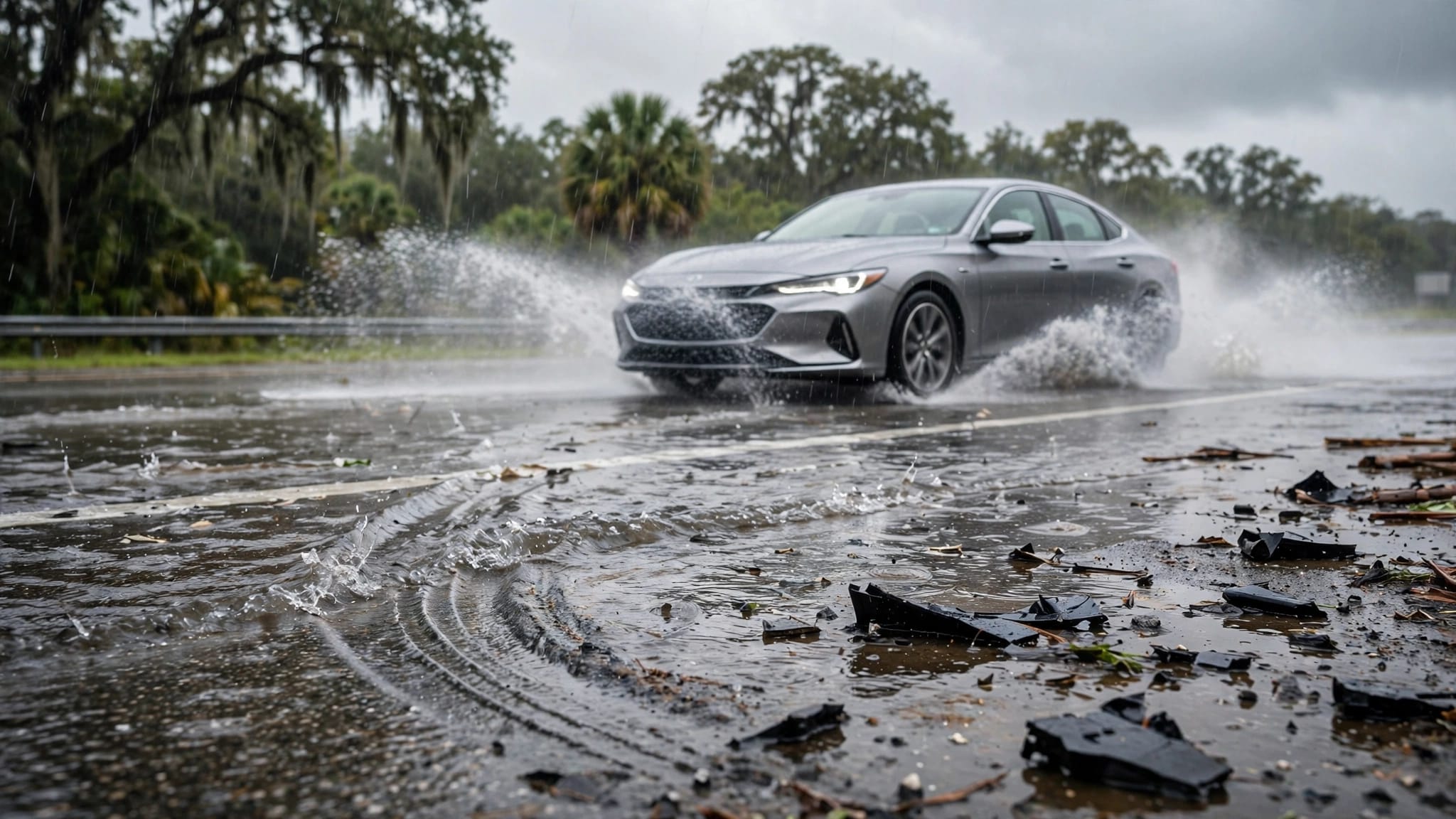
A sudden slide across rain-soaked pavement can turn a routine Florida drive into a serious crash within seconds. Yet Florida hydroplaning claims require more than proof of rain or a sudden loss of control.
Weather-related crashes still require examining driver conduct, tire condition, roadway hazards, and causation. Depending on the facts, responsibility may involve a driver, vehicle owner or employer, tire manufacturer, or government entity responsible for the roadway.
Tire condition, roadway water, vehicle data, and impact sequence can clarify what happened. No single item automatically establishes fault, and an insurer’s initial characterization doesn’t decide the claim.
How Florida hydroplaning claims establish negligence
Hydroplaning occurs when standing water separates a tire from the pavement. The tire loses its ability to channel water away, so steering, braking, and acceleration can change without warning.
Whether that water accumulation was foreseeable or avoidable depends on drainage, rainfall, and other roadway conditions. Rain does not excuse unsafe driving. Florida drivers must use reasonable care for actual road conditions. When driving in the rain, especially during heavy rainfall, drivers may need to reduce speed below the posted limit, increase following distance, avoid abrupt lane changes, and use tires capable of gripping wet pavement.
The Florida Driver License Handbook warns drivers that hydroplaning happens when tires ride on a layer of water rather than the road surface. It also advises drivers to avoid cruise control in rain on wet roads. That guidance doesn’t by itself determine civil liability.
A loss of control is not automatic proof of fault
Hydroplaning does not automatically establish negligence. Evidence must show that a party failed to use reasonable care under the circumstances. An unexpected hazard, another driver’s maneuver, a mechanical defect, or a roadway defect may have caused the crash.
The relationship between speed and hydroplaning depends on rainfall intensity, tire condition, and roadway depth. No particular speed automatically establishes fault. Evidence of unsuitable speed, short following distance, unsafe lane movement, or ignored visible conditions may support a negligence finding. That evidence may justify describing the person as a negligent driver, but reckless driving requires additional facts and a higher level of misconduct. Hydroplaning alone doesn’t establish either label.
Cruise control can make recovery harder because the driver may react more slowly. When traction returns, the system may also apply power to restore the set speed at the wrong moment.
Other parties may share responsibility
The hydroplaning vehicle’s driver is only one possible defendant. Other claims may involve the parties below, but each theory requires different proof:
- A driver who forced another vehicle into pooled water or cut across its lane.
- An employer whose commercial vehicle had unsafe tires or poor maintenance, when evidence supports a duty or responsibility for those conditions.
- A rental company or vehicle owner that knew or should’ve known about a problem and failed to repair it.
- A tire or vehicle manufacturer when a defect caused the tread to separate or the tire to fail, with proof of the defect and causation.
- A road contractor or government entity responsible for a dangerous drainage condition, subject to applicable duty, notice, and immunity rules.
A close review of how fault is determined after a Florida hydroplaning crash can help identify facts that an initial police report may not capture.
Tire tread evidence in Florida hydroplaning claims
Tire tread evidence is often the physical proof that changes a disputed case, but it doesn’t establish causation by itself. Grooves in the tread move water away from the tire’s contact patch. As the tread wears down, the tire sheds less water and traction drops sooner, especially in standing water.
A tire at or below 2/32 of an inch has reached a commonly used tread-wear reference, and its built-in wear bars may sit level with the tread. That measurement isn’t a blanket Florida negligence rule or automatic proof that the tire caused the crash. On a dry road, danger may not be obvious, but lost tread can become important evidence in hard rain.
Preserve the tires before repairs begin
Do not allow a repair shop, salvage yard, insurer, or towing company to discard the vehicle or tires before they are documented. A damaged tire may show uneven wear, exposed belts, tread separation, puncture damage, or a manufacturing issue.
Photograph every tire, including the sidewalls, tread surface, wheel position, and tire identification number. Take wide photos that show the vehicle, then close images that preserve detail.
An inspection should measure tire tread depth at multiple points across each tire and around its circumference. Records should identify the gauge used, the person taking the measurements, and the date. Because crash damage can alter a tire after impact, the inspection should not assume those measurements reflect its pre-collision condition.
A post-crash tire replacement can erase evidence about whether the tire could safely displace water before the collision.
Maintenance records can counter shifting blame
Vehicle maintenance records may counter an insurer’s claim that an injured driver ignored bald tires or underinflated tires. Service invoices, tire purchase records, inspection reports, and alignment records can confirm or rebut that allegation. If post-crash tire pressure evidence remains reliable, preserve it for inspection rather than treating it as conclusive.
On the other hand, a commercial fleet’s maintenance logs may reveal overdue tire replacement or repeated complaints about a vehicle. Those records may support a claim involving the employer’s fleet-maintenance responsibility. For a potential tire-manufacturer defect, preserving the actual tire is far more useful than relying on photographs alone.
Tire condition does not decide every case. A driver can hydroplane on good tires when water pools across several lanes. Tire age, inflation, impact damage, road water, speed, and expert analysis may all affect causation. Worn tread can support an argument that a driver or vehicle owner failed to use reasonable care, but it doesn’t prove the tire caused the crash.
Build the record at the crash scene
Standing water disappears, skid marks fade, and damaged vehicles move quickly. Water accumulation can change before investigators arrive. Evidence collected in the first hours may help document lane conditions, drainage inlets, and impact locations.
If you can do so safely, photograph the road from several angles. Include puddles, lane markings, nearby storm drains, construction zones, warning signs, vehicle positions, tire marks, and weather conditions. Video can show the depth and spread of the water. Photos, video, and agency records may also document recurring water accumulation.
Evidence that shows the sequence of events
A traffic crash report is useful, but it is not the final word on liability. Officers often arrive after vehicles have been moved and rain has changed the scene.
Other evidence may provide a clearer timeline:
- Dashcam footage can show speed, brake lights, lane movement, and standing water before impact.
- Nearby business or traffic-camera video may capture the collision or roadway conditions.
- Witnesses can describe whether a vehicle was speeding, drifting, or forced into another lane.
- Vehicle event data recorders may preserve speed, braking, throttle, and steering information.
- Cell phone records may matter if distraction played a role before the driver lost control.
- Vehicle inspections may document tire condition, damage, and other physical evidence.
Each source has limitations, so photographs, video, witnesses, inspections, event data, phone records, and the traffic crash report should be evaluated together.
In a serious collision, an attorney can send preservation notices when another driver, trucking company, insurer, or public entity may control evidence.
Multi-car crashes require impact-by-impact analysis
A chain-reaction crash should not be treated as one event with one at-fault driver. The first collision may have resulted from hydroplaning, while later collisions may involve following drivers who had enough time or space to stop.
Damage patterns, vehicle positions, airbag-control-module data, and witness accounts help separate those impacts. Accident reconstruction may also help determine how the first loss of traction led to later impacts. This analysis also matters medically. An occupant may suffer a new injury in a second or third impact, even if the first collision caused limited damage.
Comparative fault can change compensation
For causes of action accruing on or after March 24, 2023, Florida generally applies modified comparative negligence in negligence actions governed by section 768.81. Under Florida’s comparative-fault statute, a claimant found 50 percent or less at fault may recover damages reduced in proportion to that fault, subject to the statute’s scope and any applicable exceptions.
A claimant found more than 50 percent at fault generally may not recover damages in that negligence action. The rule can make tire tread, speed, and driving decisions central issues in Florida hydroplaning claims.
Percentages matter more than broad accusations
Illustration: If a jury values losses at $200,000 and assigns the injured driver 25 percent fault for excessive speed in heavy rain, the award would be reduced by $50,000.
If the same driver is assigned 51 percent fault, recovery generally would be barred under the rule. Insurance companies know fault percentages affect the outcome, so they may focus on statements such as “I lost control” while overlooking a drainage failure or another driver’s conduct.
That evidence can affect liability for accident-related injuries and losses. Florida’s 51% comparative fault rule shows why careful evidence preservation matters when weather and driver conduct are disputed.
PIP is separate from the fault dispute
Florida personal injury protection (PIP) coverage generally pays certain benefits without regard to fault. Under the current Florida PIP statute, covered individuals generally must receive initial services and care within 14 days of the crash to seek PIP medical benefits, subject to statutory conditions.
PIP generally pays 80 percent of covered, medically necessary medical expenses and 60 percent of lost gross income, subject to statutory conditions, coverage limits, and policy terms. It doesn’t resolve a third-party liability claim for pain, suffering, future care, or losses beyond available benefits.
Prompt medical care protects both your health and the record linking injuries to the crash.
Claims involving poor road drainage
Some Florida roads develop hazards from clogged inlets, deep ruts, poor grading, construction runoff, maintenance failures, or water accumulation. Rain alone and a crash don’t prove a dangerous roadway condition. A government agency may control the roadway, but poor road conditions alone don’t establish a claim without proof of control, notice, causation, and applicable immunity rules.
The claim must connect the road drainage defect and standing water to the collision and show required notice or knowledge. Photos of recurring water accumulation, maintenance records, prior complaints, engineering documents, and evidence of agency knowledge may matter.
Government claims have separate rules and limits
Florida’s sovereign-immunity law creates procedural requirements that differ from an ordinary negligence case. Under the state and local government claim statute, written notice generally must reach the appropriate agency within three years after the claim accrues.
For claims against most state agencies, notice must also go to the Florida Department of Financial Services. That additional notice generally isn’t required for a municipality or county. A lawsuit generally must be filed within four years, while wrongful death claims generally have two-year notice and filing deadlines.
The statute generally caps recovery at $200,000 per person and $300,000 for all claims arising from one incident. Punitive damages and prejudgment interest aren’t available against the government under this law.
Government defendants may argue that roadway design involved protected planning decisions. Yet failures in maintenance, drainage operation, or responses to known hazards can present different legal issues. Public-entity claims have special procedural rules and should be reviewed promptly by qualified counsel. Early investigation can preserve maintenance, warning, and roadway safety evidence before roadwork or storm cleanup changes the scene.
Steps to take after a hydroplaning crash
After a hydroplaning accident, your first priorities are safety and medical care. Move to a safe area if possible, call 911, and accept an evaluation for pain, dizziness, numbness, or other symptoms.
Then protect information while it’s still available:
- Report the crash and request the report number, even if rain makes the scene confusing.
- Photograph the roadway, water accumulation and pooled water, drains, lane markings, changing weather conditions, vehicle damage, tires, and visible injuries.
- Get contact information from witnesses and ask whether they have dashcam footage.
- Seek medical care within 14 days when possible. Under Florida Statutes section 627.736(1)(a), this generally affects eligibility for personal injury protection benefits, not a universal deadline for filing every injury claim. Follow through with recommended treatment.
- Avoid recorded statements or broad medical releases requested by another driver’s insurer before you understand the claim.
- Keep the damaged vehicle and tires available for inspection until liability is evaluated.
If injuries, multiple vehicles, commercial transportation, defective tires, or roadway maintenance may be involved, consider qualified Florida legal advice from a car accident lawyer. Legal representation may help preserve evidence and evaluate deadlines, but it can’t guarantee a particular result.
For causes of action accruing on or after March 24, 2023, Florida Statutes section 95.11(3)(a) generally provides a two-year deadline for negligence actions. Wrongful-death claims generally have a two-year period under section 95.11(4)(d), subject to accrual rules and exceptions. Claims involving government entities may require notice under section 768.28(6)(a), along with separate deadlines and exceptions. You can review Florida car accident lawsuit deadlines for general background, but the Florida Statutes control.
Frequently Asked Questions
Does hydroplaning automatically make a driver liable for a crash?
No. Hydroplaning alone doesn’t establish negligence, and liability depends on evidence about speed, following distance, lane movement, tire condition, roadway hazards, and other causes.
How can tire evidence affect a Florida hydroplaning claim?
Tread depth, inflation, uneven wear, tire age, and damage may help show whether a tire could safely displace water. Tire evidence doesn’t prove causation by itself, so the tires should be preserved and inspected with the roadway, vehicle data, and impact sequence.
Can another party share fault for a hydroplaning crash?
Yes. Depending on the evidence, responsibility may involve another driver, a vehicle owner or employer, a rental company, a tire or vehicle manufacturer, or a government entity responsible for roadway conditions. Each theory requires proof of a duty, a breach, causation, and any applicable procedural requirements.
Does Florida comparative fault apply to hydroplaning claims?
Generally, Florida’s modified comparative-negligence rule reduces damages according to a claimant’s assigned share of fault when the claimant is 50 percent or less at fault. A claimant found more than 50 percent at fault generally may not recover damages in that negligence action, subject to the statute’s scope and exceptions.
What should I do with the vehicle and tires after the crash?
Keep the vehicle and tires available for inspection, and photograph the tread, sidewalls, wheel positions, damage, and tire identification numbers. A repair shop, salvage yard, towing company, or insurer should not discard or replace them before the evidence is documented.
Final Thoughts
Hydroplaning may begin with rain, but liability often rests on choices and conditions that existed before the tires lost contact with the pavement. Speed, tread condition, vehicle or employer maintenance, roadway conditions, weather, water accumulation, and the impact sequence must be evaluated together.
Strong tire and roadway evidence gives a Florida injury claim something more reliable than competing memories after a frightening crash. That evidence can inform causation and allocation of fault, but it doesn’t automatically establish liability. The analysis may involve a negligent driver, vehicle owner or employer, tire or vehicle manufacturer, or government agency responsible for road maintenance.