
Florida Motorcycle Dooring Claims: Proving Fault
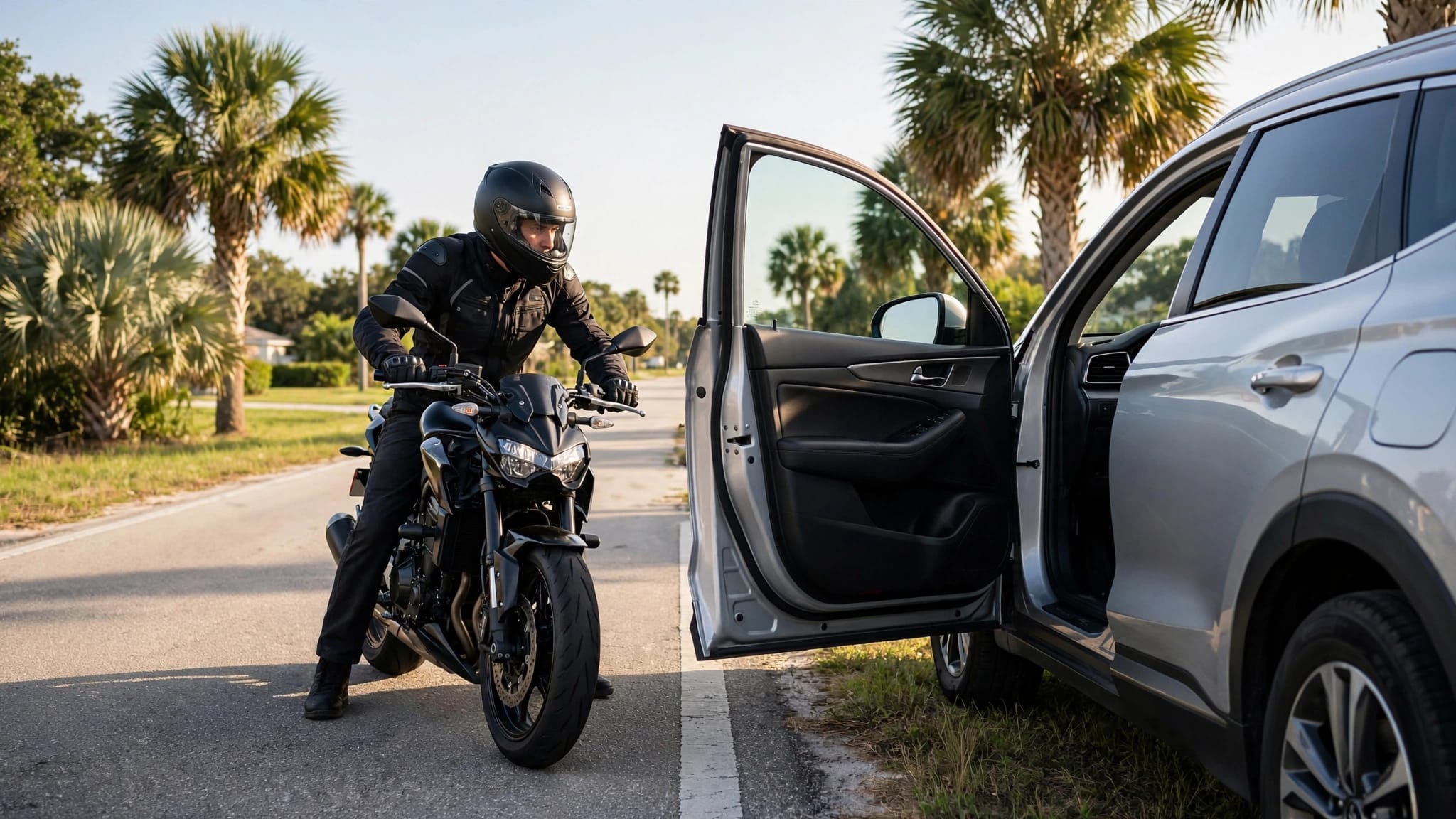
An opened car door can leave a motorcyclist with serious injuries before there’s time to brake. Florida motorcycle dooring claims often turn on a short timeline: when the door opened, where the motorcycle was, and whether the person opening it checked traffic.
If you’re facing medical bills and an insurer’s blame allegations, early evidence preservation matters. Start with the door-opening rule, then build a record that connects the unsafe act to your injuries.
What Florida Law Requires Before Opening a Car Door
Drivers and passengers must check for safety
Florida Statutes section 316.2005 prohibits opening a motor vehicle door until it’s reasonably safe and won’t interfere with other traffic. It also limits how long a traffic-side door may remain open for loading or unloading passengers.
The Florida vehicle-door safety rule applies to any person opening the door. Therefore, a passenger can breach the same duty as a driver.
Being parked doesn’t excuse someone from checking approaching traffic. The investigation should identify which occupant opened the door, which side it opened on, and how far it extended into the motorcycle’s path.
A violation supports the claim but doesn’t finish it
An unsafe door opening can support proof of negligence. However, the claim still needs evidence that the conduct caused the collision or evasive crash and resulting injuries.
A traffic citation doesn’t establish every element of a civil injury claim. Likewise, the absence of a citation doesn’t prevent you from presenting other evidence.
The driver’s statement, “I didn’t see the motorcycle,” deserves examination alongside sight lines and traffic conditions. Counsel should also investigate whether another person or entity bears responsibility, rather than assuming the door opener is the only potential defendant.
Preserve Evidence That Shows When the Door Opened
Photograph the scene and retain damaged equipment
After a crash, move to safety, request emergency help, and seek medical evaluation. If you’re able, photograph the scene without entering moving traffic.
Capture the door’s position, the parked vehicle, your motorcycle, lane markings, and nearby obstructions. Close photographs of the door edge, hinges, paint transfer, and motorcycle damage can help explain contact.
Also preserve your helmet, protective clothing, and damaged motorcycle parts. Don’t clean or alter them before counsel can assess their evidentiary value. If repairs are necessary, document the condition thoroughly first.
A missing police report creates additional work, but it doesn’t automatically defeat the claim. Avard Law Offices’ guidance on claims without a police report discusses other evidence that can support a collision investigation.
Seek video and independent witness accounts promptly
Nearby security cameras, dashcams, and helmet cameras may capture the opening sequence. However, recording systems can overwrite footage before an insurer completes its review.
Identify potential cameras and tell your attorney where they are. Counsel can request preservation of footage and other relevant records.
Get witnesses’ names and contact information. Their observations may establish whether the door opened suddenly or was already visible.
Keep original recordings with their metadata. Don’t replace them with edited clips or social-media uploads, which may omit the approach or aftermath.
How Shared Fault Affects Motorcycle Dooring Claims
Florida applies modified comparative negligence to most current injury cases. Under Florida’s comparative-fault statute, damages decrease by the injured person’s share of fault.
A 20% fault finding generally reduces recoverable damages by 20%. In a covered negligence action, someone found more than 50% responsible for their own harm cannot recover. Exactly 50% doesn’t cross that bar.
Test speed and lane-position allegations against evidence
An insurer may argue that you sped, passed too closely, or had enough time to avoid the door. Those allegations require facts about distance, visibility, door movement, and reaction time.
Florida generally prohibits riding a motorcycle between lanes or adjacent rows of vehicles. If lane splitting becomes an issue, counsel must evaluate your conduct alongside the door opener’s conduct.
An adjuster’s proposed percentage isn’t a court finding. Understanding Florida’s modified comparative negligence rule helps explain why unsupported blame deserves scrutiny.
Keep helmet questions tied to the particular injury
Helmet use presents a different question from whether someone opened a door unsafely. An insurer alleging that helmet nonuse worsened an injury needs evidence connecting that conduct to the claimed harm.
A broken wrist and a head injury require different medical analysis. Photographs, imaging, and physician opinions can help evaluate the allegation.
Reviewing helmet evidence in injury claims can help you separate collision responsibility from disputes about injury severity.
Identify Insurance Coverage Before Assuming Bills Are Covered
Liability insurance and UM coverage need separate review
The responsible person’s bodily injury liability coverage may pay supported injury losses. However, Florida doesn’t require every private driver to carry bodily injury liability coverage in every situation.
Request a coverage review rather than assuming insurance exists or is sufficient. The review should identify the door opener, vehicle owner, applicable policies, and any work-related use of the vehicle.
Uninsured or underinsured motorist coverage may provide another recovery source when the responsible party lacks sufficient insurance. Policy language, insured status, exclusions, and notice requirements matter.
Also distinguish bodily injury coverage from property-damage coverage. Payment for motorcycle repairs doesn’t settle your medical expenses or other injury losses.
Ordinary Florida PIP doesn’t automatically cover motorcycle riders
Florida’s PIP motor-vehicle definition generally requires four or more wheels. A two-wheel motorcycle doesn’t meet that definition.
Therefore, another driver’s fault doesn’t automatically give a motorcycle rider ordinary PIP benefits. Owning an insured car doesn’t, by itself, resolve that issue.
Health insurance, optional medical-payments coverage, and other applicable benefits may help address treatment costs. Each requires a separate review.
Avard Law Offices explains motorcycle injuries and PIP coverage in more detail. Don’t delay necessary care while waiting for the other insurer to accept liability.
Document Every Loss Connected to the Crash
A motorcycle dooring claim can include medical expenses, lost income, reduced earning capacity, and supported future treatment needs. Depending on the injuries and applicable law, compensation may also include pain, disability, and loss of enjoyment of life.
Keep bills, discharge instructions, imaging reports, prescriptions, and rehabilitation records together. Tell providers accurately how symptoms affect your work and daily activities.
For income losses, retain pay records and written work restrictions. Self-employed riders should preserve business records that show missed work and the resulting financial loss.
Future losses need support beyond an estimate. A physician’s treatment recommendations can clarify continuing care, while employment evidence can help establish lasting work limitations.
Also document motorcycle repair or replacement costs and damaged riding equipment. These property losses require their own proof.
Insurance limits can restrict what a policy pays even when the injuries are serious. Understanding Florida accident policy limits is useful when evaluating an offer.
An early settlement may require releasing future claims. Review the release and unresolved medical needs before accepting payment.
Protect the Filing Deadline While the Claim Is Investigated
For many Florida negligence claims accruing after March 24, 2023, the general lawsuit filing period is two years. The correct deadline depends on the accrual date, claim type, defendant, and applicable exceptions.
Older crashes and claims involving government entities can require different analysis. Don’t assume delayed symptoms restart the filing period.
An insurer can keep a claim file open after the lawsuit deadline passes. Settlement discussions don’t automatically stop the filing clock.
Early legal review gives counsel time to seek footage, inspect damage, identify witnesses, and examine coverage. Waiting until negotiations fail can leave little time for those tasks.
Be truthful when communicating with insurers, but don’t guess about speed, distance, or reaction time. Before giving the other party’s insurer a detailed recorded statement, consider legal advice. Your own policy may impose cooperation duties that also need attention.
An attorney can evaluate a denial, challenge unsupported fault allegations, and assess whether an offer accounts for documented losses. That review should happen before evidence disappears or filing time runs short.
Key Takeaways
- Florida’s door-opening rule applies to passengers as well as drivers.
- Video, door damage, witness accounts, and roadway photographs can establish the opening sequence.
- Shared fault can reduce compensation, and more than 50% fault generally bars recovery in covered negligence actions.
- Motorcycle riders shouldn’t assume ordinary PIP will pay their medical bills.
- An open insurance claim doesn’t preserve the right to file a lawsuit.
Frequently Asked Questions
Can I pursue a claim if I swerved and never hit the door?
Yes. Physical contact isn’t always necessary if an unsafe door opening caused an evasive crash. However, proving causation becomes especially important.
Video, witnesses, the motorcycle’s path, and the timing of the door movement can help connect the unsafe act to the fall. An unexplained loss of control creates a different evidentiary problem.
Who is responsible if a passenger opened the door?
The passenger may be responsible because Florida’s door-opening duty applies to any person. Liability doesn’t automatically fall entirely on the driver simply because the driver controlled the car.
Counsel should investigate the passenger’s conduct, any separate driver negligence, vehicle ownership, and applicable insurance. Identifying responsibility and finding coverage are related but separate tasks.
Do I need a traffic citation to make a claim?
No. A civil injury claim can rely on photographs, witness testimony, recordings, physical damage, and other evidence even without a citation.
The same principle applies when a crash report contains incomplete information. Preserve the report, identify errors, and collect supporting evidence rather than treating the initial account as the final decision.
Build the Claim Around the Door-Opening Timeline
A strong motorcycle dooring claim connects the unsafe opening to the crash, injuries, and financial losses. Preserved evidence gives you a basis to challenge blame and evaluate settlement offers.
Avard Law Offices offers free case evaluations for injured Floridians. Seek review early enough to investigate coverage and protect the filing deadline, before a brief door-opening incident becomes a difficult proof dispute.