
Florida Pedestrian Crosswalk Claims After a Driver Fails to Yield
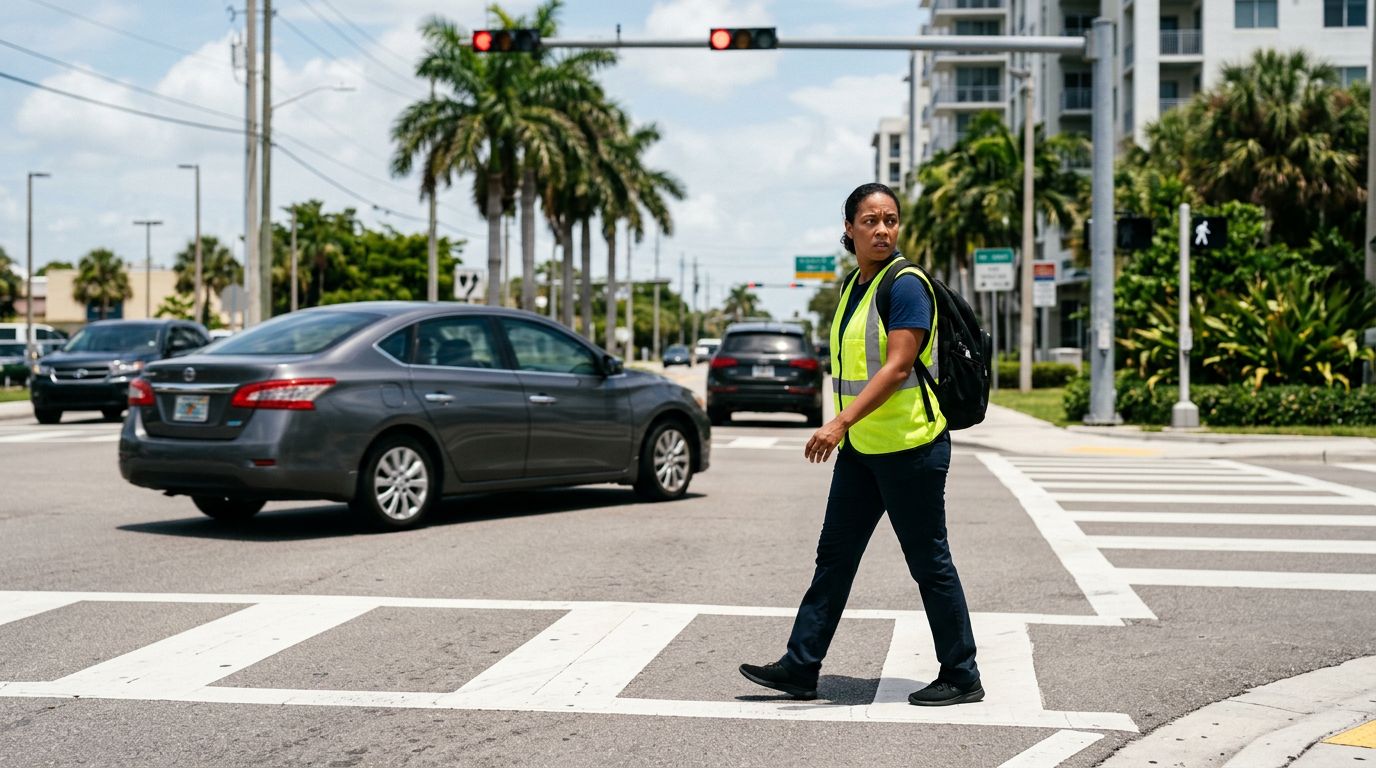
At a crosswalk, a few seconds can determine who gets home safely and who faces months of recovery. Florida pedestrian crosswalk claims often begin after a driver turns through a crossing, rolls past a stop line, or enters an intersection without yielding.
Florida law gives pedestrians important protections, but insurance companies still examine the signals, visibility, speed, distance, and pedestrian conduct. Evidence can disappear quickly. Knowing what the law requires and what proof matters can protect your claim before an adjuster controls the story.
How Florida pedestrian crosswalk claims are established
Most crosswalk injury cases rely on negligence. A successful claim generally requires proof that the driver owed you a duty of care, failed to act reasonably, caused the crash, and caused actual injuries or losses.
Every driver must watch the road, obey traffic controls, maintain a proper lookout, and respond to pedestrians. A driver who looks down at a phone, speeds through an intersection, turns without checking the crosswalk, or ignores a pedestrian signal may have breached that duty.
A traffic citation can support your case, but the citation isn’t required. Likewise, a driver who avoids a ticket may still face civil liability. The central issue is whether the driver’s conduct caused the collision and your injuries.
What Florida law requires at a crosswalk
Florida Statute 316.130 addresses pedestrian rights and driver responsibilities. The Florida pedestrian right-of-way statute requires drivers to yield when a pedestrian is in a crosswalk on the same half of the roadway, or is approaching from the opposite half closely enough to create danger.
At a signalized intersection, a driver must yield to a pedestrian crossing with a permitted signal. The driver may need to stop before the crosswalk and remain stopped while the pedestrian crosses.
Drivers also owe pedestrians a duty of care even when the situation doesn’t fit neatly into a marked-crosswalk rule. They must use reasonable care to avoid hitting someone who is walking in or near the roadway.
Florida law can recognize pedestrian crossings at intersections even when painted lines are absent. The location, traffic controls, sidewalks, lighting, and surrounding conditions may all affect the analysis.
When the pedestrian’s conduct becomes an issue
The right of way doesn’t allow a pedestrian to step suddenly from a curb into the path of a vehicle that is too close to stop. A person crossing outside a permitted location may also have a duty to yield to traffic.
Insurance companies often rely on these rules to argue that the pedestrian caused the crash. However, an accusation isn’t proof. Witness testimony, video, vehicle data, sight-distance measurements, and the physical evidence must support any fault percentage assigned to you.
Florida follows a modified comparative negligence rule. If you are found 50% or less responsible, your compensation is generally reduced by your percentage of fault. If you are more than 50% responsible, you may be barred from recovering damages.
For example, if a jury awards $100,000 but finds you 20% at fault, the award may be reduced to $80,000. That makes the evidence surrounding the crossing especially important.
Evidence that can prove a driver failed to yield
A crosswalk case often turns on what happened during a few seconds that no one remembers perfectly. Early evidence can fill in those gaps.
Useful evidence may include:
- Photos showing the crosswalk, traffic signals, stop line, lighting, signs, lane markings, and the driver’s approach.
- Video from traffic cameras, nearby businesses, homes, vehicles, or mobile phones.
- Names and contact information for people who saw the impact or watched the traffic signal.
- The crash report, 911 recordings, citations, photographs, and any available officer body-camera footage.
- Vehicle damage, skid marks, debris, clothing damage, and the final positions of the vehicle and pedestrian.
- Medical records that connect your injuries to the collision.
- Wage records, work schedules, disability notes, and other proof of lost income.
Surveillance systems may overwrite footage within days or weeks. Traffic signal records can also require a formal request. An attorney may send preservation letters before evidence is deleted or changed.
A driver’s claim that “the pedestrian came out of nowhere” carries less weight when video shows the person walking through a crosswalk under a permitted signal.
The signal timing and video evidence in pedestrian accidents can help establish whether you had permission to cross and whether the driver had enough time to stop. Video may also show a turn, lane change, distraction, or failure to slow down.
Your own statements matter as well. Avoid guessing about speed, distance, or the precise timing of the signal. Tell the truth, but explain when you don’t remember something. A mistaken estimate can later be presented as an admission.
Compensation available after a crosswalk injury
A pedestrian collision can cause immediate medical expenses and losses that continue long after the police leave. A personal injury claim may seek compensation for:
- Emergency treatment, hospital care, surgery, medication, imaging, rehabilitation, and follow-up visits.
- Future medical care when doctors expect continued treatment.
- Lost wages during recovery and reduced earning capacity after a lasting disability.
- Physical pain, emotional distress, scarring, disfigurement, and loss of normal activities.
- Damaged clothing, a phone, mobility equipment, or other personal property.
Some injuries appear worse over time. Head injuries, spinal damage, internal injuries, and fractures may require treatment that isn’t clear during the first emergency-room visit. Follow medical instructions and keep records of every appointment, prescription, restriction, and expense.
Florida’s no-fault insurance system can create a separate issue for an injured pedestrian. Depending on the household and available policies, personal injury protection benefits may be available through your own auto policy, a resident relative’s policy, or the insurer for the vehicle involved. PIP benefits don’t replace a liability claim against a negligent driver.
If the crash causes death, surviving family members may have a wrongful death claim. The damages and filing rules differ, so prompt legal advice matters.
Insurance claims, settlement pressure, and filing deadlines
The driver’s insurer may ask for a recorded statement, medical authorization, or quick settlement. Those requests can seem routine, but each one may affect the value of your claim. A broad medical release can expose unrelated records, while an early settlement may close the case before the full medical picture is known.
You should report the crash as required by applicable policies, but consider speaking with a Florida personal injury attorney before making detailed statements or signing a release. Don’t post photographs, comments, or accident theories on social media. Insurers may use those posts to challenge your injuries or version of events.
For a claim arising from an accident on or after March 24, 2023, Florida’s general deadline for filing a negligence-based personal injury lawsuit is generally two years from the crash date. Older accidents may fall under prior rules, and wrongful death claims generally have a two-year period measured from the date of death. Claims involving a government vehicle or public roadway may include separate notice requirements and shorter deadlines.
The deadline isn’t the only reason to act early. Witnesses move, businesses delete video, vehicles get repaired, and memories become less reliable. Early investigation gives your attorney a better chance to preserve the facts before fault arguments harden.
How an attorney can help with a crosswalk claim
A pedestrian injury attorney can investigate the collision independently instead of relying only on the driver’s account or the police report. That investigation may include obtaining camera footage, reviewing signal timing, inspecting the scene, locating witnesses, examining vehicle damage, and consulting accident-reconstruction or medical professionals when needed.
The attorney can also identify every potential source of compensation. The responsible party may include the driver, a vehicle owner, an employer, or an insurer. In some cases, a roadway condition or malfunctioning signal raises separate questions about a public entity, but those claims require careful review.
Your lawyer can handle communications with insurers, calculate present and future losses, challenge unfair comparative-fault allegations, and negotiate a settlement based on evidence. If the insurer refuses to offer fair compensation, filing a lawsuit may be necessary to protect your rights.
Bring the crash report, photographs, medical bills, insurance information, witness details, and any video or messages about the accident to a consultation. Even if you aren’t sure who had the right of way, those records can help clarify the case.
Conclusion
A driver who fails to yield at a Florida crosswalk may be responsible for the injuries that follow, but the outcome depends on proof. Signal records, video, witnesses, medical documentation, and an accurate account of the crossing can counter an insurer’s attempt to shift blame.
Because evidence disappears and the filing deadline may be two years for newer claims, don’t wait for the insurance company to investigate the crash on its terms. Strong Florida pedestrian crosswalk claims begin with prompt medical care, careful documentation, and a clear legal review of how the collision happened.