
Florida Slip and Fall Claims When an Owner Blames Your Shoes
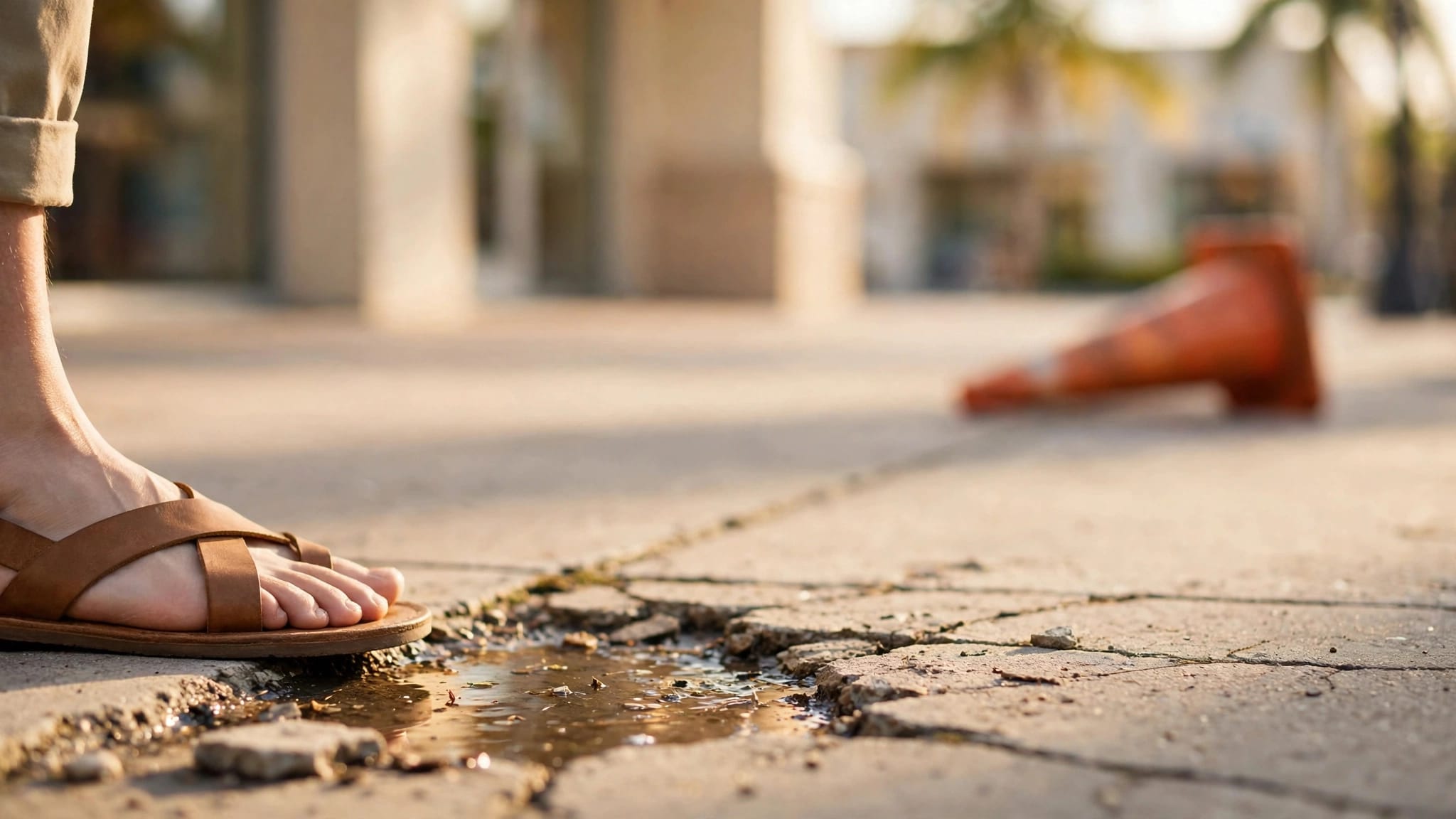
A property owner or insurer may argue that sandals, heels, flip-flops, worn soles, or wet sneakers caused your fall. That argument may overlook a spill, broken surface, or walkway defect that created a dangerous condition.
For Florida slip and fall claims, footwear is one fact in a broader causation and fault analysis. The result depends on the evidence, what caused the fall, who controlled the area, notice, how fault is assigned, and applicable law.
Acting quickly may help preserve evidence that can disappear within hours.
Key Takeaways
- Footwear may affect comparative fault, but sandals, heels, flip-flops, worn soles, or wet sneakers do not automatically eliminate a Florida slip and fall claim.
- A successful claim generally requires evidence of a dangerous condition, the responsible party’s duty and control, notice or constructive knowledge, a failure to act reasonably, and resulting injuries and losses.
- In store claims involving a transitory foreign substance, Florida Statute 768.0755 generally requires proof that the business had actual or constructive knowledge of the condition and failed to address it.
- Preserve the shoes, photograph the hazard, identify witnesses, request video and maintenance records, and obtain appropriate medical care promptly.
- Florida’s modified comparative negligence rule may reduce recovery based on assigned fault and may bar recovery when the claimant is more than 50 percent responsible; deadlines and additional notice rules may apply to public-property claims.
Why property owners focus on footwear after a fall
Shoes are visible, easy to photograph, and easy for an insurance company to criticize. A business may argue that high heels, smooth soles, loose flip-flops, or worn tread made the fall unavoidable.
However, people wear ordinary footwear in stores, hotels, restaurants, apartment buildings, and parking lots every day. A property owner cannot use a person’s shoe choice to excuse an unaddressed hazard.
Footwear may affect fault, not liability alone
The defense may claim your shoes contributed to the accident. Florida law generally treats that as a shared-fault issue, but it does not automatically eliminate a claim or establish that the fall was unavoidable. Evidence of property owner negligence may still show that the premises were not reasonably safe.
For example, a grocery store might argue that a shopper’s smooth-soled shoes contributed to a fall on spilled liquid. Video, witness accounts, or cleaning records may support an argument that the spill, rather than the footwear alone, caused the fall.
Keep the shoes you wore in their post-incident condition. Do not wash them, throw them away, or allow someone else to alter them. They may show the tread, damage, wetness, fit, and actual condition of the shoes, rather than a description from the defense.
The stated reason for the fall matters
A fall is not automatically a premises liability case. You must identify a dangerous condition that caused the injury. That condition might include a spill near an entrance, grease on a restaurant floor, an unmarked freshly mopped area, loose carpeting, a poor walking surface, poor lighting, a broken curb, or another maintenance problem.
The location also matters. A fall in a store, hotel, restaurant, apartment complex, or parking lot presents different proof than a fall on a cracked sidewalk. Control may belong to a tenant, landlord, management company, association, or government entity.
Florida slip and fall claims require proof of negligence
Under premises liability law, property owner negligence depends on who controlled the area. A successful claim must connect notice of an unsafe condition to a failure to act reasonably. An injury alone doesn’t establish negligence.
Usually, the evidence must show four basic points:
- The responsible defendant owed a legal obligation to use reasonable care. The defendant may be an owner, occupier, tenant, property manager, or another party with control.
- A dangerous condition existed on the property.
- The responsible party failed to repair it, remove it, or provide an adequate warning.
- That failure caused injuries and measurable losses.
A detailed review of Florida premises liability duty of care explains how control and notice affect the analysis. Ownership alone may not make a property owner responsible if another party controlled the location.
Your reason for being on the property affects the duty
A customer at a retail store, diner at a restaurant, hotel guest, or patient at a medical office is generally a business invitee. Businesses generally owe that visitor a duty of care. They must maintain reasonably safe premises and warn about hazards they know or should know about.
A social guest is commonly a licensee. Duties to a licensee may be more limited and depend on known hazards and the circumstances. Trespassers generally receive more limited protection, subject to recognized exceptions.
Labels don’t resolve every duty question. A leasing company may control a shopping center’s common walkway, while a store controls its own entry and floors. Lease agreements, maintenance contracts, inspection duties, and repair records may identify the party with control and responsibility for inspection, repair, and notice.
A warning sign is not always a complete defense
Businesses often rely on a yellow cone or wet-floor sign after a fall. The warning’s adequacy is fact-specific, including its visibility, placement, timing, and scope.
A sign may support a defense when it reasonably alerts visitors to the hazard. A small sign at one end of a broad, wet lobby may not alert visitors entering through another entrance.
Notice is often the deciding issue in a store fall
For a business-establishment claim involving a transitory foreign substance, Florida law places a distinct burden on the claimant. Under Florida Statute 768.0755, the claimant generally must prove the business had actual knowledge or, alternatively, constructive knowledge of the dangerous condition. The claimant must also show the business failed to address it.
These temporary hazards can include spilled drinks, tracked-in rainwater, food, detergent, or another short-lived substance. The statute applies to business establishments, so it may not govern every fall at a residence, on private property or a sidewalk, or on public property.
When the business knew about the hazard
Actual knowledge may exist when an employee saw the spill, created it, received a customer complaint, or inspected the area and left without correcting the problem.
An incident report can help, but it isn’t the only evidence. Eyewitness testimony may show someone saw the spill, warned staff, or observed employees pass the area. These facts can be more persuasive than a later statement that nobody knew what happened.
When the business should have known about the hazard
Constructive knowledge can be established under either of two statutory methods:
- The condition existed long enough that ordinary care should have led employees to discover it.
- The condition occurred regularly enough that it was foreseeable.
A puddle with track marks, dirt around its edges, or partially dried liquid may suggest the dangerous condition existed for some time. Those details aren’t conclusive by themselves. Repeated roof leaks in the same aisle, recurring rainwater at an entrance, or a history of similar spills may support foreseeability.
A shoe-blame defense does not replace the business’s notice problem. The evidence must still show whether the hazard was known or should have been found.
Notice evidence can support a broader property owner negligence theory, while maintenance records can reveal gaps in inspection practices. Cleaning log evidence in Florida premises cases explains how to compare these sources. Inspection logs, cleaning records, staffing information, and surveillance footage are most useful when compared rather than viewed in isolation.
Preserve evidence before the property owner controls the story
The hours after a slip and fall accident may determine whether useful proof survives. Stores may overwrite video. Rain can wash away the condition of an outdoor surface. Employees may clean the area before you leave.
Seek medical care first if you may have a head, neck, back, hip, or fracture injury. Urgent medical care takes priority over collecting evidence. Then document as much as your condition allows.
What to collect at the scene
If you can safely do so, gather the following information or ask a companion to help:
- Take wide and close-up photos of the dangerous condition, surrounding area, lighting, warning signs, your shoes, and visible injuries.
- Report the fall to a manager and ask for an incident report, or write down the report number and employee’s name.
- Get contact information from witnesses and record their contemporaneous observations for potential eyewitness testimony. Focus on what they saw, not assumptions about fault.
- Note the exact date, time, store entrance, aisle, room, or parking area where the fall happened.
- Save your shoes, clothing, receipts, medical paperwork, and messages about the accident. Don’t clean, repair, alter, or discard the footwear.
Photos should show scale and establish where the hazard was located. Include a shopping cart, floor tile pattern, doorway, or another reference point when possible. A close-up image of water alone may not identify where it was located.
Request video and records quickly
A written preservation request can ask the business to retain surveillance footage, inspection sheets, cleaning logs, incident reports, employee schedules, and repair records. The property owner, tenant, manager, or business may control those records. Send the request promptly because systems may overwrite older footage on a short cycle.
A preservation letter requests retention but doesn’t guarantee production. Formal discovery may be needed to obtain the records.
Don’t guess about the cause of your fall when completing an incident report. State only what you observed, such as, “I slipped on clear liquid near the produce section.” Don’t speculate, admit fault, or sign a broad release at the scene. The insurance company may rely on those statements later.
Medical records also matter. They document diagnoses, symptoms, restrictions, and recommended care, but they don’t guarantee causation or recovery. Prompt treatment supports a clear account of your symptoms and the care you needed. Gaps in treatment often give the insurance company room to argue that the injury came from another event.
How Florida’s modified comparative negligence rule changes the value of a claim
Florida generally applies this approach to negligence cases. The current version of Florida’s comparative-fault statute took effect March 24, 2023, and applies to causes of action accruing after March 23, 2023. Check the effective date and applicability before applying it to an older claim.
Under the current statute, Florida’s modified comparative negligence rule bars recovery when a claimant is more than 50 percent responsible for their own harm. The rule remains subject to applicable law and exceptions.
A claimant found 50 percent or less responsible generally receives damages reduced by that assigned percentage.
Simplified illustrations, not predictions:
| Total damages | Your assigned fault | Potential recovery |
|---|---|---|
| $100,000 | 20% | $80,000 |
| $100,000 | 50% | $50,000 |
| $100,000 | 51% | $0 |
In applying Florida’s modified comparative negligence rule, the factfinder compares all contributing conduct. It weighs footwear against the spill, lighting, warnings, inspection history, and distractions created by the business.
Footwear may influence comparative fault, but it isn’t a mathematical shortcut for the defense. Evidence of property owner negligence, including maintenance failures, notice issues, poor lighting, missing warnings, and inspection failures, may also affect the allocation.
Compensatory damages may include medical bills, future treatment, lost wages, reduced earning capacity, and pain and suffering. Self-employed losses or reduced earning capacity may require different proof.
Financial compensation depends on the injury, fault allocation, available insurance, and proof of how the fall changed your daily life. Review damages available in a Florida fall claim before relying on a quick slip and fall settlement offer. Compare it with documented medical needs, wage losses, fault allocation, insurance coverage, and future damages.
Deadlines and public property claims need early attention
For claims governed by current section 95.11(4)(a), Florida generally provides two years to file a negligence action. The current two-year negligence deadline is a statute of limitations, but the accrual date, applicable amendments, tolling rules, and other exceptions may change the analysis.
Waiting also weakens proof, and preserving evidence doesn’t replace filing a slip and fall lawsuit on time. Witnesses forget details, footage disappears, and a repaired defect becomes harder to document.
Falls at city, county, or state locations have added rules
Falls on government property, including public facilities, may involve sovereign immunity. Claims involving government property may concern a city, county, state agency, school district, courthouse, or another public entity. The applicable procedure may differ.
A claim subject to Florida Statute 768.28 generally requires written pre-suit notice. Notice usually must go to the appropriate agency. Except for a municipality, county, or other political subdivision, it must also go to the Florida Department of Financial Services.
Notice generally must be presented within three years after the claim accrues, subject to statutory exceptions and entity-specific rules. This presentation period is separate from the negligence filing period and doesn’t extend it. The appropriate agency, and when required, the Department of Financial Services, generally must deny the claim in writing. If no final disposition occurs within six months, the claim is generally treated as finally denied for filing purposes.
Government cases may also involve damages caps under section 768.28(5), exceptions, or a legislative claims bill. Identify the property owner and controlling entity because that information affects the notice and filing analysis for a personal injury claim. Not every claim involving public property follows the same process. Seek prompt advice from a personal injury lawyer when public entities, multiple defendants, serious injuries, or uncertain deadlines are involved.
Frequently Asked Questions
Can blaming my shoes defeat a Florida slip and fall claim?
No. Footwear may be considered when assigning comparative fault, but it does not automatically prove that the fall was unavoidable or eliminate evidence of a dangerous property condition.
What must I prove in a Florida slip and fall claim?
You generally must show that a responsible party controlled the area, a dangerous condition existed, and the party failed to repair it, remove it, or provide an adequate warning. You must also connect that failure to your injuries and measurable losses.
Does a business have to know about a spill before I can recover?
For many store claims involving a transitory foreign substance, Florida Statute 768.0755 generally requires proof of actual or constructive knowledge. Evidence may include employee observations, complaints, inspection practices, the length of time the spill existed, or recurring similar conditions.
What should I do with the shoes I wore when I fell?
Keep them in their post-incident condition and do not wash, repair, alter, or discard them. Photos and the shoes themselves may help show their tread, damage, wetness, fit, and actual condition.
How long do I have to file a Florida slip and fall lawsuit?
For claims governed by current section 95.11(4)(a), Florida generally provides two years to file a negligence action, subject to accrual rules, amendments, tolling, and other exceptions. Claims involving government property may also require earlier written pre-suit notice, so prompt legal review is important.
A shoe-blame argument deserves a fact-based response
Florida slip and fall claims don’t disappear because an insurance company questions your shoes. The issue is whether the footwear contributed to the fall and how that compares with the owner’s conduct.
Save the shoes, document the hazard, request preservation of relevant records, and obtain appropriate medical care without delay. The strongest response to blame is evidence showing what happened before, during, and after the fall.
You may wish to discuss the facts, deadlines, and available evidence with a personal injury lawyer. This article provides general legal information. Results depend on the facts and applicable law. Reading it or requesting information doesn’t create an attorney-client relationship.