
Florida U-Turn Crash Claims: Evidence That Proves Fault
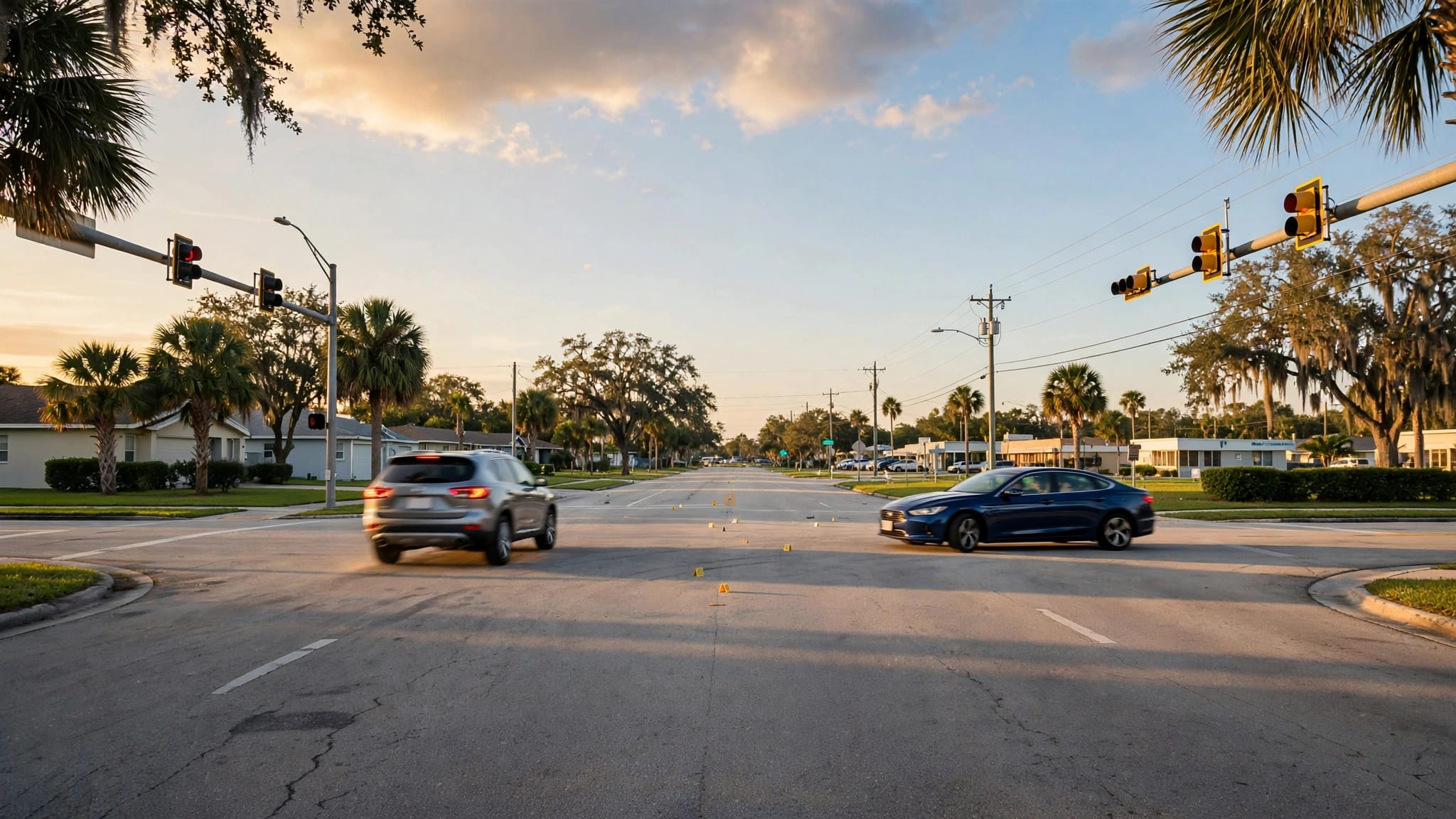
A U-turn can happen in seconds, yet the resulting crash can leave drivers with injuries, medical bills, and competing stories about what occurred. Florida U-turn crash claims often turn on one question: did the turning driver have a safe, clear path before crossing traffic?
The driver making a U-turn may carry significant responsibility, but fault isn’t automatic. Speed, visibility, traffic signals, lane position, and the actions of the other driver can all affect the outcome.
Strong evidence preserves the facts before an insurer turns a brief collision into a dispute over blame.
Florida U-turn crash claims start with the safe-turn rule
Florida permits U-turns in many places, but the movement must be safe. A driver cannot turn around where a sign prohibits it or when the maneuver interferes with approaching traffic.
The controlling rule appears in Florida Statutes section 316.1515. It requires a driver to make the turn in safety and without interfering with other traffic. A violation is a moving traffic infraction, and it can support a negligence claim after a collision.
A U-turn is not automatically illegal
Many Florida roads have medians, center turn lanes, or wide intersections where U-turns are common. The absence of a “No U-turn” sign does not give a driver an unlimited right to cross lanes.
A lawful U-turn still requires a safe gap. The driver must judge the speed and distance of oncoming vehicles, move from a proper lane, and complete the maneuver without forcing another motorist to brake or swerve.
For example, a driver may make a U-turn from a designated opening but still cause a crash by pulling across an oncoming vehicle’s path too late. The legal issue is the safety of that moment, not merely the presence of a median opening.
Signs and lane markings can change the case
Photograph every nearby sign, pavement arrow, lane divider, and traffic signal after a crash, if you can do so safely. A visible “No U-turn” sign provides direct proof that the turning driver ignored a traffic control device.
Lane markings also matter. A driver who begins the turn from an outside travel lane rather than a proper turn lane may have created the danger. The broader Florida traffic rules in Chapter 316 also address how drivers must approach and complete turning movements.
Negligence depends on the full sequence of events
A successful injury claim must show more than that a crash happened. The injured person must establish that another driver owed a duty of reasonable care, breached that duty, and caused injuries and losses.
Every driver has a duty to watch the road, obey traffic laws, use signals when required, and avoid unsafe movements. A U-turn accident often involves a breach of that duty when a driver crosses active lanes without enough time or space.
Right of way often controls the dispute
The through driver usually has the right to continue in a travel lane. A motorist attempting a U-turn generally must yield until the roadway is clear.
Still, insurers often look for reasons to shift blame. They may claim the through driver was speeding, distracted, following too closely, or failed to react. Those arguments gain traction when there is no video, no independent witness, and no clear record of where the vehicles met.
The point of impact can answer many of those questions. Front-end damage to the through vehicle and side damage to the turning vehicle may support the account that the U-turn driver entered traffic abruptly. Rear-quarter damage may suggest the turning car had nearly completed the maneuver, although damage patterns must be assessed with the roadway layout and other proof.
A ticket helps, but it does not decide civil liability
A citation for an unsafe U-turn can strengthen a claim. It records an officer’s initial view that the driver violated a traffic rule. However, insurers and courts consider all available evidence.
A crash report may contain an incomplete diagram or miss an important witness. Officers often arrive after the vehicles have moved, and they may not see a camera angle that later becomes available. For that reason, a citation should support a larger evidence file, not replace one.
A disputed U-turn case becomes stronger when video, vehicle damage, road markings, and independent testimony point to the same sequence of events.
Evidence that can prove an unsafe U-turn
Evidence disappears quickly after a roadside collision. Vehicles get repaired, debris gets cleared, and private surveillance footage may be overwritten within days. Early action protects proof that cannot be recreated later.
For a closer look at the physical proof that often decides these cases, review video and lane evidence in U-turn crashes.
Video can show timing, gaps, and lane position
Dashcam footage is often the clearest record of a U-turn collision. It can show whether the turning driver paused, used a signal, crossed multiple lanes, or moved into an oncoming vehicle’s path.
Nearby businesses, gas stations, apartment complexes, and public intersections may have cameras facing the road. Ask promptly whether footage exists, then request preservation in writing. A business may overwrite video before an insurance adjuster ever asks for it.
Phone video taken after the impact also has value. It can capture vehicle positions, traffic congestion, weather, blocked sightlines, and road signs. Keep the original file whenever possible because screenshots may omit time data and other details.
The scene itself can tell a consistent story
Photos should capture each vehicle from several angles before repairs begin. Include damage, tire marks, broken parts, debris fields, roadway markings, and the distance to nearby signals or median openings.
The most useful evidence answers a specific factual question:
| Evidence | What it may show |
|---|---|
| Dashcam or traffic video | The driver’s turn path, vehicle speed, and available gap |
| Damage photographs | The point and angle of impact |
| Road signs and pavement markings | Whether the U-turn was prohibited or made from an improper lane |
| Witness contact information | An independent account of the vehicles before impact |
| Vehicle data and repair records | Braking, impact force, and the consistency of damage |
Witnesses are most helpful when they saw the events before the crash. A person who only heard the impact may still confirm traffic conditions, but may not know which driver entered the lane first.
Medical records connect the crash to your injuries
Liability evidence establishes how the collision occurred. Medical documentation establishes what it did to you. Both parts matter in Florida U-turn crash claims.
Get evaluated promptly after a crash, especially if you have pain, dizziness, headaches, numbness, or limited movement. Adrenaline can mask symptoms at the scene, and some soft-tissue or head injuries become more apparent over the next several hours or days.
Consistent records protect the value of a claim
Tell medical providers how the collision happened and describe all symptoms accurately. Follow recommended care, keep appointments, and save receipts for prescriptions, co-pays, medical devices, and transportation to treatment.
Gaps in care give insurers room to argue that an injury came from a later event or was less serious than claimed. That does not mean every delay defeats a case. It means the reason for the delay should be documented honestly.
Lost-income proof matters too. Pay stubs, tax records, employer letters, and missed-work records can establish wage losses. Serious injuries may also require evidence about future treatment or reduced earning ability.
Shared fault can reduce or bar recovery
Florida uses a modified comparative negligence rule in most negligence cases. A claimant’s compensation may be reduced by that person’s percentage of fault. If the claimant is more than 50 percent responsible, recovery is generally barred.
This makes the defense version of events important. Even when another driver made an unsafe U-turn, an insurer may argue that you could have avoided the collision.
Common insurer arguments after a U-turn accident
Insurers may claim that the through driver traveled too fast for conditions, used a phone, failed to keep a proper lookout, or had enough room to brake. They may also say the U-turn driver had completed the turn and was already traveling lawfully when the crash occurred.
Objective evidence can counter those arguments. Video may show the short time available to react. Vehicle data may reveal braking. Witness testimony can establish that the U-turn vehicle suddenly crossed the lane.
Understanding Florida’s modified comparative negligence rule is important before accepting an insurer’s early fault assessment. A percentage of blame can significantly affect a settlement offer.
Be careful with recorded statements
Report the basic facts to your own insurer, but avoid guessing about speed, distance, or fault when you are injured and shaken. Statements such as “I never saw the car” can be taken out of context.
Stick to what you know: where you were driving, what you observed, the location of impact, and your symptoms. Do not minimize injuries because you hope they will quickly improve.
What to do after a Florida U-turn crash
Safety comes first. Call 911 for injuries, dangerous traffic conditions, or significant damage. Florida law generally requires immediate notice to law enforcement for crashes involving injury, death, or apparent property damage of at least $500.
If you can move safely, use the following steps to protect your claim:
- Exchange insurance and contact information, but do not argue about fault at the scene.
- Photograph vehicles, the intersection, lane markings, signs, and visible injuries.
- Ask witnesses for their names, phone numbers, and a brief description of what they saw.
- Seek medical care and follow through with treatment.
- Save damaged property, photos, repair estimates, medical bills, and communications with insurers.
Review the crash report for factual errors
The Florida Traffic Crash Report can identify drivers, witnesses, damage, weather conditions, and the officer’s observations. Obtain a copy when it becomes available and read it closely.
Correctable errors may include a wrong date, vehicle description, location, or missing witness. Although an officer may not revise every disputed opinion about fault, other proof can still challenge an inaccurate narrative. Learn more about correcting errors in a Florida crash report.
Most negligence lawsuits arising from crashes on or after March 24, 2023 must be filed within two years. Deadlines can differ based on the claim and circumstances, so waiting for an insurance company to act can put important rights at risk.
When legal help makes a difference
A U-turn crash often looks simple until an insurer disputes the speed, timing, or lane position of each vehicle. Legal counsel can help preserve video, locate witnesses, obtain records, assess insurance coverage, and present the facts before key evidence disappears.
This is especially important when the crash caused serious injuries, involved a commercial vehicle, resulted in disputed fault, or left a family grieving a fatal loss. An attorney can also address insurer requests and settlement offers while you focus on treatment.
A free case evaluation gives an injured driver a chance to discuss the evidence, injuries, and available next steps without committing to a claim.
A clear record protects a Florida U-turn injury claim
The turning driver’s duty is simple: make the U-turn only when it can be completed safely without interfering with traffic. Proving a breach requires more than a conclusion about who “should” have yielded.
Florida U-turn crash claims are strongest when the evidence preserves the exact traffic movement, lane position, impact pattern, medical harm, and financial loss. Acting early gives the facts a better chance to speak for themselves.