
Deleted Surveillance Video Workers Comp Claims in Florida
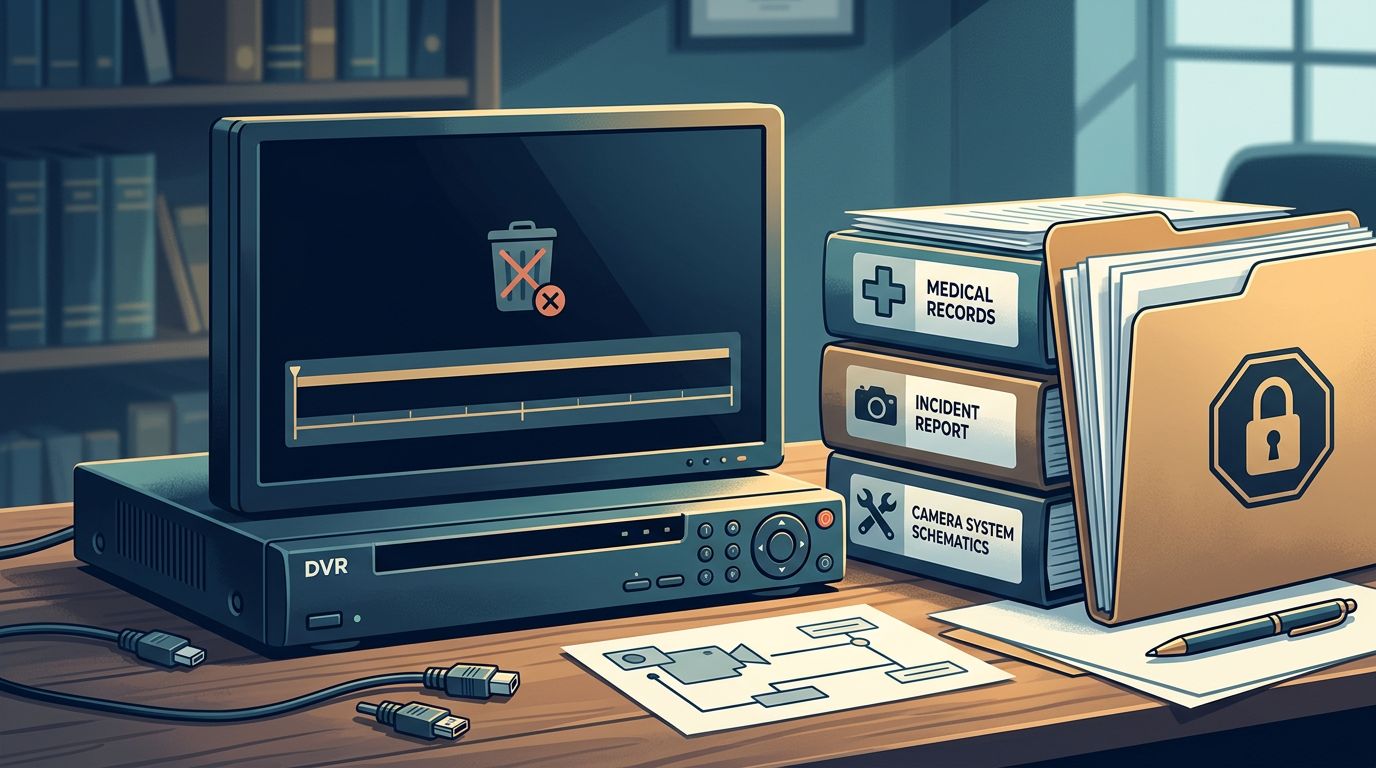
If you searched “deleted surveillance video workers comp”, you may worry that missing footage will sink your Florida claim. It usually won’t. A deleted recording can create an evidence dispute, but your claim also depends on medical records, injury reports, witness accounts, work restrictions, and other proof.
The response should be fast and organized. Ask for preservation, document who controlled the cameras, request records through discovery, and get legal advice before assuming the missing video ends your case.
Key Takeaways
- Deleted footage doesn’t automatically defeat a Florida workers’ compensation claim.
- A preservation demand can help prevent routine overwriting after the employer or insurer learns about the injury.
- Spoliation requires more than proof that a recording disappeared. Duty, fault, and harm must be established.
- Surveillance footage may be discoverable when the defense plans to use it at trial or in the claim.
- Florida workers’ comp benefits and a separate spoliation claim involve different legal questions.
Deleted Surveillance Video Workers Comp Claims: What Florida Law Allows
A workplace video may show the accident, the condition that caused it, or what happened immediately afterward. It can also confirm whether the employer received notice and whether your description of the injury matches what witnesses saw.
However, workers’ compensation does not require you to prove fault. You generally must show that an injury arose out of and occurred in the course of employment. The video may support that proof, but it isn’t the only evidence available.
A missing recording can result from several causes. The system may overwrite files after a short retention period. An employee may delete a clip. A manager may fail to preserve the recording after receiving an injury report. The camera may have been pointed elsewhere, malfunctioned, or stored footage under a different date and time.
Those facts matter because deletion alone doesn’t establish spoliation. A court or judge will examine whether the video existed, whether someone had a duty to preserve it, whether the loss was intentional or negligent, and whether its absence harmed your ability to prove the case.
Florida spoliation law often requires proof that the missing evidence significantly impaired the underlying lawsuit. The effect is different from proving the workers’ compensation claim itself. If other evidence establishes the injury, the missing video may have limited value. If the recording was the only proof of how the accident occurred, its loss may carry more weight.
The Florida Bar has discussed possible spoliation remedies, which can include an adverse inference, exclusion of evidence, striking pleadings, or other sanctions. The remedy depends on the facts and the seriousness of the conduct. A judge won’t automatically assume the missing video would have helped you.
Why the Timing of a Preservation Request Matters
Security systems often delete older files automatically. Some businesses retain footage for only a limited period, although the exact period depends on the system, settings, storage capacity, and company policy.
Send a written preservation request as soon as possible after the injury. Address it to the employer, property owner, security company, claims administrator, and any other person or business that controls the cameras. Identify the date, approximate time, location, camera angles, and the incident involved.
Request more than the short clip showing the accident. Ask that the recipient preserve:
- Original footage from all cameras covering the area
- Footage from a reasonable period before and after the incident
- Audio, if the system records it
- Still images, exports, and metadata
- Incident reports and internal investigation materials
- Camera maps, retention policies, and maintenance records
- Names of people who reviewed, copied, or handled the video
A preservation letter doesn’t recover footage that the system already erased. It does provide evidence that the recipient knew the recording mattered and had a reason to preserve it. That notice can affect the analysis of duty and fault.
You should also preserve your own evidence. Write down what happened while the details remain fresh. Keep copies of medical records, work restrictions, texts with supervisors, photographs, pay records, and claim correspondence. Ask coworkers whether they saw the accident or know who reviewed the footage.
Your first actions after an injury can affect the claim. Avard Law’s Florida workers comp first 24 hours checklist covers immediate reporting, medical care, documentation, and work-related records.
How Deleted Video Can Affect Your Workers’ Comp Case
The impact depends on what the video would have shown and what other evidence exists. A recording may help answer several disputed questions.
First, it may establish that the accident occurred at work. This can matter when an employer claims the injury happened elsewhere or occurred during a personal activity.
Second, video may show the physical cause of the injury. A camera could capture a fall, a machine incident, a struck-by accident, or a lifting event. It may also show whether warning signs, barriers, or safety equipment were present.
Third, footage can support your account of symptoms and limitations. For example, a recording might show that you immediately reported pain, stopped working, or needed help after an incident. That evidence can counter an allegation that you waited to complain or fabricated the injury later.
Still, surveillance can cut both ways. An insurer may conduct lawful surveillance in public places and use the footage to argue that your activities conflict with claimed restrictions. Surveillance does not automatically prove that you can work full time. A short clip may omit pain, limited endurance, medical instructions, or what happened before and after the recording.
The Florida Bar’s guidance on video surveillance discusses discovery and courtroom issues involving this type of evidence. The footage must be relevant, authentic, and presented fairly. A misleading or incomplete clip may face objections.
If the employer’s camera footage disappears, gather substitute evidence. Witness statements, photographs, time records, delivery logs, text messages, medical histories, and incident reports may fill parts of the gap. Request the employer’s written retention policy and ask who had access to the system.
A missing video creates a proof problem, but it doesn’t erase the injury, the medical evidence, or the employer’s notice.
What Discovery Can Reveal About Missing Footage
Your attorney can use discovery to determine whether the footage existed and why it disappeared. Useful requests may seek the incident report, emails, texts, claims notes, recorded statements, camera records, retention policies, and communications about the accident.
Interrogatories can ask who controlled the surveillance system, when the footage was first reviewed, whether anyone copied or exported it, and when the file became unavailable. Requests for production can seek the original recording, duplicate copies, screenshots, metadata, and related video.
Depositions may clarify whether a supervisor watched the footage before it was deleted. A witness may remember what appeared on screen even if the file no longer exists. The person who manages the system can explain automatic deletion, storage limits, and whether a backup server held the recording.
Florida discovery rules also affect surveillance obtained by an investigator or insurer. The Florida Supreme Court discovery rules address when surveillance evidence must be disclosed, particularly when a party plans to use it at trial. Footage held as work product may not receive the same treatment if the defense doesn’t intend to introduce it.
A claimant shouldn’t assume the insurer must voluntarily provide every recording. A formal discovery request may be necessary. If the insurer produces only edited footage, ask for the complete version and information about how it was created.
The judge may address missing evidence through an evidentiary motion. Depending on the circumstances, the court could allow testimony about the lost recording, limit arguments based on its absence, issue an adverse inference, or impose another remedy. The requested remedy must match the proven harm.
When Spoliation May Support a Separate Claim
Florida recognizes spoliation as a possible independent civil claim when a person or entity had a duty to preserve evidence and destroyed or seriously impaired it. Workers’ compensation cases add an important limitation because employers generally receive immunity from ordinary injury lawsuits under Florida’s workers’ compensation system.
Florida Statute § 440.39(7) has been interpreted to allow an exception when an employer or insurer negligently destroys evidence needed for a third-party claim. The Florida Fourth District Court of Appeal addressed this issue in Shaw v. Cambridge Integrated Services Group, Inc. The theory is narrow. It generally concerns lost evidence that substantially impairs a separate claim against a manufacturer, property owner, contractor, or another responsible third party.
For example, a defective machine may have caused your injury. You receive workers’ compensation benefits, but a product liability claim may also exist against the manufacturer. If the employer or insurer destroys the machine, photographs, or video needed to prove the defect, the evidence loss may affect the third-party case.
That is different from saying the missing video automatically creates extra workers’ compensation benefits. A spoliation claim usually seeks damages tied to the lost recovery in the underlying lawsuit. It doesn’t replace the workers’ compensation claim or guarantee payment.
A lawyer will examine whether:
- You had a potential underlying civil claim.
- The other party had a legal or contractual duty to preserve evidence.
- The evidence was destroyed or significantly altered.
- The loss impaired your ability to prove the claim.
- The destruction caused that impairment.
- You suffered damages because of the loss.
The facts surrounding deletion are central. Routine overwriting before anyone knew about the accident is different from deleting footage after receiving a preservation letter. Intent, timing, access, company policy, and available backups can all affect the result.
Protecting Your Claim Before Deadlines Pass
Report the injury promptly and follow the authorized medical process. In Florida, employees generally must report a workplace injury within 30 days after they know or should know that it is work-related. Your Florida workers compensation claim deadlines can also depend on treatment dates and the type of claim.
Tell the employer in writing that surveillance may exist. Don’t rely on a verbal conversation with a supervisor. Keep a copy of every email, letter, text message, and response.
Avoid contacting a suspected investigator aggressively or posting about the incident online. Public social media posts and public activities may become evidence. Follow your doctor’s restrictions, but remember that ordinary activity doesn’t automatically contradict a disability claim.
A Florida workers’ compensation attorney can request records, question witnesses under oath, address discovery violations, and evaluate whether a third-party case exists. Bring your attorney the injury date, report date, location, names of supervisors, medical records, photographs, and any notice you sent about the footage.
The filing deadline remains important even while a video dispute develops. Evidence preservation doesn’t pause the deadline for seeking benefits. Missing footage should prompt legal action, not delay.
Conclusion
A deleted recording can complicate a Florida workers’ compensation claim, but it rarely decides the case by itself. The strongest response is to document the accident, request preservation quickly, identify who controlled the system, and use discovery to investigate what happened.
If the missing footage impaired a separate claim against a third party, Florida spoliation law may provide another legal path. A timely review of the evidence can protect both your workers’ compensation benefits and any related recovery.