
Florida Traffic Signal Failure Crash Claims and Records
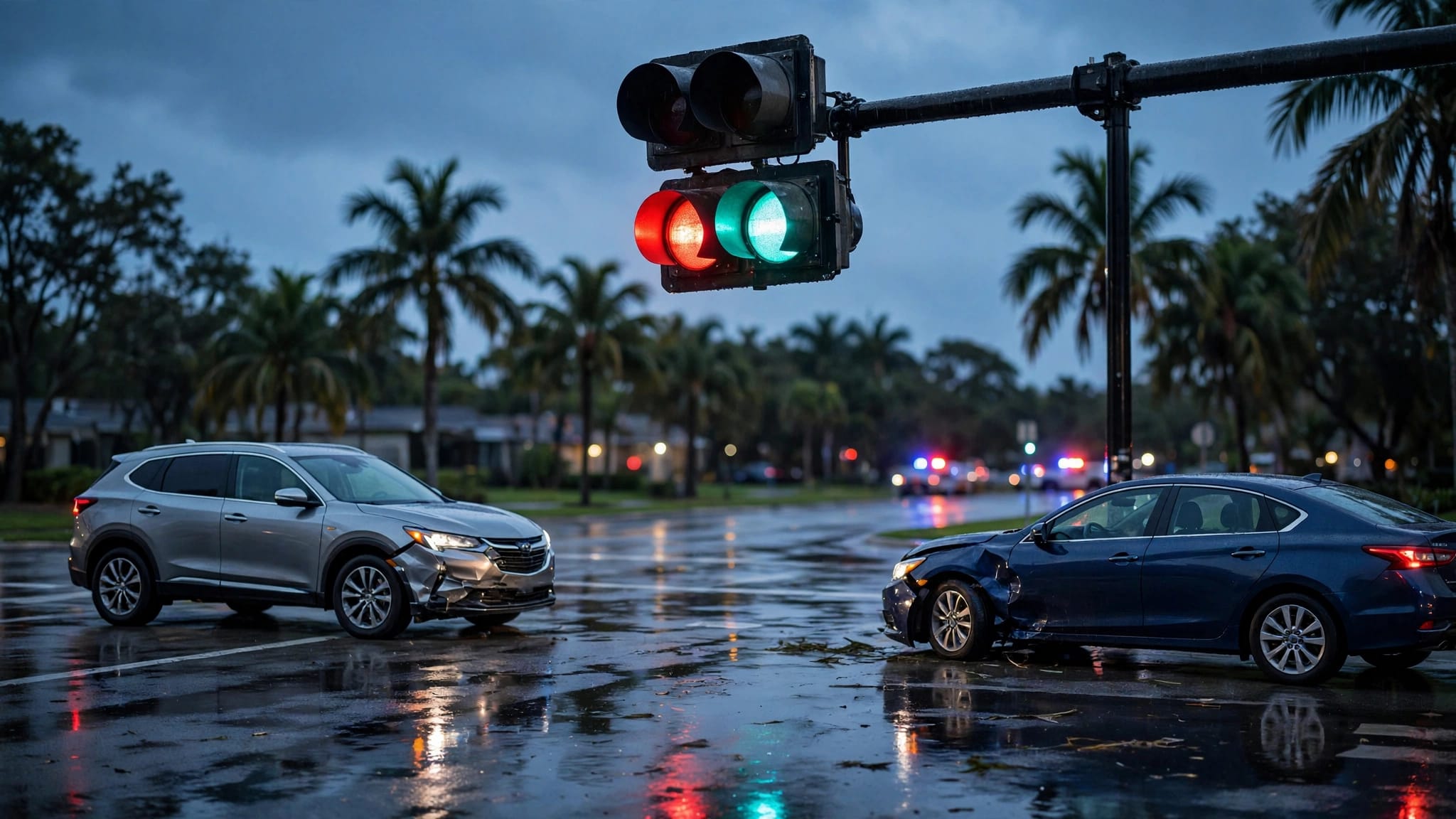
A faulty light can turn an ordinary intersection into a collision scene within seconds. One driver may see green while another sees a dark signal, a late yellow, or an instruction that never came.
A Florida traffic signal failure claim requires more than proving a crash occurred at an intersection. You must identify the defect, the party responsible for the signal, and the records that show what happened before impact. The strongest cases begin before crucial evidence disappears.
How Florida Traffic Signal Failure Claims Take Shape
Traffic signals are mechanical and electronic systems. A failure may involve a complete outage, conflicting green indications, an improperly timed phase, defective vehicle detection, an obstructed signal head, or a controller problem.
The fact that a signal malfunctioned does not automatically make a public agency liable. A successful claim connects the unsafe condition to a legal duty, a breach of that duty, the crash, and measurable harm.
A defect must have caused the collision
The signal issue must be more than background context. For example, a driver who entered an intersection against a working red light may remain primarily at fault. However, a signal that displayed green in conflicting directions can change the entire case.
The timing matters. Evidence should establish the signal’s condition at the moment of the wreck and whether that condition caused drivers to make incompatible decisions.
Maintenance failures can create liability
Signal systems need inspection, repair, testing, and prompt response to reported outages. A traffic agency may face a claim when it knew, or reasonably should have known, about a dangerous defect and failed to address it within a reasonable time.
A claim can also involve an unsafe temporary configuration during road work. In those cases, the public agency, construction contractor, traffic-control subcontractor, and driver may all require review.
Identify Who Owned and Maintained the Intersection
An intersection inside city limits is not always a city-owned intersection. Florida roads often cross local boundaries, and the state, county, municipality, or a private contractor may hold separate responsibilities.
Florida law gives municipalities original jurisdiction over many streets within their boundaries, subject to exceptions for state roads. The broader Florida traffic-control statutes govern how agencies place and maintain official traffic-control devices.
Road ownership and signal maintenance are separate questions
A state road can run through a city. The Florida Department of Transportation may own the roadway, while a local agency handles routine signal maintenance under an agreement.
FDOT documents show that traffic-signal agreements can cover funding, installation, maintenance, and operation. One FDOT signal maintenance agreement describes these shared responsibilities among public entities.
Start with the precise location, including both street names, direction of travel, and nearby landmarks. Then identify the road owner, the signal owner, and the entity responsible for the controller cabinet and repair calls.
A city name on a signal cabinet or police report does not prove that the city maintained the signal. Written maintenance agreements often provide the answer.
Private contractors may also matter
Government agencies often hire vendors for signal upgrades, emergency repairs, or work-zone traffic control. A contractor that installed defective equipment, ignored an outage report, or failed to follow a maintenance contract may face an ordinary negligence claim.
Unlike a public entity, a private contractor generally does not receive Florida’s sovereign-immunity damages cap. That difference can matter when injuries are severe.
Preserve Evidence Before It Is Lost
Intersection cases move quickly. Vehicles get repaired, weather changes, surveillance footage is overwritten, and a malfunction may be fixed before anyone documents it.
After a Florida traffic signal failure crash, photographs and video can preserve facts that an accident report cannot. Take wide shots of every signal head, the controller cabinet, lanes, pavement markings, construction signs, and sight obstructions.
Capture the signal’s condition
If the signal is dark, flashing, stuck, or showing conflicting indications, record it from a safe location. A short video may reveal that the signal cycles improperly or that one direction receives no visible instruction.
Dashcam footage from involved vehicles, nearby drivers, delivery trucks, and transit vehicles can be equally important. Ask nearby businesses, residences, and public facilities to preserve camera footage as soon as possible.
Witnesses should be asked what they saw before the impact. Their observations may establish whether the light was red, green, yellow, dark, flashing, or inconsistent.
Medical documentation also supports causation
Prompt medical care protects health and creates a clear record of injuries after the crash. Follow-up appointments, diagnostic imaging, therapy records, work restrictions, and proof of lost income help show the practical cost of the collision.
Florida’s no-fault insurance system may provide initial Personal Injury Protection benefits. Yet a malfunctioning-signal claim can involve damages beyond available PIP benefits when another driver’s negligence or a dangerous road condition caused serious injury.
Request Traffic Signal Maintenance Records
Maintenance records often decide whether an agency had notice of a defect. A repair ticket from the day before the crash can be more persuasive than conflicting witness memories.
Florida’s Public Records Act generally gives people the right to inspect and copy state, county, and municipal records. Chapter 119 of the Florida Statutes is the starting point for requests to public custodians.
Ask for records by location and signal site number
A useful request identifies the intersection, crash date, a meaningful date range, and the traffic signal’s site or cabinet number if available. Broad requests can lead to delays or incomplete production.
Records that may reveal a pattern include:
- Work orders, service tickets, repair invoices, and preventive-maintenance logs.
- Citizen complaints, police notifications, outage reports, and dispatch communications.
- Controller event logs, detector reports, battery-backup reports, and power-outage records.
- Signal timing sheets, phase diagrams, clearance intervals, and traffic engineering plans.
- Contracts and agreements that identify the maintenance agency or private vendor.
- Prior crash reports and correspondence about safety concerns at the same intersection.
A request should cover at least the months before the collision and the period immediately after it. Post-crash repairs may reveal what technicians found, even though a repair alone does not prove prior negligence.
A 60-day response rule has a narrow role
Florida law states that a county or municipality providing signal services by agreement must respond within 60 days to a request about the evaluation, installation, operation, or maintenance of those devices. The language appears in section 316.0081.
That provision does not replace a public-records request or a formal evidence-preservation letter. Both may be needed, especially if a crash claim is likely.
Proving Notice of a Dangerous Signal Condition
Maintenance records matter because a public entity usually cannot repair a defect it had no reasonable chance to discover. The legal dispute often centers on notice.
Actual notice exists when the responsible agency received a complaint, outage alert, police call, inspection report, or vendor communication. Constructive notice can arise when the defect existed long enough that reasonable inspection and maintenance would have found it.
Look for warnings before the crash
Repeated reports about a dark signal, intermittent operation, missing visibility, or conflicting phases can establish a troubling history. The same is true when technicians made temporary repairs but left the underlying problem unresolved.
A pattern of crashes may also support a closer review. Prior collisions alone do not prove that a signal malfunctioned, but they can lead to reports, engineering studies, and internal discussions about the intersection.
Separate design decisions from operational neglect
Some claims concern an agency’s high-level decision about whether to install or redesign a signal. Others concern day-to-day work such as replacing a failed component, responding to outage calls, or maintaining signal timing.
Operational maintenance failures often create a different liability analysis than planning-level decisions. Records help distinguish the two. They show whether the agency had an existing maintenance duty and whether personnel performed it reasonably.
Driver Conduct Still Affects the Claim
A signal defect does not erase every driver’s duty to use reasonable care. Insurance companies and government defendants will examine speed, distraction, impairment, following distance, and whether a driver had a clear chance to avoid the impact.
Florida applies comparative fault in most negligence actions. A claimant’s damages may be reduced by that person’s percentage of responsibility. In many cases, a person found more than 50% at fault cannot recover damages.
A dark light calls for added caution
Drivers may need to treat a nonfunctioning intersection with extra care. The defense may argue that the driver should have slowed down, yielded, or stopped based on surrounding conditions.
Still, a driver cannot anticipate every system failure. Conflicting green lights, hidden signal heads, defective detection equipment, or an abrupt phase change may leave little time to react.
The key is a detailed reconstruction. Vehicle damage, skid marks, event data recorder information, video, signal records, and witness accounts can show whether the driver’s conduct or the failed system caused the crash.
Government Claims Have Different Notice Rules
When FDOT, a county, or a city maintained the traffic signal, Florida’s sovereign-immunity law applies. Florida Statute section 768.28 allows certain negligence claims against public entities, but it imposes procedural requirements and payment limits.
The current sovereign-immunity statute also recognizes municipal liability when a municipality breaches its duty to maintain streets, roads, highways, and traffic-control signals.
Written presentment comes before a lawsuit
For most injury claims, section 768.28 requires written presentment to the appropriate agency within three years after the claim accrues. Claims against state agencies also generally require notice to the Florida Department of Financial Services.
Counties and municipalities are treated differently for the Department of Financial Services notice requirement. However, the appropriate public agency still needs written notice. The agency generally has six months to investigate before the claim is considered denied.
Wrongful death claims have a shorter two-year presentment period. Because a standard negligence lawsuit may also face a two-year filing deadline, waiting to send notice can put a valid claim at risk.
For a closer review of these procedural issues, see Avard Law’s guide to Florida government negligence claims.
Damage caps can limit government payment
Section 768.28 generally caps damages at $200,000 per person and $300,000 per incident for claims against the state and its agencies or subdivisions. The statute also bars punitive damages and pre-judgment interest against those entities.
A court may enter a judgment above the cap, but payment beyond the statutory limit usually requires a legislative claims bill. The cap does not automatically protect a separate negligent driver or private maintenance contractor.
Track Filing Deadlines With Care
Time limits can differ based on the crash date, the identity of the defendant, and whether the collision caused injury or death. An ordinary negligence claim from a Florida crash occurring after the 2023 law change generally has a two-year filing period.
Government notice requirements do not give someone extra time to file suit. Instead, they add a separate step that must be completed early enough to preserve the case.
Wrongful death claims demand immediate action
Florida wrongful death actions generally must be filed within two years of the death. The personal representative of the estate brings the claim for eligible survivors and the estate.
When a signal-related crash causes a fatal injury, potential defendants should be identified quickly. Government agencies may need statutory notice, while claims against drivers or contractors follow different procedures.
Avard Law’s overview of the Florida car accident lawsuit deadline explains why the earliest possible deadline should control case planning.
Do not rely on an insurer’s timetable
An insurer may request records, investigate fault, or discuss settlement after a crash. None of those actions pauses a statutory deadline unless a legally valid agreement or rule applies.
Preserving a claim requires more than opening an insurance file. It requires timely legal action against every responsible party.
Damages and Other Parties in a Signal Failure Case
A Florida traffic signal failure case can involve medical expenses, lost income, reduced earning ability, pain and suffering, property damage, and future treatment needs. The available compensation depends on the injuries, insurance coverage, fault allocation, and defendant.
A serious crash may involve several overlapping claims. The at-fault driver may carry liability insurance, a commercial vehicle employer may have separate responsibility, and a public agency or contractor may face claims for the unsafe signal condition.
Work-related crashes may create two paths
If you were driving for work, workers’ compensation may cover medical care and wage benefits. However, a negligent driver, contractor, or government entity may still be a separate third party.
A third-party claim after a Florida work injury may provide a route to damages that workers’ compensation does not cover. The facts determine whether both claims can proceed.
The police report is only one piece of evidence
Crash reports can identify witnesses, document road conditions, and record early observations. Yet officers may arrive after a signal resets or technicians repair it.
A thorough claim goes beyond the report. It uses signal logs, maintenance history, scene evidence, medical proof, and a clear account of each defendant’s role.
A Strong Claim Starts With the Right Records
A defective signal can create confusion in seconds, but proving fault takes disciplined evidence collection. The intersection’s maintenance history often reveals whether the collision followed a sudden, unforeseeable event or a danger that should have been corrected.
Florida traffic signal failure claims demand fast action because video, electronic logs, and repair records may not remain available for long. Identifying the responsible agency or contractor early can protect both evidence and legal rights.