
Florida Railroad Crossing Claims: Gate and Signal Records
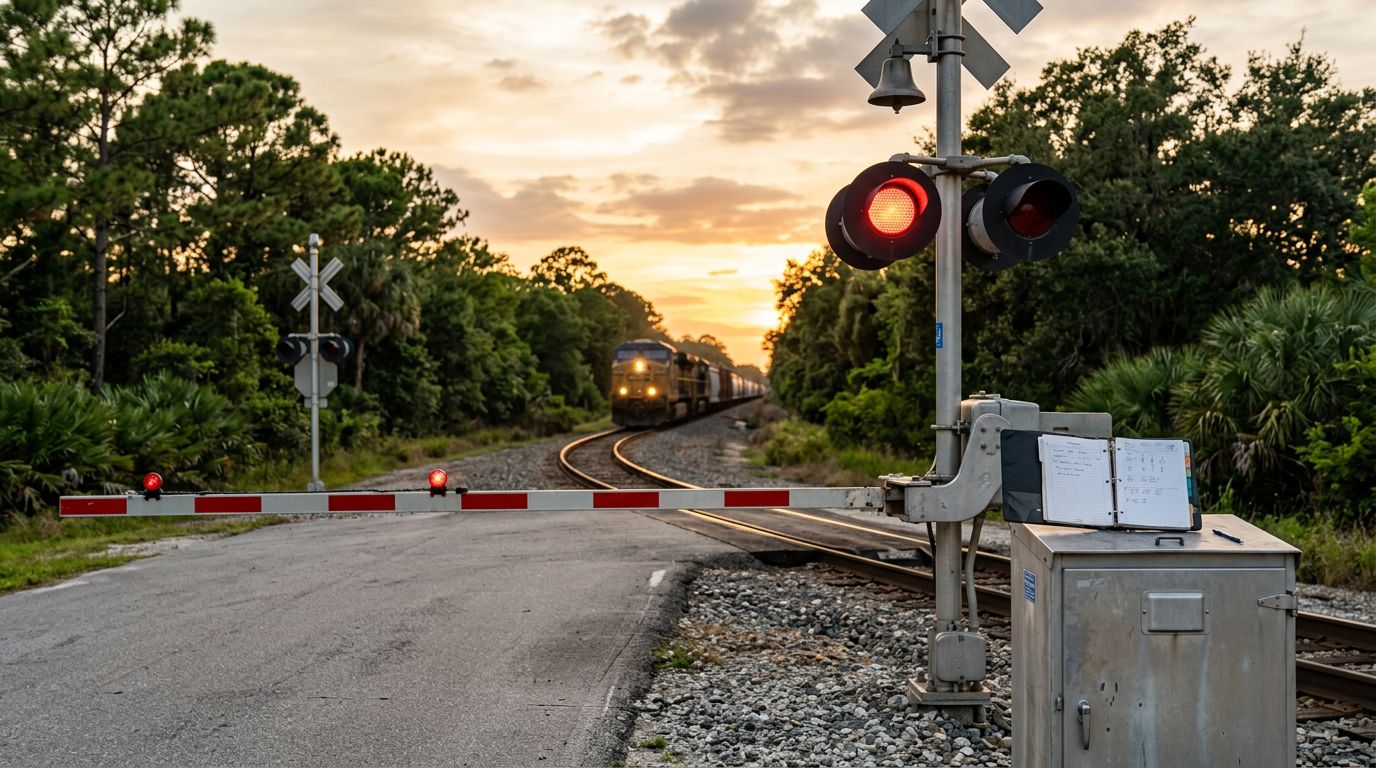
Gate and signal records can help establish whether a railroad crossing’s warnings operated before a collision. In Florida railroad crossing claims, those records become stronger evidence when matched with video, train data, maintenance files, and witness accounts.
If you’re injured, the immediate concern is treatment, but evidence preservation also needs early attention. Start with the records that can explain what the crossing equipment did during your approach.
Key Takeaways
- Gate logs, signal tests, repair files, and available electronic recordings can help reconstruct the warning sequence, but no single record establishes fault.
- Preserve original video, damaged vehicles, and electronic evidence promptly. A request for document copies is different from a request to prevent evidence loss.
- Responsibility may involve several parties. Claim deadlines and government notice requirements depend on the defendant and type of claim.
What Gate and Signal Records Can Show
A railroad crossing collision often turns on seconds: when warnings began, when a vehicle entered, and when the train arrived. Different records answer different parts of that sequence.
Warning activation and gate movement
Where recording equipment exists, available information may show warning activation, gate-control commands, equipment faults, or other system events. However, the available fields depend on the installed equipment and configuration.
A recorded command to lower a gate doesn’t, by itself, establish that the gate arm physically lowered.
Video, photographs, witness observations, and equipment inspections help test whether a recorded command matched actual operation. The distinction matters when a railroad points to a log as proof that every warning worked.
Inspection, repair, and complaint history
Inspection sheets and maintenance files may reveal earlier problems involving flashing lights, gate mechanisms, wiring, power supplies, or detection equipment. Complaints and dispatch records can establish when someone first reported trouble.
Follow each reported defect through the repair process. A closed work order may reflect an administrative update rather than completed work at the correct crossing.
Likewise, repairs after a crash don’t automatically prove earlier negligence. Their significance depends on the underlying facts and applicable evidence rules.
Building a Reliable Crossing Crash Timeline
Useful evidence must connect to the correct crossing, equipment, and collision. An unexplained timestamp or unrelated repair entry can distort the sequence.
Identify the crossing and responsible equipment
Record the road name, county, direction of travel, nearby intersection, and crossing identification number if safely available. U.S. DOT crossing identifiers generally contain six digits followed by a letter.
Precise identification matters because nearby crossings may share a railroad operator but have different equipment and maintenance histories. A request should also cover a meaningful period before the collision, rather than only the moment of impact.
The FRA’s Grade Crossing Toolkit identifies national crossing incident data that can support background research. Earlier incidents provide context, but they don’t establish that the same defect caused your crash.
Compare clocks, recordings, and traffic signals
Crossing equipment, locomotive systems, dashcams, and nearby cameras may use different clocks. Investigators must account for time offsets before comparing events.
At crossings near intersections, highway traffic-signal records may also matter. Signal preemption, queue clearance, and available storage space can affect whether vehicles clear the tracks.
Our discussion of Florida intersection crash claims addresses how timing records and recordings help resolve conflicting accounts. Crossing cases require a similar comparison between recorded events and actual vehicle movement.
Preserve Railroad Crossing Evidence Early
Medical care and scene safety come first. Don’t enter railroad property, open equipment cabinets, or return to the tracks to collect evidence.
Protect records held by other parties
An attorney’s preservation notice can identify the crossing, crash date, approximate time, involved train, and relevant evidence. Potential recipients include the railroad, maintenance contractor, roadway agency, nearby businesses, and recording-system custodians.
The request may cover crossing event data, locomotive video, dispatch communications, inspection records, complaint logs, repair files, and damaged components. It should distinguish preserving original materials from producing copies.
A preservation letter doesn’t guarantee that a record exists or compel immediate disclosure. However, it puts the recipient on notice that identified evidence may be relevant to anticipated litigation.
Keep original files and vehicle evidence
Save original dashcam footage and photographs with their date information intact. Avoid relying only on compressed clips sent through messaging apps.
Preserve witness names, phone numbers, and email addresses. Someone who watched the gate during your approach may provide information that a witness arriving afterward cannot.
Also identify where the damaged vehicle is stored. Repairs, salvage, or disposal can remove physical evidence and affect access to electronic data.
Depending on the vehicle and collision, an event data recorder may contain speed, braking, throttle, or other information. A qualified examiner must associate any retrieved data with the correct event.
Who Holds the Records and May Be Responsible?
The company operating the train isn’t necessarily the only entity with relevant records. Track ownership, warning-system maintenance, and roadway control may involve different parties.
Railroad files and regulatory reports
A railroad may hold maintenance records, dispatcher communications, onboard recordings, and crossing-system information. Contractors may hold separate inspection or repair files.
Railroad regulatory reports follow the FRA’s accident-reporting framework. A submitted report can help identify reported facts, but it isn’t a complete investigative file or a final determination of legal fault.
The police crash report has similar limits. Compare its directions, diagram, witness information, and narrative with original recordings and physical evidence.
Public agencies and private custodians
A roadway agency may hold traffic-signal plans, preemption records, roadway complaints, or project documents. Relevant public records may be available through Florida’s public-records process.
Private railroad records generally require a different route. An attorney may seek voluntary production or use formal discovery after filing suit.
Contracts and maintenance agreements can help establish who controlled the equipment and who had repair duties. Ownership alone doesn’t answer every responsibility question. The investigation must connect a party’s conduct to the collision.
Proving Fault, Injuries, and Financial Losses
Evidence of a warning-system problem must connect to how the crash occurred. Florida railroad crossing claims also require proof that the collision caused the injuries and losses claimed.
Connect the warning failure to the collision
The investigation should address visibility, vehicle position, train movement, warning timing, and the driver’s opportunity to react. A malfunction unrelated to the approach or impact may not establish causation.
An insurer may argue that a driver ignored operating warnings or entered without space to clear the tracks. Those allegations require evidence, just as allegations against the railroad do.
Federal railroad safety law can also limit some state-law claims involving warning-device design or adequacy. Legal review must distinguish those issues from alleged maintenance failures and other conduct.
Document the consequences of the crash
Medical records should describe your symptoms, diagnoses, treatment, restrictions, and future care needs. Follow-up visits matter when concussion symptoms, pain, or functional limitations develop over time.
Keep bills, prescription receipts, therapy records, wage information, and documentation of missed work. These records help connect the collision to actual financial losses.
Our Florida accident demand checklist explains how supporting documents fit into a settlement demand. Technical liability evidence and medical proof need to support the same claim.
Florida Deadlines and Government Claim Rules
Don’t treat the deadline for filing suit as the deadline for preserving evidence. Electronic recordings may disappear much earlier through routine system operation.
The applicable filing period depends on the claim, crash date, and defendant. Settlement discussions and an open insurance file don’t automatically extend it.
Claims against qualifying government defendants can also involve presuit notice requirements. For wrongful-death claims governed by Florida Statute 768.28, the statute requires written presentation to the Department of Financial Services within two years after accrual. That requirement is separate from filing a lawsuit.
Don’t assume that a railroad operating in Florida is a government entity. An attorney must identify the actual parties and applicable procedures early enough to protect the claim.
Frequently Asked Questions
Can I bring a claim if the gate was up?
A raised gate is relevant, but it doesn’t establish liability by itself. The investigation must determine whether the crossing had active warnings, what the equipment did, and how the collision occurred. Video, system records, witness observations, and maintenance history can help explain whether a warning failure contributed to your injuries.
What if the railroad says its records show normal operation?
The underlying records still need interpretation. A system entry may document a command or monitored condition without establishing everything a driver encountered. Investigators should compare the data with recordings, inspections, equipment configuration, and witness accounts. They must also confirm that the records concern the correct crossing and time.
Does missing signal data automatically prove negligence?
No. A missing record doesn’t automatically establish a malfunction or legal fault. The explanation may involve equipment capabilities, retention practices, or another issue. If evidence disappeared after a preservation duty arose, an attorney can assess the legal consequences. Meanwhile, maintenance files, locomotive recordings, photographs, and witnesses may provide other proof.
Protect Your Claim Before Records Disappear
A strong crossing-crash investigation connects equipment records with real-world events. Gate commands, repair entries, and regulatory reports each need context before they can support a reliable account of the collision.
At Avard Law Offices, we offer a free initial consultation for personal injury matters. If you’ve been injured at a Florida railroad crossing, early legal advice can help protect the evidence while your treatment continues.