
Florida Child Passenger Injury Claims and Car Seat Evidence
After a motor vehicle accident, seek care promptly. Pediatric trauma symptoms may be delayed or hard for children to describe.
For Florida families, a claim involving an injured child requires more than an insurance form. Medical findings, crash facts, insurance coverage, and applicable deadlines can affect the outcome.
The steps taken after a car accident can protect your child’s health and preserve the evidence needed later.
Key Takeaways
- Seek prompt medical care and recommended follow-up after a crash, even when a child appears calm or has no visible injury. Pediatric symptoms can be delayed, and accurate medical records help document the child’s condition over time.
- Preserve the car seat, vehicle, and crash evidence. Photograph the restraint’s damage, labels, installation, and harness position before disposal, replacement, or reuse.
- Florida’s child-restraint statute generally prevents a restraint violation from being used as comparative negligence or other fault evidence in a civil action. That rule does not decide collision fault, injury causation, or damages, and seatbelt issues involving older children may be analyzed differently.
- Review every potential source of coverage, including liability, uninsured or underinsured motorist, umbrella, and medical payments coverage. PIP benefits may help with medical expenses but do not necessarily resolve the full claim.
- Do not assume a child’s age pauses the filing deadline. Florida generally provides two years for negligence claims, and settlements involving minors may require court approval or protections for the child’s funds.
Put medical care ahead of the insurance claim
A child should receive a medical evaluation after a motor vehicle accident when there is any concern about injury. This remains true if the child was secured in a car seat, appeared calm, or didn’t need emergency transport.
Children can have head injuries, internal injuries, neck strain, or fractures without obvious external marks. Prompt care creates records documenting the timing and condition. Those records don’t, by themselves, prove causation or damages.
Watch for delayed symptoms
Pediatric trauma can involve symptoms that change over time, and these symptoms can have different causes. Seek prompt medical attention if a child has vomiting, confusion, unusual sleepiness, headaches, dizziness, irritability, abdominal pain, limping, weakness, or behavior changes.
Tell the provider how the crash happened, where the child sat, and what restraint the child used. Report symptoms accurately, regardless of their perceived injury severity, and attend recommended follow-up care.
Follow-up appointments matter. A pediatrician, specialist, therapist, or school professional may later document symptoms that weren’t present during the first examination.
Keep every record in one place
Save discharge instructions, imaging reports, prescriptions, therapy referrals, bills, insurance explanations of benefits, and school absence records. A short parent journal can also track sleep problems, pain complaints, activity restrictions, and emotional changes.
Answer an insurance company’s questions accurately, but avoid speculation or minimizing symptoms in a recorded statement. An early comment such as “they seem fine” may be used to question whether later treatment relates to the crash.
A child’s first emergency-room visit is only one part of the medical record. Follow-up care often shows whether an injury resolves or creates lasting limitations.
Who can bring a claim for an injured child?
A minor generally cannot pursue an injury case alone. In a personal injury claim arising from a motor vehicle accident, a parent or legal guardian usually acts for the child, whose injury rights remain protected.
That representative role differs from a driver’s duty of care to operate safely. The adult must make decisions that protect the child’s interests, not merely close the file quickly. That matters when an insurance company offers money before doctors assess future treatment or permanent effects.
When a parent has a conflict of interest
A conflict may exist if the parent drove the vehicle, owned it, or may share fault for the crash. It may also arise when the parent’s own injury claim competes for limited insurance coverage.
Depending on the circumstances, Florida statutes and court rules in effect as of 2026 may require added protection for the child, including a guardian ad litem in qualifying settlements. The child’s claim needs an independent evaluation when the adult responsible for protecting it may also face liability.
A family member can still be the at-fault driver
A collision caused by a grandparent, spouse, older sibling, or another relative can create a claim. Potential recovery depends on the facts, available coverage, and policy limits, not the family relationship alone.
The practical review often includes bodily injury liability coverage, uninsured or underinsured motorist coverage, and policy exclusions. Family relationships can make these matters emotionally difficult, but they don’t eliminate the need to review the driver’s policy, the vehicle owner’s policy, and the child’s household coverage. Claims involving a teen driver may also raise issues of vehicle ownership and parental responsibility. Learn more about Florida parent liability for teen driver crashes.
Preserve car seat evidence after the crash
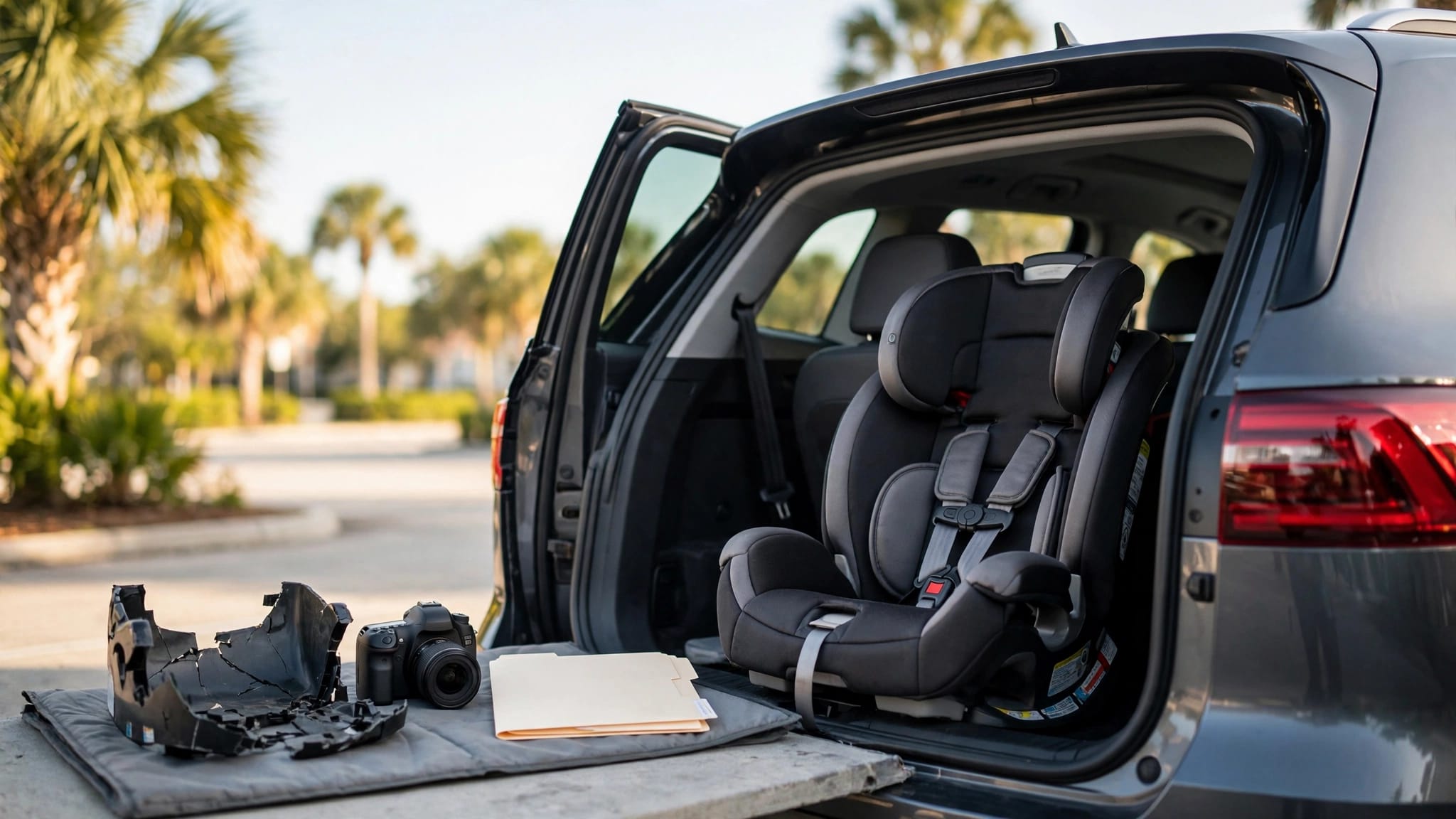
After a motor vehicle accident, child safety seats, including the damaged restraint, can provide important evidence about crash forces, installation, harness position, damage, and possible product defects. Don’t throw it away, donate it, or replace it before documenting its condition.
Take clear photographs from every angle. Include the seat’s shell, harness straps, buckle, base, labels, manufacturing date, model number, and any visible cracks or deformation. Photograph the vehicle seat where it was installed and any related property damage as well.
Save the details that explain how the seat was used
Keep the purchase receipt if available, the owner’s manual, registration card, packaging, and proof of any recalls or replacement communications. Write down who installed the seat, whether the child was rear-facing or forward-facing, and whether the seat used LATCH anchors or the vehicle belt.
Preserve scene photos showing the child’s seating position, deployed airbags, and property damage. Keep a copy of the police report, but treat it as one evidence source, not conclusive proof of fault or causation. Ask the towing company and insurer to preserve the vehicle until it can be inspected if the collision caused serious injuries.
The National Highway Traffic Safety Administration offers car seat and booster seat guidance that can help families choose the correct restraint type and review car safety practices and installation concerns. Preserving a restraint protects potentially relevant evidence, but it doesn’t establish a product defect, negligent installation, injury causation, or automatic liability. A safety review after a crash shouldn’t delay medical care or legal advice.
Do not reuse a seat without checking safety instructions
A damaged car seat may no longer protect a child in another collision, so don’t reuse it if it may be unsafe. Follow the manufacturer’s post-crash instructions for child safety seats, and obtain photographs or an inspection before disposal if the seat may be evidence.
An insurance carrier may ask for the seat or offer a replacement amount. Get the request in writing, document the seat first, and don’t sign a broad release merely to obtain a replacement.
Florida child restraint law and fault arguments
After a motor vehicle accident, Florida law requires a crash-tested, federally approved child restraint device for children age 5 and younger traveling on Florida roads. Children through age 3 must use a separate carrier or integrated child seat. Children ages 4 and 5 may use a carrier, integrated child seat, or booster seat.
The current text of Florida’s child restraint statute includes an important civil claim rule. A violation remains an enforcement issue, but it cannot be used as comparative negligence or other fault evidence in a civil action.
That protection prevents an at-fault driver from shifting blame to an injured young child because a restraint was absent or improperly used. It doesn’t decide collision fault, causation, or damages, including whether the restraint caused or failed to prevent a particular injury.
Car-seat issues differ from seatbelt issues
Florida treats child restraints and ordinary seatbelt use under separate statutes. For an older child outside the child-restraint law, the defense may raise seatbelt use under Florida Statutes section 316.614. That statute allows a violation to be considered when evaluating comparative fault, subject to the facts and applicable evidence rules.
The legal analysis can change based on the child’s age, the restraint involved, and the facts of the crash. A defense argument about restraint use doesn’t answer the central question of who caused the collision.
Evidence such as traffic-camera footage, vehicle data, witness accounts, cell phone records, and the crash report may establish that another driver ran a light, followed too closely, sped, or drove while distracted.
Identify every source of responsibility and coverage
The at-fault driver is not always the only responsible party in a motor vehicle accident. A thorough investigation examines the driver, vehicle owner, employer, and permissive use. It also considers rental arrangements, road conditions, and rare claims involving a defective vehicle or restraint product.
An employer may face responsibility when an employee causes a crash while working, but that theory depends on the facts. A vehicle owner may have separate exposure when someone else was driving with permission. The driver also has a duty of care to operate reasonably under the circumstances.
Insurance limits can shape the entire case
Florida drivers aren’t universally required to carry bodily injury liability coverage. As a result, a catastrophic child injury can involve limited coverage even when fault is clear.
A lawyer should identify all policies early, including the driver’s liability policy, the household’s uninsured or underinsured motorist coverage, umbrella coverage, and applicable medical payments coverage. An insurance company’s first offer may reflect policy limits. It may also be a quick attempt to close a claim before the child’s condition is known.
When the available coverage is low, families should understand their underinsured driver settlement options before accepting payment. A signed release can end claims against parties or policies that have not yet been fully identified.
Shared fault requires careful evidence
Florida’s modified comparative negligence rule can reduce recovery when a legally responsible claimant shares fault. A claimant who is more than 50 percent at fault generally cannot recover in a negligence action.
Young children don’t create the same fault questions as adult drivers. Under Florida’s child-restraint statute, a restraint violation doesn’t automatically establish comparative negligence by the child. Still, disputes can involve the driver transporting the child, another motorist, or vehicle ownership. Early evidence helps prevent unsupported blame from being assigned to the family. Review how the Florida modified comparative negligence rule can affect an accident case.
Pediatric injuries can change over time
Children are not small adults. After a motor vehicle accident, pediatric trauma may affect school, mobility, behavior, or future care differently than adult injuries.
A child’s condition can also evolve as the body develops, without meaning every symptom is permanent.
Head injuries deserve close attention after a crash. A concussion can involve headaches, concentration problems, mood changes, sleep disruption, or sensitivity to light and noise. Providers may need time to identify the full pattern.
Abdominal injuries need prompt attention
An improperly positioned lap belt can concentrate force across a child’s abdomen. In severe collisions, doctors may look for internal injuries, spinal trauma, or the pattern often called seatbelt syndrome.
A booster seat can help position the vehicle belt across stronger parts of a child’s body. It doesn’t, by itself, prove what caused an injury. The seat, its labels, the belt path, medical findings, and expert interpretation may all matter.
Damages should reflect the child’s actual needs
Economic and non-economic damages may include current medical expenses, future medical costs, rehabilitation, counseling, assistive devices, and travel for care. Supported losses involving pain, disability, disfigurement, or reduced future earning capacity may also be evaluated separately.
Parents may have related losses, including parental lost wages for necessary time away from work or out-of-pocket care expenses. The legal ownership of each claim can depend on the facts, so settlement papers must clearly describe what the payment covers.
PIP benefits do not settle the whole case
Florida’s no-fault system may make Personal Injury Protection, or PIP, available after a motor vehicle accident for covered medical expenses. Coverage, limits, eligibility, and payment percentages depend on the applicable policy and Florida law. PIP alone may not fully pay for a serious injury, nor does it prevent a claim against a responsible party.
A child’s permanent injury, significant permanent scarring or disfigurement, permanent loss of an important bodily function, or death may meet Florida’s statutory threshold. If documented, that serious injury may support a claim against a responsible party for pain and suffering and other non-economic damages outside PIP. The threshold doesn’t itself prove fault, causation, or the amount of damages.
Medical proof drives the serious injury analysis
Doctors’ opinions, diagnostic imaging, therapy records, and future-care recommendations help establish injury severity. With pediatric trauma, only medical professionals, not a parent, adjuster, or lawyer, should describe permanence or functional loss. Don’t pressure a provider for a conclusion, report symptoms accurately, and attend recommended follow-up care.
The Florida serious injury threshold is especially important when a child may need long-term care or has permanent harm. The child’s treatment should guide the claim timeline, not an insurer’s preferred deadline.
Florida’s filing deadline is shorter than many parents expect
Florida generally gives a person two years to file a personal injury lawsuit based on negligence. That statute of limitations often applies to claims from a motor vehicle accident. The state’s 2026 statutes identify the current two-year period for covered actions.
Parents sometimes assume a child’s age automatically pauses this deadline until age 18. Florida’s current rules don’t treat minority as an automatic pause in every case.
Minority tolling has narrow limits
Florida Statutes section 95.051 provides limited tolling when a minor has no parent or guardian authorized to act. It also addresses cases where a parent or guardian is the alleged tortfeasor, and the tolling period has an outside limit.
When a fit parent or guardian can act for the child, waiting may destroy a valid claim. Medical malpractice, wrongful death, claims against governmental entities, and product liability cases can have different deadlines or notice requirements.
An open insurance claim or negotiations do not ordinarily suspend the filing deadline. Families should seek prompt, fact-specific legal review and check the Florida car accident lawsuit deadline before valuable time passes.
Minor settlements need protection beyond a signature
A settlement after a motor vehicle accident can affect a child’s care for years. Florida law may require court approval of settlements involving a minor because the child cannot evaluate a release or manage substantial recovery funds alone.
Under Florida Statutes sections 744.301 and 744.387, a natural guardian may settle a minor’s claim without appointment, authority, or bond when the aggregate amount received does not exceed $15,000. If the child’s net settlement exceeds $15,000, a guardianship of the property is generally required.
Gross and net amounts are not the same figure
The $15,000 guardianship rule focuses on the net settlement to the child. Attorney fees, costs, liens, and payment terms can affect that calculation.
A gross settlement value of $50,000 or more may trigger additional review, but that figure is not universal. Court approval or a guardian ad litem may be required. The result depends on the amount, net-versus-gross calculation, statutory exceptions, and current court rules.
Filings for court approval of settlements identify the child, explain the claim, disclose potential conflicts, describe settlement terms, and include the proposed release. The court can examine attorney fees, costs, medical liens, and the plan for holding the child’s funds.
Protecting funds after approval
Funds may be held in a guardianship account, court-approved investment plan, or restricted account. A minor’s account may also be used, subject to the court’s order and applicable guardianship rules. A structured settlement can provide scheduled future payments rather than one lump sum, but it isn’t automatically best for every child.
No single arrangement fits every family. The plan should account for immediate medical needs, future treatment, public-benefit concerns, and the child’s access to funds as an adult.
Mistakes that can weaken a child’s injury case
Parents have enough to manage after a crash. Still, several choices can create avoidable problems for child passenger injury claims:
- Discarding the car seat before photographing its labels, damage, and installation details can erase useful evidence.
- Skipping recommended follow-up care may create an evidentiary issue about ongoing symptoms, but it doesn’t automatically defeat a claim.
- Posting crash details, injuries, or recovery updates online can create statements that may be taken out of context. A social-media post doesn’t automatically defeat a claim.
- Accepting a fast settlement can waive future care costs before doctors understand the child’s prognosis.
- Relying on a pending claim can allow a court filing deadline to expire.
Keep communication with adjusters factual and brief. Provide necessary information, but don’t guess about fault, prognosis, causation, or damages.
Frequently Asked Questions
Should I keep my child’s car seat after a crash?
Yes. Photograph the seat, labels, harness, buckle, base, installation, and any visible damage before replacing or disposing of it. Follow the manufacturer’s post-crash instructions, and preserve the seat if it may be evidence.
Can improper car seat use reduce my child’s injury claim?
Florida’s child-restraint statute generally prevents a violation from being used as comparative negligence or other fault evidence in a civil action. It does not automatically establish who caused the crash or whether the restraint caused or failed to prevent a specific injury.
Who can bring a personal injury claim for an injured child?
A parent or legal guardian usually acts for the child in a personal injury claim. If the parent drove the vehicle, may share fault, or has competing claims, additional protections or independent review may be necessary.
How long does a child have to file a Florida car accident lawsuit?
Florida generally provides two years to file a negligence lawsuit, but a child’s minority does not automatically pause the deadline until age 18. Claims involving governmental entities, medical malpractice, wrongful death, or defective products may have different deadlines or notice requirements.
Does PIP pay for the entire child passenger injury claim?
PIP may provide benefits for covered medical expenses, but it may not fully pay for serious injuries or future care. If the child meets Florida’s serious-injury threshold, a claim for pain and suffering and other non-economic damages may also be available against a responsible party.
A careful claim protects the child’s future
The strongest claims for an injured child start with health after a car accident. Timely medical care and preserved car seat evidence build a sound foundation. Accurate records and a clear crash account help address future care when pediatric trauma symptoms change.
Florida’s statute of limitations and minor-settlement rules leave little room for casual delay. Protecting the child’s interests means knowing outcomes depend on medical proof, crash evidence, applicable insurance, and settlement rules. A Florida car accident attorney can explain the available options during a free consultation.