
Florida Motorcycle Rear-End Claims: Proving Fault
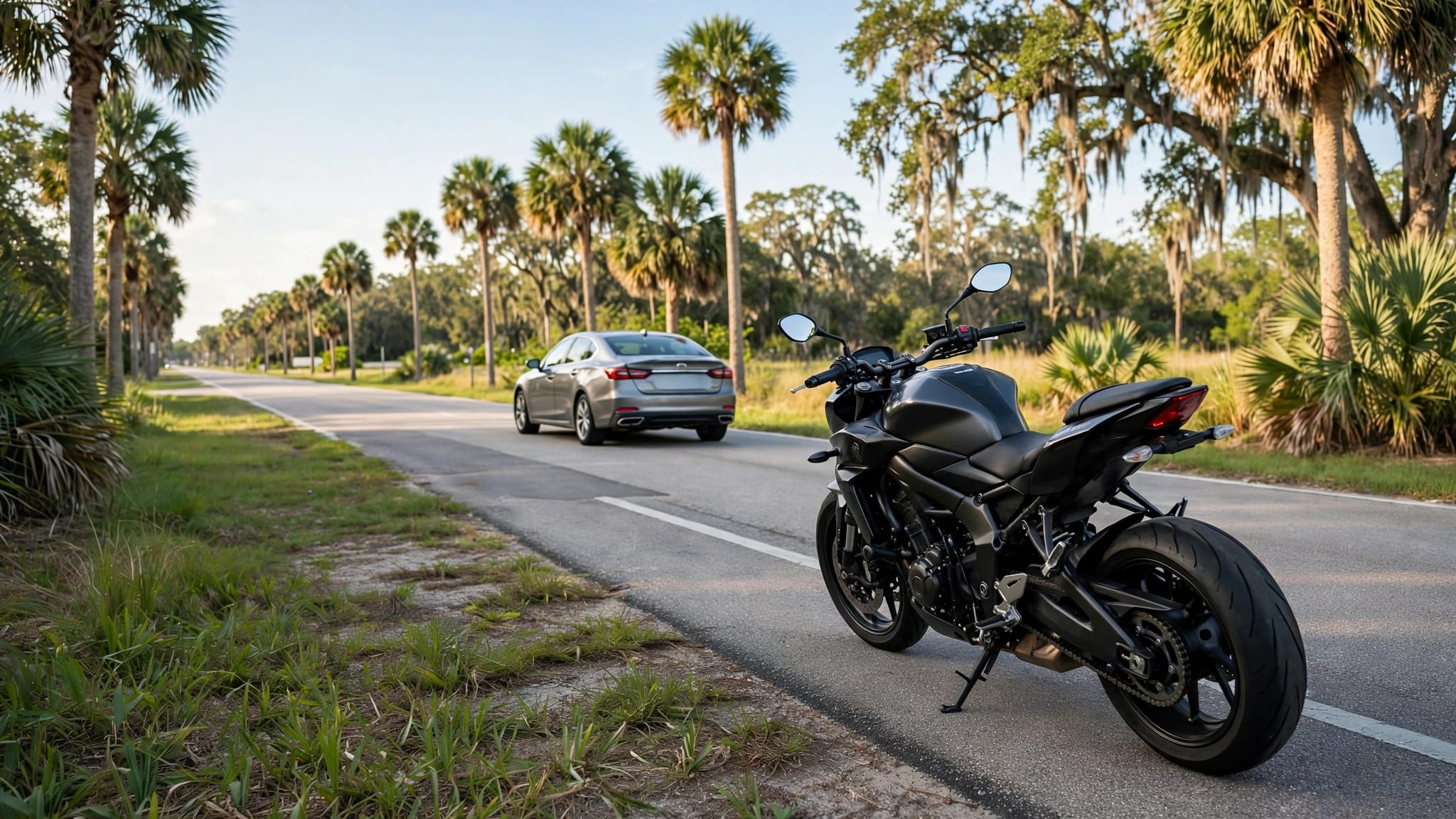
A driver who hits your motorcycle from behind may still blame you for braking. Florida motorcycle rear-end claims often turn on evidence showing the driver’s following distance, available reaction time, and what happened before impact.
Florida’s following-too-closely law and rear-end negligence presumption can support your case, but neither automatically settles liability. Preserving evidence early helps you answer sudden-braking accusations and unsupported claims that you caused the collision.
Start with the driver’s duty to leave enough room for the traffic conditions.
What Florida’s Following-Too-Closely Law Requires
The law requires a reasonable distance
Florida Statutes section 316.0895 prohibits following another vehicle more closely than is reasonable and prudent. The rule considers vehicle speed, traffic, and highway conditions.
The statute doesn’t establish one universal distance for cars following motorcycles. Instead, the question is whether the driver left enough space under the circumstances. Wet pavement, reduced visibility, and congestion all affect that analysis.
The Florida traffic statutes provide the governing rule. A claim should connect that rule to the driver’s actual approach, rather than rely on a general accusation of tailgating.
An unsafe gap must connect to the crash
Proving that a driver followed closely is only part of the liability case. The evidence must also connect that conduct to the collision and your injuries.
Relevant questions include whether traffic was slowing, whether your motorcycle was already stopped, and how much warning the driver had. Video may show a shrinking gap before impact. Witnesses may describe repeated close following or delayed braking.
These details help distinguish inadequate stopping space from a collision caused by another event. They also explain why the driver couldn’t avoid striking your motorcycle.
How the Rear-End Presumption Supports Motorcycle Claims
The trailing driver starts with a presumption of negligence
Florida generally applies a presumption of negligence against the driver who strikes another vehicle from behind. This legal presumption is separate from proving a violation of the following-too-closely statute.
In Birge v. Charron, 107 So. 3d 350 (Fla. 2012), the Florida Supreme Court addressed the relationship between that presumption and comparative negligence. The court’s rear-end collision case summary explains that comparative-negligence principles govern these cases.
For an injured motorcyclist, the presumption provides a useful starting point. However, the investigation still needs to establish how the impact happened and what losses it caused.
Sufficient contrary evidence can remove the presumption
The presumption can disappear when legally sufficient evidence would allow a jury to find negligence by the leading driver. The parties then address liability through the underlying evidence.
Potential rebuttal evidence includes an unsafe lane change, an improper stop, or mechanical failure. Those explanations require factual support; merely naming a possible cause doesn’t establish what occurred.
A driver might argue that your motorcycle moved directly into a gap too short for safe braking. Footage showing when you entered the lane could support or defeat that argument. The complete sequence matters more than either driver’s initial accusation.
Evidence That Proves the Driver Followed Too Closely
Preserve the approach, not only the impact
Original dashcam and helmet-camera recordings can show following distance, brake-light activity, traffic signals, and the timing of a lane change. Footage that begins at impact may omit the facts needed to explain fault.
Save the complete original files with their date information intact. Nearby businesses, homes, or property managers may also have recordings, but routine overwriting can erase them.
Witnesses can fill gaps that a camera misses. Get their names and contact information, along with what they actually observed. Someone who watched the approaching car offers different evidence than someone who only saw your motorcycle on the ground.
Match physical evidence to the timeline
Photograph vehicle damage, debris, roadway marks, traffic controls, and sight obstructions when it’s safe. Wide views establish road conditions, while close photographs document contact points.
Rear-wheel damage, crushed components, and paint transfer may help explain the impact. However, damage alone usually doesn’t establish an exact following distance.
Some vehicles store event data involving speed, braking, or throttle activity. Access depends on the vehicle and event, and retrieving usable data may require a qualified specialist.
Repairs or salvage disposal can remove evidence needed to test a braking or mechanical-failure defense, even after the insurer documents repair costs.
A crash report may identify witnesses and record an officer’s observations. FLHSMV’s crash report information explains how to obtain reports. Compare the report with footage and physical evidence; it doesn’t automatically decide civil liability.
Answering Sudden-Braking and Shared-Fault Defenses
Sudden braking doesn’t establish rider fault
Stopping for a red light, slowing traffic, or a roadway hazard can require quick braking. The fact that you stopped suddenly doesn’t, by itself, establish that you caused the rear-end collision.
A sudden-stop defense needs evidence about the surrounding circumstances. An abrupt, arbitrary maneuver that a following driver couldn’t reasonably anticipate raises different questions than ordinary traffic braking.
Our discussion of rear-end sudden-braking defenses addresses how these disputes develop. For motorcycle rear-end claims, the investigation should examine why you braked, what warning existed, and whether the driver left adequate space.
Fault percentages require supporting evidence
Insurers may allege speeding, an unsafe lane change, a malfunctioning brake light, or a missed opportunity to avoid impact. Each allegation needs evidence connecting your conduct to the collision or harm.
Under Florida’s comparative-fault statute, your share of fault reduces recoverable damages in covered negligence actions. A finding of more than 50% fault bars recovery. Exactly 50% doesn’t cross that threshold, although it reduces damages by half.
For example, a 20% fault finding generally reduces $100,000 in established damages to $80,000, before other claim issues.
An adjuster’s proposed percentage isn’t a court finding. Video, vehicle data, and witness testimony may contradict the insurer’s account.
Documenting Injuries and Finding Available Coverage
Medical and financial records establish your losses
Liability evidence explains who caused the crash. Medical and financial records establish what compensation the claim can support.
Tell medical providers how the collision happened and describe symptoms accurately. Keep treatment records, bills, diagnostic results, and written work restrictions. If symptoms affect sleep, mobility, or daily activities, document those changes without exaggeration.
Lost-income claims need employment and pay records. Self-employed riders may need business records showing interrupted work and resulting losses. Future treatment and reduced earning capacity require supporting medical and employment evidence.
Also preserve repair estimates, towing charges, and evidence of damaged riding equipment. Property losses need documentation separate from the injury claim.
Ordinary motorcycle PIP doesn’t pay automatically
Florida’s ordinary personal injury protection system generally concerns covered four-wheel motor vehicles. A two-wheel motorcycle falls outside that definition.
Another driver’s fault doesn’t automatically give an injured rider PIP benefits. Our explanation of Florida motorcycle PIP coverage addresses that distinction.
The driver’s bodily injury liability insurance may provide a source of recovery, subject to coverage and policy limits. Other potentially applicable coverage, including uninsured or underinsured motorist coverage, requires a separate policy analysis.
Proving negligence and identifying available insurance are different tasks. A claim needs both, particularly when serious injuries exceed the coverage available under one policy.
How a Florida Motorcycle Accident Attorney Can Help
An attorney can organize the investigation around the disputed issue: following distance, braking, lane position, or the order of impacts. Prompt legal review also allows time to request preservation of footage, vehicle data, and damaged components.
In a chain-reaction collision, the closest vehicle may have been pushed into your motorcycle by another driver. Our discussion of Florida multi-vehicle crash claims explains why the impact sequence matters.
Bring available photographs, recordings, insurance documents, medical records, and insurer correspondence to a consultation. You don’t need a complete file before seeking help. Identify where the damaged vehicles are located and who might hold additional evidence.
Stay truthful in insurance communications, but don’t guess about speed, distance, or reaction time. Follow your own policy’s notice and cooperation requirements. Discuss another insurer’s recorded-statement request with counsel before responding.
We offer free consultations for Florida motorcycle accident matters. Early advice can help you evaluate a proposed settlement before signing a release that ends your injury claim.
Key Takeaways for Motorcycle Rear-End Claims
- Florida requires a reasonable following distance based on speed, traffic, and road conditions.
- The rear-end negligence presumption supports a claim, but sufficient contrary evidence can remove it.
- Original recordings, vehicle evidence, and witnesses can answer sudden-braking accusations.
- Shared fault affects compensation, while insurance coverage requires its own analysis.
Frequently Asked Questions
Does the driver need a traffic ticket for me to bring a claim?
A missing citation doesn’t automatically defeat a civil injury claim. Likewise, a citation doesn’t automatically decide liability. Video, witness accounts, roadway evidence, and vehicle data can establish negligence independently of whether the officer issued a ticket.
Can I prove unsafe following without video?
Yes. Witness testimony, vehicle damage, roadway marks, available electronic data, and evidence about traffic conditions can support the claim. The strength of those sources depends on what they establish. Avoid estimating an exact gap if you didn’t observe it.
Does helmet nonuse make me responsible for being rear-ended?
Helmet use and collision responsibility raise different questions. If an insurer argues that helmet nonuse worsened an injury, that allegation needs evidence connecting the conduct to the particular harm. A head injury and a broken wrist require different medical analysis.
Should I accept an offer once the driver admits fault?
An admission doesn’t establish the full value of your injuries or available coverage. A settlement should account for documented losses and supported future needs. Signing a release may end further claims even if treatment continues.
Build the Claim Around the Seconds Before Impact
A rear impact provides an important starting point, but the strongest claim explains why the following driver couldn’t stop safely. Preserved evidence helps answer blame allegations before repairs, lost footage, or fading memories weaken the investigation.
Medical records and coverage analysis complete that picture. Together, they support a claim based on the crash sequence and your actual losses, rather than an insurer’s assumptions.