
Florida Four-Way Stop Crashes: A Proof Checklist for Not-At-Fault Drivers
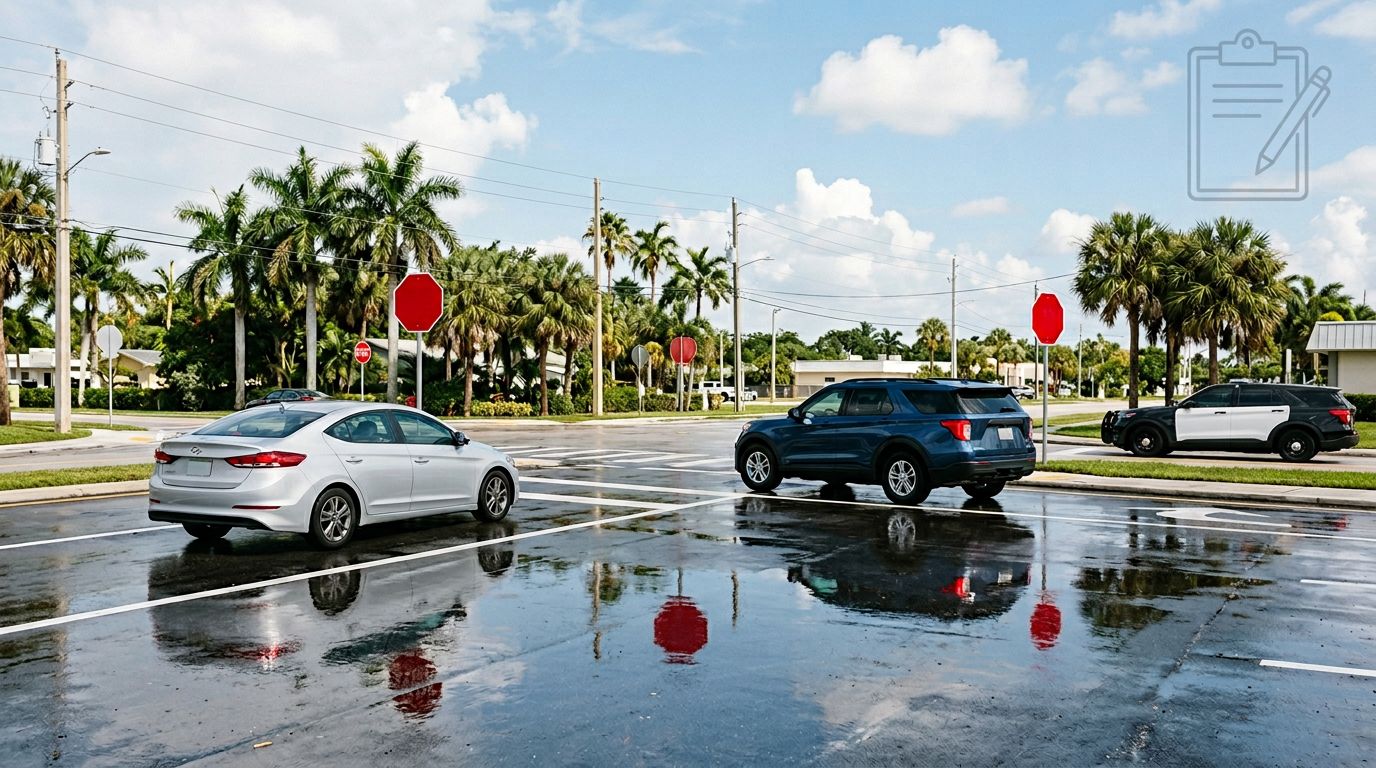
A four-way stop looks simple until it isn’t. One driver rolls through, another “waves” someone on, and suddenly everyone swears they had the right-of-way. After a Florida four-way stop accident, the biggest risk for a not-at-fault driver is getting pulled into a shared-blame story.
Proof fixes that. Not opinions, not confidence, not the loudest voice at the corner.
This guide breaks down what to document, what to say (and not say), and how to keep an insurance company from rewriting what happened after the fact.
How Florida four-way stop right-of-way really works (and why blame gets flipped)
Four-way stop crashes often start with a tiny timing dispute. Who stopped first? Did someone stop at all? Did two cars “arrive at the same time”? Those details decide who had the duty to yield.
Florida’s stop sign rule sits in Florida Statute 316.123. In plain terms, drivers must stop at the line (or crosswalk, or before entering), then yield to vehicles already in the intersection or close enough to be a hazard. When vehicles stop at the same time, the driver on the right generally goes first.
As of March 2026, the right-of-way rules for stop-controlled intersections haven’t changed. The problem isn’t the rule. The problem is proving the timeline when drivers disagree.
Insurance adjusters know four-way stops create easy “shared fault” arguments. They’ll often push one of these angles:
- The “you hesitated, so I went” excuse: The other driver claims you waived your turn by pausing.
- The “we stopped together” tie: They say it was simultaneous, then insist you were on their left.
- The “rolling stop” denial: They claim they fully stopped, even if they didn’t.
- The “blocked view” defense: They blame bushes, parked cars, glare, or signage placement.
If the crash turns into a timing argument, neutral proof matters more than your memory.
That’s why your goal is simple: capture evidence that shows (1) who entered first, (2) where each vehicle came from, and (3) whether anyone failed to stop or yield.
The first-hour proof checklist: lock down the scene before it disappears
Think of a four-way stop scene like chalk on a sidewalk. Rain, traffic, and tow trucks erase it fast. If you can safely do so, start collecting proof immediately after you call 911 and check for injuries.
Begin with a 20 to 40-second phone video. Walk slowly and narrate basics (date, time, intersection name). Then take photos from wide to close.
Here’s what to focus on, because it answers the questions insurers fight about:
- Stop control and lane setup: Get each stop sign, stop line, crosswalk, and any “All Way” plaques.
- Approach views: Take driver-eye photos from your lane, and from the other driver’s lane if safe.
- Final positions: Capture where both vehicles stopped, including curb lines and corner landmarks.
- Impact points: Photograph damage areas and any paint transfer. Angle damage often shows who moved into whom.
- Road markings and debris: Skid marks, scuffs, and debris fields can show the point of impact, not just where cars ended.
One quick way to keep your evidence organized is to match each item to what it proves:
| Evidence to gather | What it helps prove | Why it matters at a four-way stop |
|---|---|---|
| Wide corner photos (all 4 approaches) | Intersection layout and control | Prevents “there was no stop line” arguments |
| Driver-eye view photos | Sight lines and visibility | Counters “I couldn’t see” defenses |
| Vehicle positions and damage angles | Direction and timing | Supports who entered first |
| Witness names and phone numbers | Neutral timeline | Breaks “he said, she said” disputes |
| Nearby camera locations | Objective recording | Video often ends the argument |
Witnesses matter more at four-way stops than on many other crashes. A good witness is often the driver behind you, or someone stopped at a different approach who saw the order clearly. Ask for a name and number, then text yourself a note about what they saw.
Also, keep your words clean at the scene. Don’t fill silence with guesses. Avoid statements like “I didn’t see you” or “Maybe we got there together.” Those lines can sound like admissions later, even when you were being polite.
Proof after the tow: medical records, fault rules, and paperwork traps that shrink claims
Once the cars leave, insurance becomes a paperwork contest. Even with clear fault, the other side may still try to reduce what they pay by shifting partial blame or minimizing injuries.
Watch for Florida’s fault-percentage pressure
Four-way stop crashes are a favorite place to argue comparative fault. The adjuster might say you “should’ve waited,” “should’ve yielded,” or “should’ve avoided” the impact.
That matters because Florida uses a modified comparative fault system in most negligence cases. If an insurer can pin enough blame on you, it can cut the value of the claim, or block recovery in some situations. For a clear explanation of how those percentages work in real claims, read Avard Law’s guide on the Florida 51% fault rule explained.
To protect yourself, keep your story consistent and fact-based:
- Where you were stopped.
- When you entered.
- What you saw before you moved.
- Where the impact happened on your vehicle.
If you don’t know something, don’t guess. “I’m not sure” is safer than a confident assumption that turns out wrong.
Build a medical timeline that matches the crash
A low-speed corner crash can still cause serious injury. However, insurers often treat four-way stop collisions as “minor” and look for any gap to question you.
Get checked out promptly, then follow through. Continue care if symptoms persist. Just as important, tell providers how the crash happened (for example, “T-boned entering a four-way stop after stopping”). Clear notes help connect the injury to the event.
Keep a simple folder with:
- ER or urgent care discharge papers
- Imaging reports (X-ray, CT, MRI)
- Work notes and missed-time documentation
- Medication receipts and therapy bills
- A short weekly pain and limitation log (one paragraph is enough)
Don’t sign away injury rights in a property-damage deal
After a crash, some insurers rush to pay for the vehicle. That can be fine. The danger is signing a release that closes more than property damage.
Before you accept any settlement paperwork, understand the common pitfalls in Florida property damage release traps. A “quick fix” for the car can create a long problem for medical compensation if the paperwork is too broad.
Track deadlines early, even if you’re focused on healing
Deadlines creep up faster than people expect, especially when treatment, work, and car replacement take over your schedule. If injuries are significant, learn the basics of time limits for filing. Avard Law’s overview of the Florida injury statute of limitations is a practical starting point.
Conclusion: win the four-way stop argument with objective proof
Four-way stop crashes feel personal because the blame talk starts immediately. Still, the best protection is objective evidence, gathered early and kept organized. Photos, witness contacts, and a clean medical timeline can stop an insurer from turning your Florida four-way stop accident into a shared-fault story. If the facts are disputed or injuries are serious, getting legal help quickly can preserve proof that won’t be available later.