
Florida PIP 14-Day Rule in 2025, what counts as “initial treatment”, where people slip up, and how to fix it fast (Cape Coral)
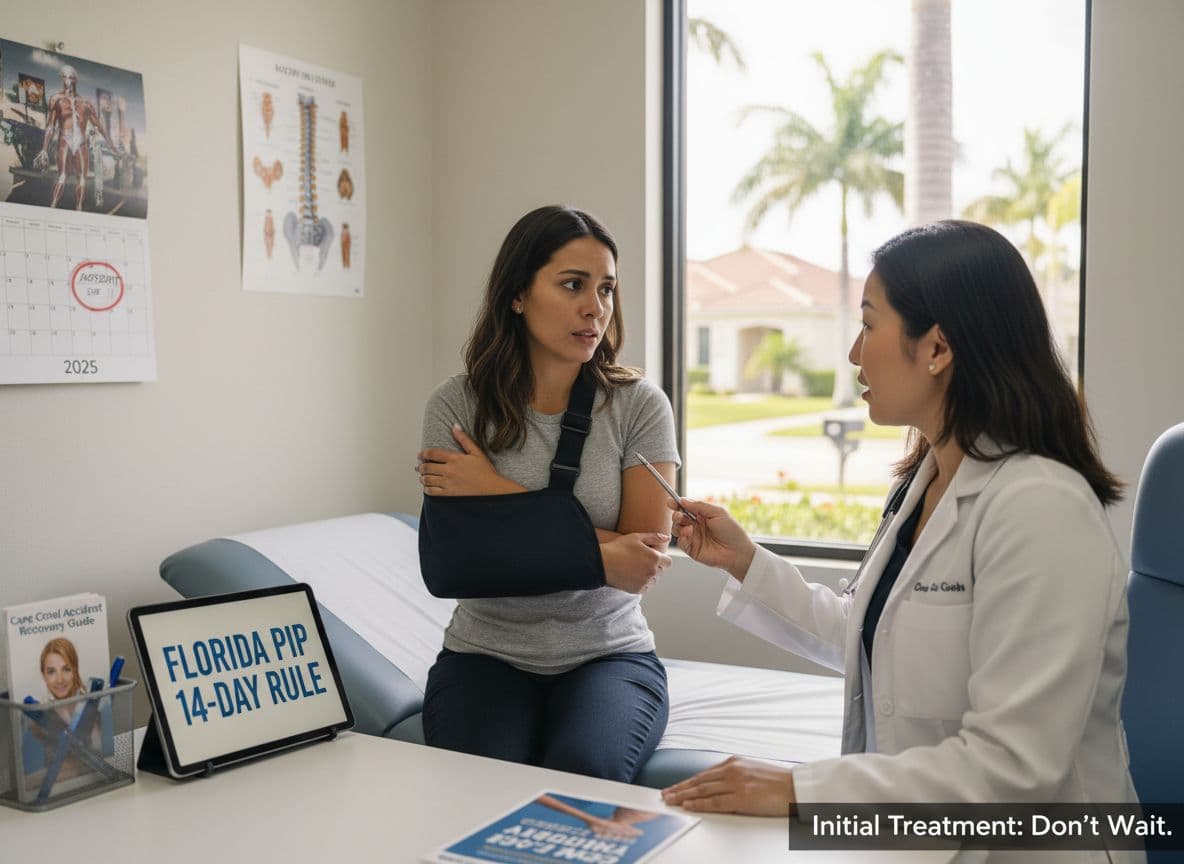
After a car crash in Cape Coral, your body might feel “mostly fine” for a day or two. Adrenaline can hide pain, and soreness can creep in later. But Florida’s insurance rules don’t wait for symptoms to show up.
The Florida PIP 14-day rule is one of the fastest ways people accidentally lose access to medical coverage under their own auto policy. It’s not about toughness, it’s about timing and paperwork.
This guide explains what counts as “initial treatment” in 2025, where people slip up, and what to do right now to protect your claim.
The 14-day rule in plain English (and why it matters)
Florida is a no-fault state. That means your own Personal Injury Protection (PIP) coverage is usually the first source of payment for accident-related medical bills and some wage loss, even if the other driver caused the crash.
PIP commonly pays:
- 80% of reasonable medical expenses (subject to rates and rules)
- 60% of lost wages (with proof)
- Certain replacement services and a death benefit in fatal cases
The catch is the deadline: you must get medical care within 14 days of the crash to qualify for PIP benefits. Miss it, and your insurer may deny PIP entirely, leaving you to fight over payment through health insurance, out of pocket, or a liability claim.
For a helpful overview of how no-fault works locally, see Understanding Florida PIP after a Cape Coral crash.
What counts as “initial treatment” in 2025?
Think of “initial treatment” like stamping a parking ticket. Once it’s stamped by the right person, you’re in the system. If it’s stamped by the wrong person, it’s as if nothing happened.
To satisfy the 14-day rule, your first visit must be with a qualified medical provider under Florida’s PIP rules. Common examples that usually count include:
- Emergency room evaluation and treatment
- Ambulance or EMT care at the scene (documented)
- Urgent care visit with a licensed provider
- Primary care doctor visit
- Chiropractic evaluation and treatment
- Dental treatment for crash-related injuries (for example, a broken tooth)
What often doesn’t count as initial treatment:
- Massage therapy by itself
- Bodywork or “adjustments” not done by a licensed qualifying provider
- Advice from a friend who is a nurse, without an actual patient visit and record
Two details matter more than most people realize:
1) The record has to connect the visit to the crash.
If the note says “neck pain” but doesn’t mention an auto accident, insurers may argue the visit isn’t related.
2) The provider has to be eligible under PIP rules.
People lose benefits because they went somewhere that felt medical, but didn’t meet the legal definition for PIP.
If you want a broader picture of what PIP covers and how it fits with other auto coverages, this page helps: Florida automobile insurance basics and PIP overview.
The EMC issue: why some people only get $2,500 (not $10,000)
Many drivers assume “I have $10,000 in PIP, so I’m covered.” In practice, the available amount can depend on whether a provider finds an Emergency Medical Condition (EMC).
In general terms:
- With an EMC finding, PIP benefits may be available up to $10,000 (policy limits and rules still apply).
- Without an EMC finding, benefits may be capped at $2,500.
This is a common surprise in Cape Coral cases, especially with soft-tissue injuries, headaches, and back pain that are real but harder to prove on day one. Early evaluation and clear documentation can make a big difference.
Where Cape Coral crash victims slip up (and how insurers use it)
Insurance companies look for gaps. Not because they’re personal, but because gaps make denial easier.
Waiting because the pain “isn’t that bad”
A lot of injuries act like a slow leak, not a blowout. Neck and back pain, concussions, and shoulder injuries can worsen over days.
If you wait past day 14, the insurer can say you failed the basic requirement for PIP. At that point, the argument often shifts from “how hurt are you?” to “you missed the rule.”
Going to the wrong first stop
People often start with massage, a gym trainer, or a wellness clinic because it feels less intimidating than a medical office. If that first stop isn’t a qualifying provider under PIP, you may not have “initial treatment” for PIP purposes.
Getting seen, but not saying it was a car accident
This one is brutal because it’s fixable if caught early.
If you go to urgent care and say “my neck hurts,” but you don’t clearly report “I was in a car crash on (date),” the chart may not tie your symptoms to the collision. Insurers love vague charts.
Not keeping proof
You don’t need a binder on day one, but you do need basics: discharge papers, visit summaries, imaging orders, prescriptions, and work notes. If your provider uses a patient portal, download the visit note.
How to fix it fast (day 1 to day 14)
If you’re still within the 14 days, your job is to lock in a qualifying visit and clean documentation.
Do this today:
- Get evaluated by a qualifying provider (ER, urgent care, physician, chiropractor).
- Tell them the crash date, where it happened (Cape Coral, Fort Myers, etc.), and what hurt right after impact.
- Ask for a visit summary that clearly references the motor vehicle accident.
- Start a simple symptom log (headache, sleep, driving anxiety, numbness, missed work).
If you’re unsure what steps to take after the crash itself, this guide is a solid checklist: What to do right after a Cape Coral collision.
Missed the 14 days? Focus on damage control, not blame
If the 14-day window has already passed, there’s no magic reset button. You can still protect yourself, but you need a realistic plan.
Step 1: Get medical care anyway
Your health comes first. Also, treatment creates records that may help with other coverage (health insurance, MedPay if you have it) and any potential liability claim.
Step 2: Notify your insurer and organize records
PIP claims are paperwork heavy. In 2025, claims handling timelines and documentation rules are tighter than many people expect. Keep copies of everything you submit, and keep a log of who you spoke with and when.
Step 3: Talk to a personal injury attorney quickly
When PIP is denied, you can be stuck between providers demanding payment and insurers pointing at deadlines. A personal injury attorney can review whether the denial is valid, whether any exception applies, and whether you have options outside PIP.
This matters even more now because Florida’s recent tort changes also affect fault and timelines in many injury cases. For a Cape Coral focused explanation, see How HB 837 affects Florida crash claims in Cape Coral.
The fastest “right” plan for Cape Coral drivers
If you’re reading this after a crash, keep it simple:
- Within 24 to 48 hours: Get checked by a qualifying provider and make sure the crash is in the chart.
- Within 14 days: Don’t let the deadline pass without documented initial treatment.
- Within the first weeks: Follow the treatment plan, keep records, and don’t ignore new symptoms.
- If the insurer pushes back: Don’t guess, get legal advice before you sign anything or give long recorded statements.
Conclusion
The Florida PIP system is supposed to pay quickly, but the Florida PIP 14-day rule can shut it down just as fast. “Initial treatment” only counts if it’s with the right provider and tied to the crash in writing. If you’re inside the 14 days, act now and get the documentation right. If you missed it, protect your health, collect your records, and speak with a personal injury attorney to find the fastest path forward.