
Rotator Cuff Tears from Airbag Deployment in Cape Coral Car Crashes: Symptoms and Proof for Claims
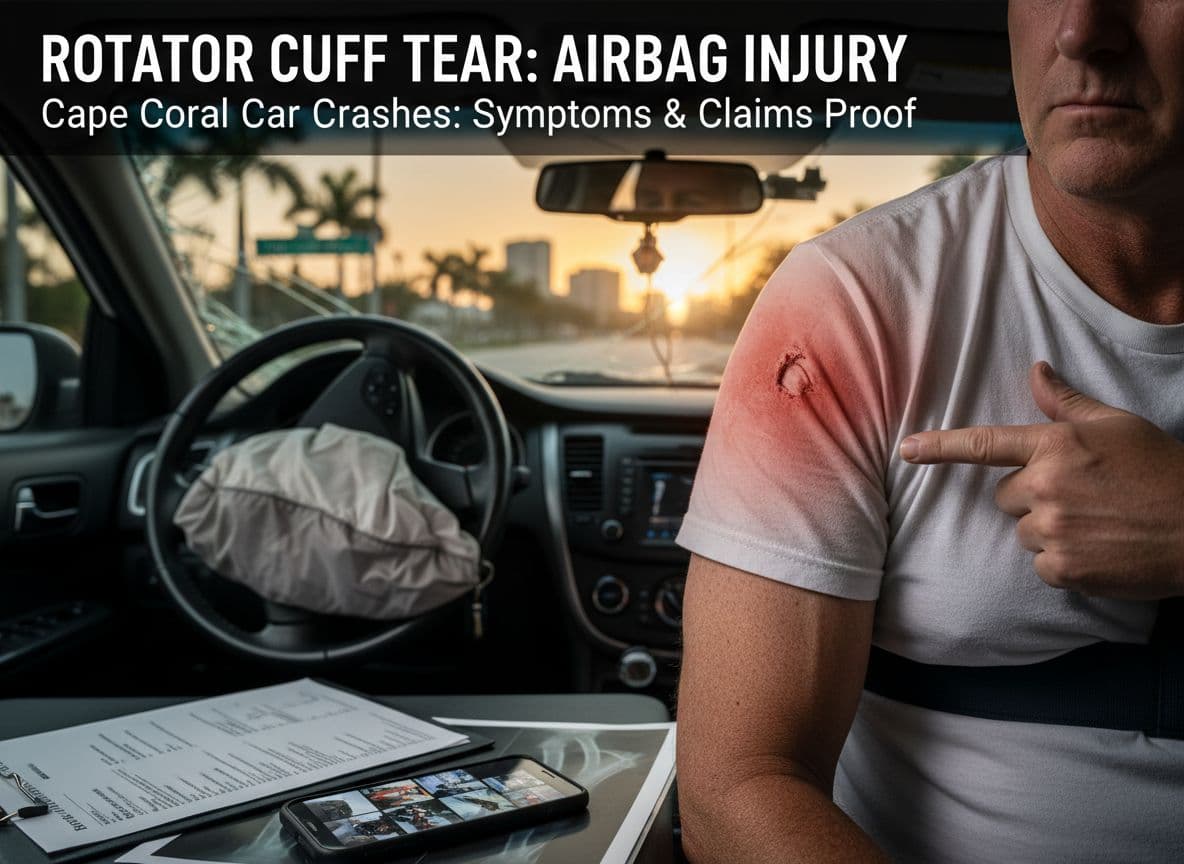
Airbags save lives, but they can also leave you hurt in ways you didn’t expect. One moment you’re driving through Cape Coral, the next there’s a loud pop, powder in the air, and a deep shoulder pain that wasn’t there before.
If your shoulder started hurting right after a collision, or worsened over the next day or two, an airbag rotator cuff tear may be the reason. These injuries can be hard to prove without the right medical testing and clean documentation, and insurers often treat shoulder pain like “just soreness.”
This guide explains what rotator cuff tears from airbag deployment can look like, what symptoms matter, and what evidence helps support a strong injury claim in Cape Coral.
Why airbag deployment can tear the rotator cuff
A rotator cuff is a group of tendons and muscles that stabilize your shoulder and help you lift and rotate your arm. In a crash, those tendons can be injured by sudden force, even if the airbag did what it was designed to do.
Airbags inflate in a fraction of a second. That rapid inflation can slam into the shoulder and upper arm, or force your arm into an unnatural position. Add a tight seat belt and the instinct to brace on the steering wheel, and the shoulder can take a hit like a door being kicked open.
Common crash scenarios that raise concern for an airbag-related shoulder tear include:
- Your hands were on the steering wheel at impact.
- The airbag struck the front or side of your shoulder.
- Your vehicle was hit at an intersection and the cabin jolted hard.
- You felt immediate weakness when trying to lift your arm afterward.
A tear can be partial (frayed or damaged tendon fibers) or full-thickness (the tendon pulls away from the bone). The symptoms and imaging results often drive the value of the claim, because they show the injury isn’t just pain, it’s structural damage.
Symptoms that suggest a rotator cuff tear after a Cape Coral crash
Some people feel shoulder pain right away. Others notice it later, once swelling sets in and adrenaline fades. Either way, a rotator cuff tear often makes daily tasks feel weirdly impossible, like your arm suddenly has a dead spot.
Here are common symptoms doctors associate with rotator cuff injuries:
| Symptom | What it can suggest after an airbag deployment |
|---|---|
| Shoulder pain that worsens with lifting or reaching overhead | Tendon irritation or tearing |
| Weakness when raising the arm (even with light objects) | Loss of tendon function, possible tear |
| Night pain, worse when lying on the injured side | Typical rotator cuff pattern |
| Stiffness or reduced range of motion | Pain-limited motion or inflammation |
| Clicking, popping, or grinding with movement | Tendon/bursa irritation, possible tear |
| Bruising or swelling around the shoulder/upper arm | Acute trauma from impact |
Red flags that deserve fast medical attention
Don’t wait it out if you have sudden weakness, a shoulder that “gives out,” or sharp pain when lifting the arm away from your body. Those can signal an acute tear where early diagnosis matters for both treatment and documentation.
How doctors diagnose an airbag-related rotator cuff tear
For claims, the goal isn’t just to say “my shoulder hurts.” The goal is to show a clear medical diagnosis, backed by imaging, that matches the crash forces.
A typical workup includes:
1) History tied to the crash A provider note that records “motor vehicle crash with airbag deployment, immediate shoulder pain” helps connect the dots early.
2) Physical exam findings Doctors often test strength and range of motion, looking for pain with certain movements and weakness patterns.
3) Imaging
- X-rays can rule out fractures or dislocations, but they don’t show tendon tears well.
- MRI or diagnostic ultrasound can reveal partial or full-thickness tears and related findings (inflammation, tendon retraction).
If your first visit didn’t include imaging and symptoms persist, follow up. Gaps in care and “I didn’t go back because it was busy” are easy openings for an insurance adjuster.
What proof matters most in an airbag rotator cuff tear claim
Think of your claim like a timeline. The cleaner the timeline, the harder it is to argue your shoulder problem came from something else.
Proof category 1: Evidence the crash caused shoulder trauma
- Crash report noting severity, impact direction, and airbag deployment.
- Photos of the interior (steering wheel airbag deployed, side curtain airbag, damage near the door).
- Vehicle damage photos that support a high-force event.
- Statements you gave at the scene (be accurate, don’t guess about fault).
Proof category 2: Medical records that “lock in” the injury
Strong documentation usually includes:
- First medical visit notes describing shoulder pain and mechanism (airbag strike, bracing, seat belt load).
- Referral to orthopedics if symptoms persist.
- MRI report confirming a tear (and describing features consistent with an acute injury, when noted).
- Physical therapy evaluations tracking loss of function and progress.
Under Florida’s no-fault system, timing can matter. PIP rules and deadlines affect access to benefits, so it helps to understand how coverage works early. For a plain-language overview, see Florida no-fault law explained for Cape Coral drivers.
Proof category 3: Documentation of how the injury changed your life
This is where many cases quietly rise or fall.
Useful support includes:
- Missed work records, job duty limits, and reduced hours.
- A simple pain and activity journal (short entries, consistent dates).
- Receipts for out-of-pocket costs (copays, braces, mileage, help at home).
- Notes about lost activities (sports, fishing, lifting kids, housework).
Common challenges insurers raise (and how good documentation answers them)
Insurance companies often question rotator cuff claims because shoulder tears can also happen from aging or prior strain. That doesn’t mean your injury isn’t real. It means your proof needs to be tight.
Typical arguments include:
“It’s a pre-existing condition.”
A prompt evaluation, early complaint of shoulder pain, and imaging that shows a tear after the crash can help separate old wear from new trauma.
“The crash was low impact.”
Airbags usually deploy when sensors detect a threshold of force. Photos, repair estimates, and the crash report can support the seriousness of the event.
“You waited too long to treat.”
Delays invite doubt. If you had a delay, document why (urgent care referral issues, appointment shortages) and get evaluated as soon as you can.
Steps to take after a Cape Coral crash if your shoulder hurts
If you suspect an airbag rotator cuff tear, focus on health first, then paperwork.
- Get checked quickly, even if the pain seems mild at first.
- Tell the provider exactly what happened (airbag strike, bracing, shoulder position).
- Follow through with referrals and physical therapy.
- Save all paperwork and take photos early.
If you need a checklist that covers the whole post-crash process, use what to do after a Cape Coral car crash.
When to talk with a personal injury attorney about an airbag shoulder injury
Rotator cuff tears can lead to weeks of therapy, possible injections, and sometimes surgery. They can also affect your ability to work, sleep, drive, and lift.
It’s smart to speak with a personal injury attorney when:
- Imaging confirms a tear or surgery is being discussed.
- Your job requires lifting, carrying, or overhead work.
- The insurer downplays the injury or pushes a quick settlement.
- You’re being blamed for part of the crash.
You can learn more about local representation through Cape Coral personal injury attorneys. If you’re also trying to set realistic expectations about compensation, this guide on how much you can expect for a rotator cuff tear after a Cape Coral crash can help you understand the factors that shape case value.
Conclusion
A shoulder injury after airbag deployment isn’t “just soreness” when you can’t lift your arm, sleep through the night, or do your job. The strongest airbag rotator cuff tear claims usually have the same foundation: fast medical care, imaging that confirms the tear, and consistent records that connect the injury to the crash.
If your shoulder pain started after a Cape Coral collision, treat it like a warning light on your dashboard. Get it checked, document it, and protect your claim as carefully as you protect your recovery.