
Parking lot crashes in Cape Coral: proving fault and protecting your claim
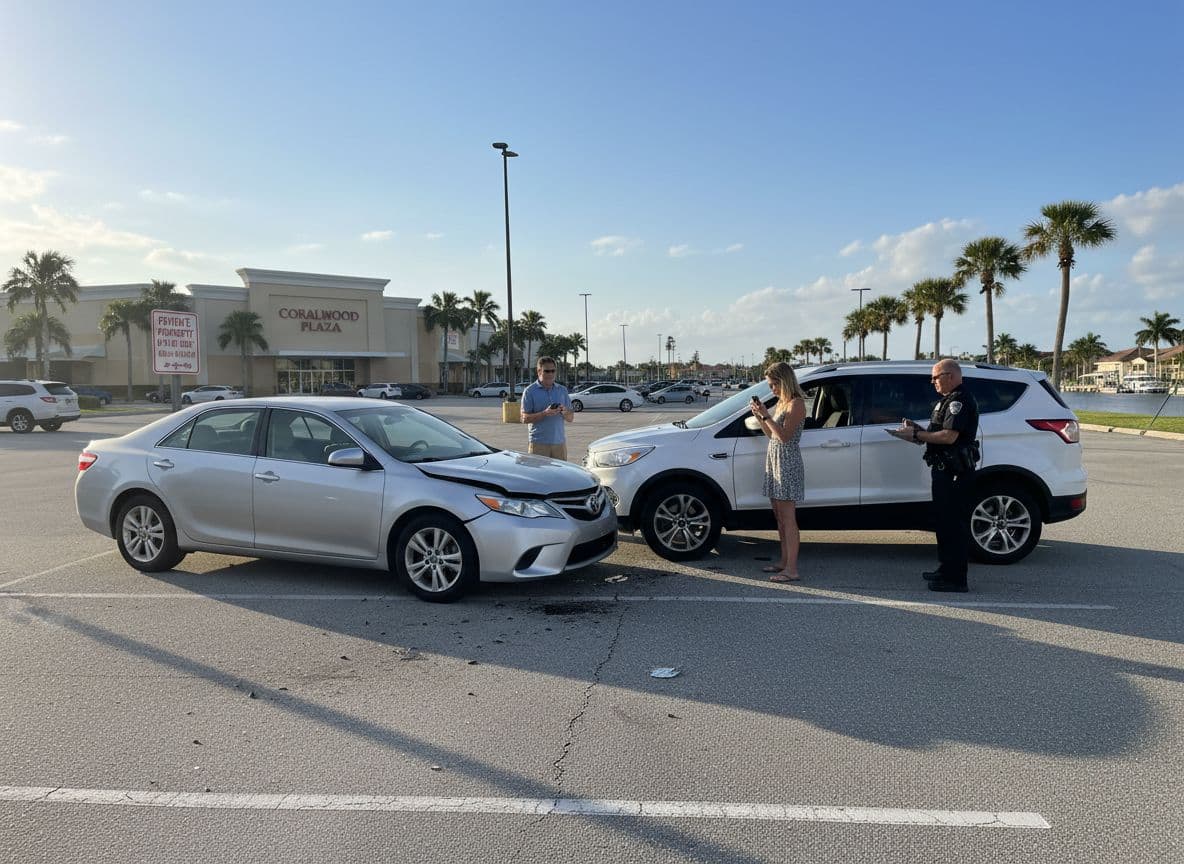
A parking lot can feel like a slow-speed zone, but it’s more like a crowded dance floor with cars. Drivers back out without looking, shoppers cut between bumpers, and nobody agrees on who had the right-of-way. When a Cape Coral parking lot accident happens, the damage may look minor, yet the injury claim can turn into a fight fast.
Insurance companies often treat parking lot crashes as “shared fault” by default. If you don’t lock down the facts early, your claim can shrink, stall, or get blamed on you.
This guide explains how fault is proven in Cape Coral parking lot crashes, what evidence matters most, and what steps protect your claim.
Why parking lot crashes are harder to prove than road crashes
On a main road, traffic signals, lane lines, and official crash reports create a clear framework. Parking lots are different. Many have faded markings, confusing arrows, and “courtesy rules” that drivers follow only when it suits them.
Two issues show up in almost every parking lot case:
1) Fewer neutral records. Police may not respond, and there may be no traffic camera footage.
2) Competing stories. One driver says, “I was already backing out,” the other says, “They shot out of the space.” Without evidence, insurers often call it 50/50.
That’s why a Cape Coral parking lot claim is less about what “should’ve” happened, and more about what you can prove happened.
Common parking lot crash scenarios and who may be at fault
Fault depends on the exact movement of each vehicle, the layout, and what a careful driver should have done. These are the most common patterns in a Cape Coral parking lot accident and how liability is usually analyzed.
Backing out collisions
Backing drivers have a high duty to check and yield. If you’re reversing out of a space, you’re expected to move slowly and stop if there’s cross-traffic.
That said, the other driver isn’t off the hook. If they were speeding through the aisle, cutting diagonally, or distracted, fault can be shared.
Aisle right-of-way disputes
In most lots, the vehicle traveling straight down the main aisle has the advantage over a car pulling out of a parking space or side lane. Problems happen when drivers treat the aisle like a racetrack or roll through painted stop lines.
Two cars backing out at the same time
These often become shared-fault cases because both drivers were reversing. The deciding details are usually angle, timing, and whether one driver stopped while the other kept moving.
Pedestrian knockdowns and near-crosswalk areas
Lots near big stores and restaurants often have heavy foot traffic. Drivers must watch for pedestrians even when there’s no marked crosswalk. If a driver was searching for a space instead of watching the walkway, that can support negligence.
When the property owner may share blame
Sometimes the layout creates the danger. Poor lighting, blocked sightlines, missing signage, and broken speed bumps can contribute. In those cases, there may be a claim beyond the driver’s insurance, but it takes evidence and careful review.
What evidence proves fault in a Cape Coral parking lot accident
Think of evidence like a puzzle. A single piece rarely wins the case, but several pieces together can make the story hard to deny.
The evidence types that matter most
| Evidence | What it can show | Why it helps |
|---|---|---|
| Photos of vehicle positions and angles | Who was moving, who was established in the lane | Helps defeat “he said, she said” arguments |
| Damage patterns (corner vs. side swipe) | Direction of travel and impact point | Often matches one driver’s version better |
| Surveillance video (stores, banks, condos) | The crash itself, speed, and right-of-way behavior | Can end fault disputes quickly |
| Witness names and short statements | Independent account of who moved first | Strong credibility with insurers |
| Lot markings and signage photos | Stop lines, arrows, blind spots | Shows what a reasonable driver should’ve done |
| Medical records from prompt treatment | Injury link to the crash | Prevents “you weren’t really hurt” defenses |
Move fast on video, it disappears
Many businesses recycle footage in days, not months. If you wait, the best proof may be gone. A personal injury attorney can send preservation requests quickly and follow up before the footage is overwritten.
Don’t underestimate “small” scene photos
Take wide shots (the whole aisle), then closer shots (paint lines, arrows, obstructions). A tight photo of a dent is helpful, but a wide photo that shows you were already in the travel lane can be the difference between full payment and a 50/50 split.
Florida insurance rules that can shape your recovery
Even when the other driver caused the crash, Florida’s insurance system affects how money flows and what you must prove.
No-fault (PIP) still applies to many injuries
Florida’s no-fault system often means you start with your own Personal Injury Protection coverage for medical bills and some lost wages. Deadlines matter, including the common 14-day treatment window that can impact PIP access. For a clear overview, review Understanding PIP coverage after a Cape Coral crash.
Partial fault can cut your payout
Parking lots are prime territory for “you share the blame” arguments. If an insurer can push meaningful fault onto you, it can reduce what they pay. Learning how Florida evaluates shared responsibility helps you avoid mistakes in statements and paperwork, see How comparative negligence impacts Cape Coral claims.
Legal deadlines are shorter than many people think
In recent years, Florida shortened key timelines for many negligence cases. Waiting to “see how you feel” can cost you leverage, or your claim, even when the crash seemed simple at first.
Steps that protect your claim (before the insurance company shapes the story)
Good claims are built early. Here’s what helps most after a Cape Coral parking lot accident.
Get medical care quickly. It protects your health and creates a clean record linking the injury to the crash.
Report the crash. If law enforcement won’t respond, still document the event with the property owner or security office. Ask for an incident report number.
Collect the right info, not a long argument. Names, plates, insurance, and witness contacts matter more than debating fault at the scene.
Be careful with recorded statements. Insurers often ask friendly questions that turn into blame, like “Were you in a hurry?” or “Did you see them at all?”
Keep a simple symptom log. One short note per day is enough (pain level, missed work, sleep problems). It helps later when the insurer claims you “got better in a week.”
For a practical checklist you can follow after any crash in Cape Coral, use What to do after a Cape Coral crash.
Conclusion
Parking lots are messy, and insurers count on that mess to water down claims. The strongest Cape Coral parking lot cases are the ones backed by quick photos, preserved video, independent witnesses, and prompt medical care.
If you were hurt, speaking with a personal injury attorney early can help secure evidence and stop unfair fault-shifting before it hardens into the official story. Your claim is only as strong as what you can prove, so treat the first few days like they matter, because they do.