
Emergency Medical Condition (EMC) Forms in Florida PIP, how Cape Coral crash victims can avoid the $2,500 cap
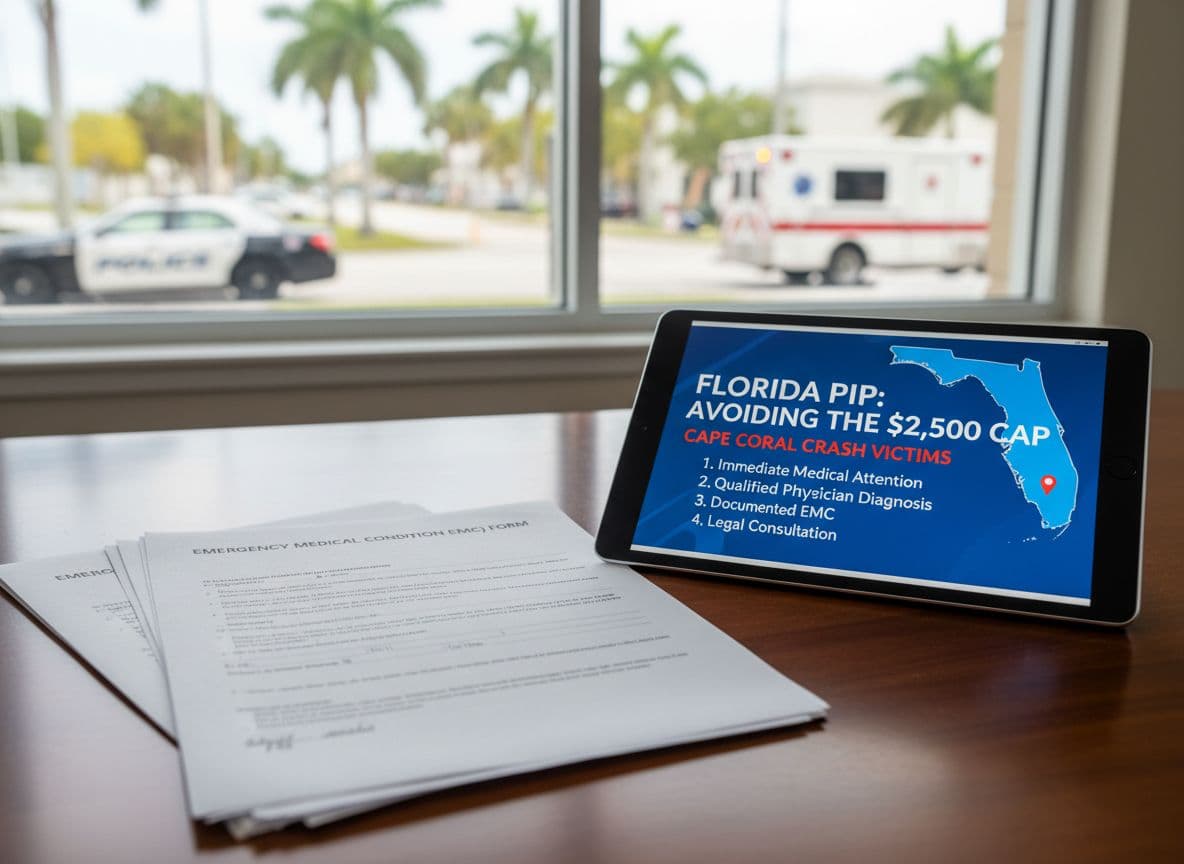
After a Cape Coral car crash, the first medical bill can feel like a punch. The ambulance, the ER, the imaging, the follow-up visit, it adds up fast. Then you learn Florida PIP might only pay $2,500, even though you’ve carried PIP for years.
That gap often comes down to one thing: the Florida PIP EMC form (or more accurately, an Emergency Medical Condition determination in your records). Think of PIP as a safety net. The EMC is the knot that keeps it from tearing.
This guide explains what an EMC is, why the paperwork matters, and what steps Cape Coral crash victims can take to protect the full $10,000 PIP benefit.
Florida PIP in plain English: $2,500 vs $10,000
Florida’s no-fault system requires most drivers to look to their own Personal Injury Protection (PIP) coverage first, no matter who caused the wreck. PIP generally pays a portion of medical bills and some lost wages, up to the policy limit.
The catch is the cap tied to an Emergency Medical Condition determination.
| PIP situation | What PIP may pay for medical care | What usually triggers it |
|---|---|---|
| No EMC determination | Up to $2,500 | Records do not clearly state EMC |
| EMC determination documented | Up to $10,000 | Qualified provider documents EMC |
For a local overview of how no-fault claims work, see Florida no-fault law explained for Cape Coral accidents.
What an Emergency Medical Condition (EMC) really means
An EMC isn’t “I’m sore.” It’s a medical finding that your condition could reasonably be expected to cause:
- serious harm to your health, or
- serious problems with a body part or organ, or
- serious dysfunction, without prompt medical care
That can include injuries people sometimes downplay at first, like a neck injury with severe symptoms, head injury symptoms, or back pain with neurological signs. The point is not whether you can walk, it’s whether delaying care creates a serious risk.
Insurance companies pay close attention because an EMC determination is often the switch between $2,500 and $10,000.
For a deeper explanation of how insurers treat the EMC requirement, see Emergency Medical Condition requirement under Florida PIP.
The “Florida PIP EMC form” isn’t always a literal form
People commonly call it the Florida PIP EMC form because many ERs and clinics use a checkbox form or template. But what matters most is the medical record.
If the insurer doesn’t see clear language that an EMC was found, it may treat the claim as non-EMC and stop paying at $2,500. Vague notes like “patient in pain” can be risky. A clean statement is better, such as a provider documenting that the patient “suffers an emergency medical condition” under Florida’s no-fault definition.
Who can make the EMC determination (and why that detail matters)
Not every provider’s opinion carries the same weight for PIP. The EMC determination must be made by a qualified medical professional authorized under Florida’s PIP rules. In practice, that often means a physician (MD or DO), and in some settings other licensed practitioners may be involved under proper authority.
If you’re getting care at an urgent care or clinic, ask a direct question:
“Who will sign the EMC determination for my PIP file?”
That one question can prevent weeks of delay and a surprise cap.
How Cape Coral crash victims can avoid the $2,500 cap (step-by-step)
1) Get medical care within 14 days, even if symptoms feel “minor”
Florida PIP has a strict treatment window. If you don’t get medical care within 14 days, you can lose PIP eligibility entirely, not just the extra $7,500.
If you’re not sure what to do first, follow what to do right after a Cape Coral accident.
2) Tell the provider it was a car crash, and describe symptoms clearly
Doctors document what you report. If you say “I’m fine, just stiff,” your chart may read like a non-emergency issue.
Be specific:
- where it hurts
- how intense it is
- what you cannot do (turn your head, lift your arm, sleep, concentrate)
- new symptoms (numbness, dizziness, nausea, headache, weakness)
3) Ask about EMC documentation before you leave
You don’t need to argue with the doctor. You do need clarity.
Good phrasing:
- “Will my chart include an EMC finding for PIP?”
- “If not today, when will you re-evaluate for EMC?”
4) Get a copy of your visit notes or discharge paperwork
Many people assume the clinic “sent everything.” Sometimes it doesn’t happen quickly. Sometimes it happens with missing pages.
Request:
- the ER discharge papers, or
- the clinic visit summary, and
- any imaging impressions (X-ray, CT, MRI)
5) Keep treating consistently and follow through on referrals
Insurance adjusters love gaps. A two-week break in care can turn into “you must have gotten better,” even when that’s not true.
Consistency also helps your doctor make a stronger, better supported EMC decision.
Common mistakes that lead to the $2,500 cap
Waiting it out: Hoping pain fades can cost you the 14-day deadline, and it can also weaken your medical record.
Assuming the ER automatically equals EMC: An ER visit helps, but it doesn’t guarantee the EMC language was documented.
Not checking who signed: If your records don’t show the proper credentials behind the EMC determination, you can end up in a paperwork fight.
Treating without a clear diagnosis: If your care looks generic, insurers may claim it was unnecessary.
What if your doctor didn’t mark EMC right away?
This happens often. The good news is that an EMC determination can sometimes be made after the first visit, based on later findings, worsening symptoms, imaging results, or how you respond to treatment.
Practical next steps:
- Schedule a follow-up with a qualified provider promptly.
- Bring your records and imaging results.
- Ask the provider to address EMC clearly in the chart.
If the insurer is still refusing to apply the full benefit, a personal injury attorney can help push for proper PIP payment and protect your broader injury claim.
When PIP isn’t the whole story (serious injuries and lawsuits)
Even if you secure the EMC and unlock up to $10,000, that amount can vanish fast. If your injuries are severe or lasting, you may need to pursue claims beyond PIP.
Florida’s rules for stepping outside no-fault are strict, and recent legal changes have also affected deadlines and fault arguments. For a Cape Coral focused explanation, review 2025 Florida tort reform impact on Cape Coral claims.
For some people, the real financial recovery comes from proving the at-fault driver’s liability and documenting how the injury changed daily life, not just submitting bills.
Conclusion
In Cape Coral, the difference between a manageable recovery and a financial spiral can be one line in a medical record. The Florida PIP EMC form issue is really a documentation issue, and it’s fixable when you act early. Get care within 14 days, make sure a qualified provider evaluates you for EMC, and keep your records organized. If your insurer pushes back, getting help fast can protect both your PIP benefits and your larger injury claim.