
Cape Coral Crash Witness Statements: Call and Text Scripts, What to Ask, and How to Get a Signed Statement
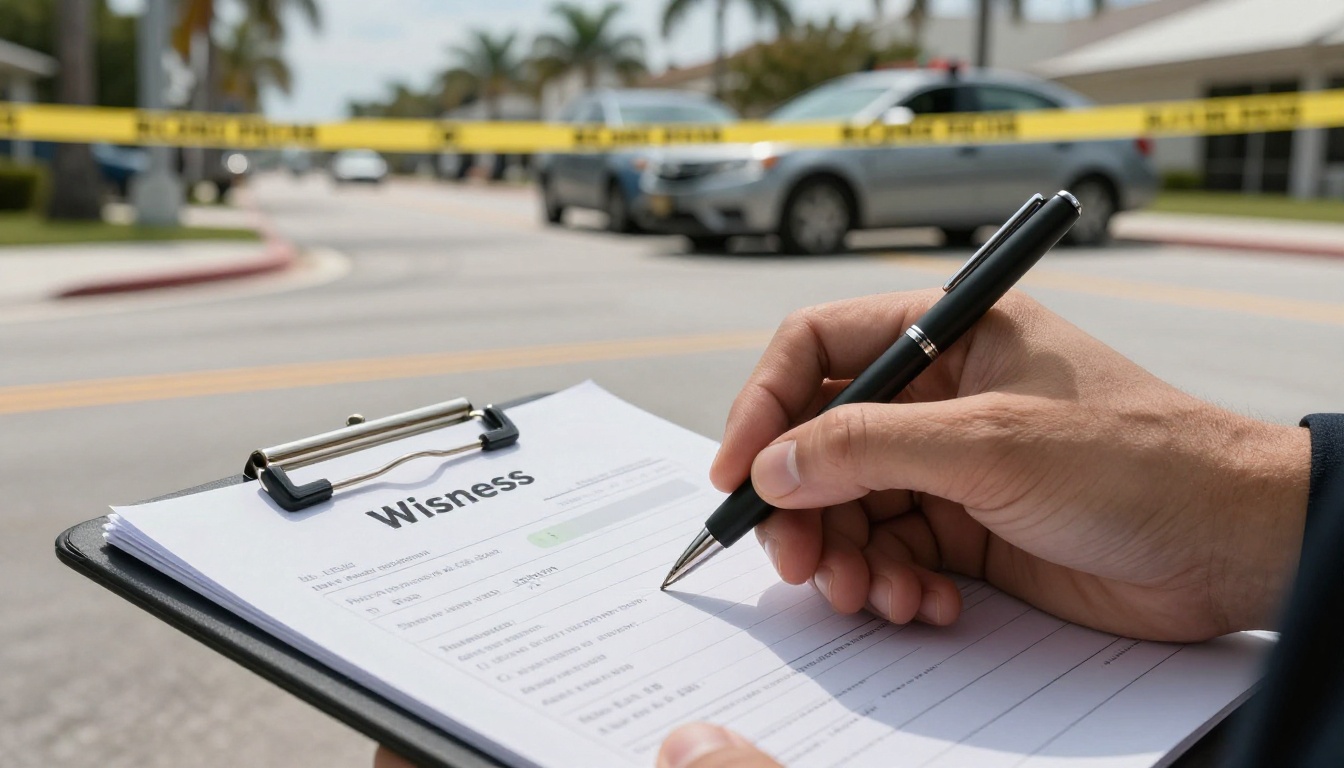
After a Cape Coral car crash, facts don’t disappear all at once. They drip away. A car accident witness who clearly remembers the light sequence on day one may feel unsure by day ten, especially after talking to an insurance adjuster or friends.
A strong accident witness statement (eyewitness testimony) can steady your claim when other evidence is thin, such as when the other driver changes their story, the crash report is thin, or there’s no video. The key is simple: reach out fast, ask clean questions, and capture the witness’s words in a way that holds up later.
Why witness statements can make or break a Cape Coral crash claim
Witnesses provide an unbiased account as the “outside eyes” of a wreck. They usually have no reason to shade the truth, offering third-party verification, and that’s exactly why the insurance company takes witness statements seriously. When proving fault is disputed, they can establish liability by confirming basics like who entered on red, who drifted lanes, or whether a driver was speeding or looking down.
Witness statements also help with the parts of a crash you might not notice in the moment. You may be focused on pain, airbags, or your child in the back seat. Bystanders might notice the other driver holding a phone, rolling through a stop sign, or making an unsafe turn, so gathering evidence early from them is crucial for your case.
Treat witness evidence like ice in the Florida sun. It starts melting immediately. Start building your proof package early, including names and numbers, photos, and notes. If you want a practical “first week” checklist that includes witness contacts (and other time-sensitive records), use this Cape Coral car crash evidence checklist.
Finally, remember that witness statements work best when they match other evidence. If you can also secure nearby store footage or intersection video, the two can reinforce each other. If video might exist, see how to get Cape Coral crash surveillance video fast.
Before you contact a witness: prepare, protect privacy, and keep it neutral
Start by organizing what you already know. Write down the crash date, the exact location (intersection and direction of travel), and a short time window. When you contact a witness, being specific makes you sound credible, and it helps them anchor their memory.
Next, decide how you’ll communicate. A text is often the best first move because it’s low-pressure and it documents the contact. Calls work well after the witness agrees to talk.
Keep your tone neutral. Don’t “sell” your version of events. Being neutral helps you come across as credible to the witness, encouraging a potential credible witness to remain cooperative. If you lead with “You saw them run the red, right?” you risk planting ideas, and you risk turning a cooperative witness into someone who backs away.
A few rules that protect you:
- Ask for permission before recording any call or taking any statement on video.
- Don’t argue or correct the witness, even if they get a detail wrong. Ask calm follow-up questions instead.
- Don’t ask a witness to “help you win.” Ask them to describe what they saw.
- Don’t confront the at-fault driver directly at the scene.
It also helps to understand why some crash documents are hard to get right away. Florida limits access to a police report for a period of time, and eligibility can matter when you’re trying to confirm witness names listed in the report; these reports help determine comparative negligence in Florida. For the legal source on police report handling, see Florida Statutes 316.066. For general post-crash guidance from the state, review FLHSMV’s “Involved in a Crash?” page.
Cape Coral witness call and text scripts that get real answers
The best script sounds like a person, not a form letter. Your goal is to (1) confirm they’re willing to talk, (2) capture what they remember in their own words, and (3) lock in a way to follow up. Ideally, collect contact information at the accident scene if possible.
Text message script (first contact)
Hi, my name is [Name]. You gave your contact information at a crash in Cape Coral on [Date] near [Location]. I’m one of the drivers. Would you be willing to share what you saw? If yes, what’s the best time to call?
If they respond yes, send a second text that sets expectations:
Thank you. I’m only asking what you remember, in your own words. A 5-minute call is enough. Are you OK with me taking notes? (This is just notes, not a formal recorded statement.)
Phone call script (short and respectful)
Hi [Witness Name], thanks for taking my call. I’m [Name]. We spoke by text about the crash near [Location] on [Date].
Before we start, are you in a spot where you can talk for a few minutes?
I’m going to ask a few simple questions, and I’ll write down your answers as you say them.
Then ask open questions first:
Where were you when you first noticed the vehicles?
What did you see happen, step by step?
What stood out to you most?
Witness interview questions (without turning it into an interrogation)
Use questions that pull out details insurers care about: position, timing, signals, and who did what. This table keeps it focused.
| Topic | Questions that work |
|---|---|
| Where they were | “Where were you located (lane, sidewalk, parking lot)?” “How far away?” |
| What they saw first | “Which vehicle did you notice first?” “What drew your attention?” |
| Traffic control | “Do you remember the light or stop sign for each direction?” “Any turn arrows?” |
| Road conditions | “Were there any hazards or slick road conditions?” |
| Movement and timing | “Did either car change lanes or turn?” “Any sudden braking?” |
| Speed and driving behavior | “Did anything suggest speeding or distraction?” “Did you see a phone?” |
| After the impact | “Did either driver say anything at the scene?” “Did anyone leave?” |
Close by confirming contact details:
What’s the best phone number and email for you? If someone needs to follow up later, is that OK?
If police spoke with the witness, body-worn camera footage can sometimes capture early, unfiltered comments at the scene. If that might help your case, read how to request Cape Coral body cam video.
How to get a signed witness statement (and keep it usable)
A signed statement doesn’t need fancy language. It needs clarity. Think of it like a receipt for the witness’s memory, dated and tied to a real person.
The simplest format that works
Ask the witness to put their statement in this structure (one page is fine):
- Contact information: full name, address (city and state is often enough), phone, email
- Date and location of crash
- Where they were positioned and what they could see
- A step-by-step description in their own words
- A sentence confirming it’s true to the best of their knowledge
- Signature and date
You can send the witness a clean draft that contains only headings and blank space, then have them fill it in. If you draft the words for them, be careful. It can look coached. A better approach is to write what they said during the call, then email it back with: “Please edit anything that’s not exactly how you remember it.”
Signed, electronic, notarized: what’s worth doing?
For many claims, a signed and dated statement is enough. If witness accounts conflict, a personal injury attorney might bring in accident reconstruction experts. If the case is serious or heavily disputed, a notarized statement can add weight, but it also adds friction, and some witnesses won’t bother.
Electronic signatures can work well because they’re easy. If you use e-signing, save the final PDF and any audit or confirmation email that shows the date and the signer.
Don’t forget the “paper trail”
Save these items in one folder:
- The first text message (shows the contact date)
- The witness’s signed statement file
- Your notes from the call (with date and time)
- Any emails used to send or return the statement
- Records from first responders or the police report
- Photos documenting property damage
If you also need the official crash report quickly and you’re within the restricted access period, Florida uses a sworn statement form for certain requesters. You can review FLHSMV’s Sworn Statement for Crash Report (HSMV 94010) so you understand what the state asks for and why.
Conclusion
A clear accident witness statement can be the difference between “it’s your word against theirs” and a claim that stays consistent from day one to settlement talks. Building a strong portfolio of witness statements empowers your personal injury attorney to negotiate better settlement offers. Contact witnesses early, keep your questions neutral, and capture their words in a signed format that’s easy to verify later. When witness accounts line up with video, photos, and official records, you can recover compensation for medical care and pain and suffering, leaving insurers with less room to rewrite what happened.