
Florida U-Turn Accident Evidence That Proves An Illegal Turn
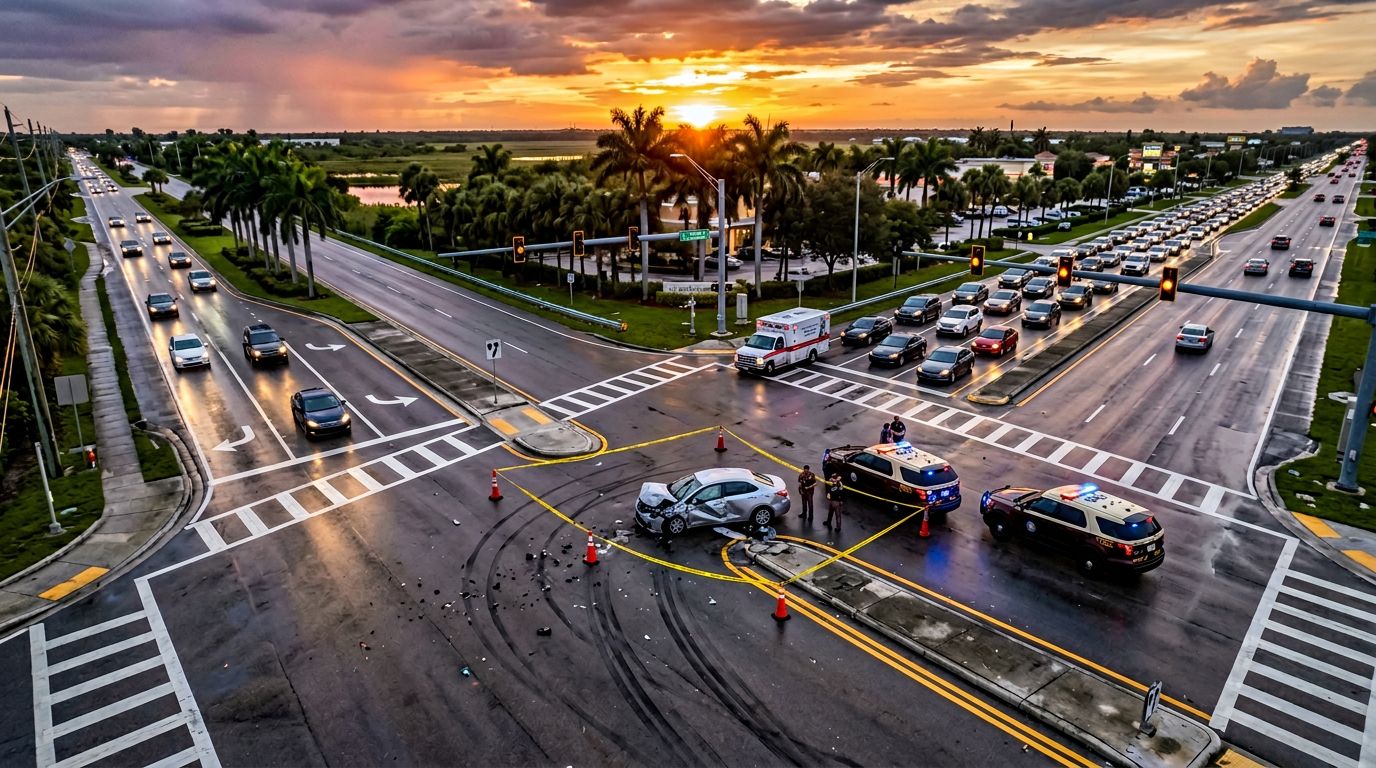
A U-turn looks simple until a car swings across your lane like a door flung into a hallway. One second you’re driving straight, the next you’re braking hard, and metal is folding.
After a Florida U-turn accident, the biggest question is often the same: was the turn illegal, or just a bad judgment call? That difference matters because it can decide who pays, and how much.
The good news is that illegal U-turns leave clues. The best cases don’t rely on opinions. They rely on proof, like road markings, video, impact angles, and witness accounts.
Why a Florida U-turn accident turns into a fault dispute
U-turn crashes create arguments because both drivers usually claim they “had no time.” The U-turn driver may say they checked and it was clear. The other driver may get blamed for speeding, distraction, or “not yielding.”
Florida doesn’t publish crash stats that isolate U-turns as their own category. So, these claims get decided the old-fashioned way: by reconstructing what happened from the scene and records.
Several facts tend to drive liability in a U-turn case:
The first is right-of-way. In many real-world situations, a U-turn acts like a left turn across traffic. That usually means the turning driver must yield to oncoming vehicles that are close enough to be a danger.
Next is location. Some spots are trouble magnets, like median openings near shopping centers, left-turn pockets used as “turn-around lanes,” and intersections where drivers assume “green means go.”
Finally, there’s legality versus safety. A U-turn can be “allowed” by signage yet still be negligent if the driver made it when it wasn’t safe. On the other hand, a U-turn can be illegal even if it would have been safe, because the road markings or signs flat-out forbid it.
If you want a starting point for how Florida regulates turning movements in general, see the Florida Statutes turning rules. In practice, a claim rises or falls on whether the evidence shows the U-turn driver broke the rules, or ignored obvious risk.
Evidence that proves the U-turn was illegal or unsafe
To prove an illegal U-turn, you’re usually building a timeline. Where was each car, what did the road require, and what warning signs were present?
Road signs and pavement markings (the “silent witnesses”)
A “No U-turn” sign is strong evidence because it’s simple and visual. Photos taken right after the crash can show the sign’s placement and sight lines. If the sign is missing later due to road work or storms, your early photos may matter even more.
Pavement markings can also support illegality. Examples include double-yellow center lines, painted medians, turn arrows that only allow left turns from a dedicated lane, and channelized areas that cars aren’t supposed to cross. Even when a U-turn is not explicitly banned, markings can show the driver turned from the wrong lane or cut across multiple lanes.
Sight distance and “you couldn’t see them in time”
Many illegal U-turn arguments come down to visibility. Was the U-turn attempted near a curve, hill crest, or other spot where oncoming traffic couldn’t see the turning car soon enough? When a driver turns where sight distance is short, the move can be both illegal and negligent.
You can support this with scene photos taken from a driver’s eye level, measurements, and sometimes a reconstruction expert. Even a basic phone video walking the approach can show how late the U-turn car becomes visible.
Video, data, and impact patterns that tell the real story
Modern evidence often settles disputes fast:
Traffic camera footage can show whether the U-turn happened on a red light, from the wrong lane, or across active traffic.
Vehicle damage and the point of impact also matter. A straight-on driver who hits the side of the turning car often supports the claim that the U-turn driver cut across the lane too close. Meanwhile, rear-quarter damage patterns can show the U-turn car entered the lane and got struck before it stabilized.
Phone records and event data can also help in the right case. If the U-turn driver claims they “never saw you,” distraction evidence may explain why.
One quick way to organize what matters most is to think in categories:
| Evidence type | What it can prove | Best way to secure it |
|---|---|---|
| Scene photos of signs and markings | The U-turn was prohibited or made from the wrong lane | Take wide and close shots immediately |
| Traffic or red-light video | Timing, lane position, signal phase, and the exact turn path | Send requests fast, retention can be short |
| Witness statements | Independent proof of who moved first and whether the U-turn was sudden | Get names and record a summary same day |
| Police diagram and citation info | The officer’s observations, measurements, and listed violations | Request the crash report and attachments |
| Vehicle damage angles | Whether you struck a turning vehicle that intruded into your lane | Photograph both cars before repairs |
The takeaway is simple: the best proof is objective. Signs, markings, and video don’t “pick sides,” they just show what happened.
For the official text of Florida’s turning movement statute, review Florida Statute Section 316.151. Your case may also involve related sections that address unsafe turns and U-turn limits based on location and visibility.
If the other driver’s insurer says, “U-turns are legal in Florida,” that’s not the end of the discussion. The real issue is whether that U-turn was legal there, and safe then.
How to lock down proof after an illegal U-turn crash
Evidence in a U-turn case can disappear faster than people expect. Skid marks fade. Vehicles get repaired. Video gets overwritten. Even witnesses forget details within days.
Start with the basics at the scene, if you’re able. Get out of traffic, call law enforcement, and seek medical care. Then shift to proof.
Photos are the foundation. Capture both cars, the full intersection or median opening, and the approach from both directions. Include lane arrows, “No U-turn” signs, and any view blocks (trees, walls, parked trucks). If you want a practical shot list, this guide on Cape Coral crash scene photos lays out the kinds of images that tend to matter in real claims.
Video is often the difference-maker, but it’s time-sensitive. That can include traffic cameras, nearby business cameras, and doorbell systems facing the road. If you suspect a camera caught the turn, move quickly using a process like this walkthrough on how to get traffic camera video in Cape Coral.
Witnesses help when video is missing or unclear. A neutral witness can confirm that the U-turn driver hesitated, darted out, or ignored a posted sign. The key is gathering details right away, while memories are fresh. This Cape Coral witness statement guide explains what to ask for, and how to keep it usable.
The earlier you collect proof, the less you have to argue later. Insurance companies negotiate differently when the story is backed by hard evidence.
Conclusion
A Florida U-turn accident claim often comes down to one issue: can you prove the turn was illegal or unsafe at that location and moment? Signs, road markings, video, impact patterns, and witness accounts can turn a disputed crash into a clear liability case.
If you’re dealing with injuries, medical bills, or a driver who denies fault, focus on preserving evidence early. The facts you save in the first few days can shape the outcome months later.