
Florida Restaurant Slip And Fall Claims And What Proves Notice
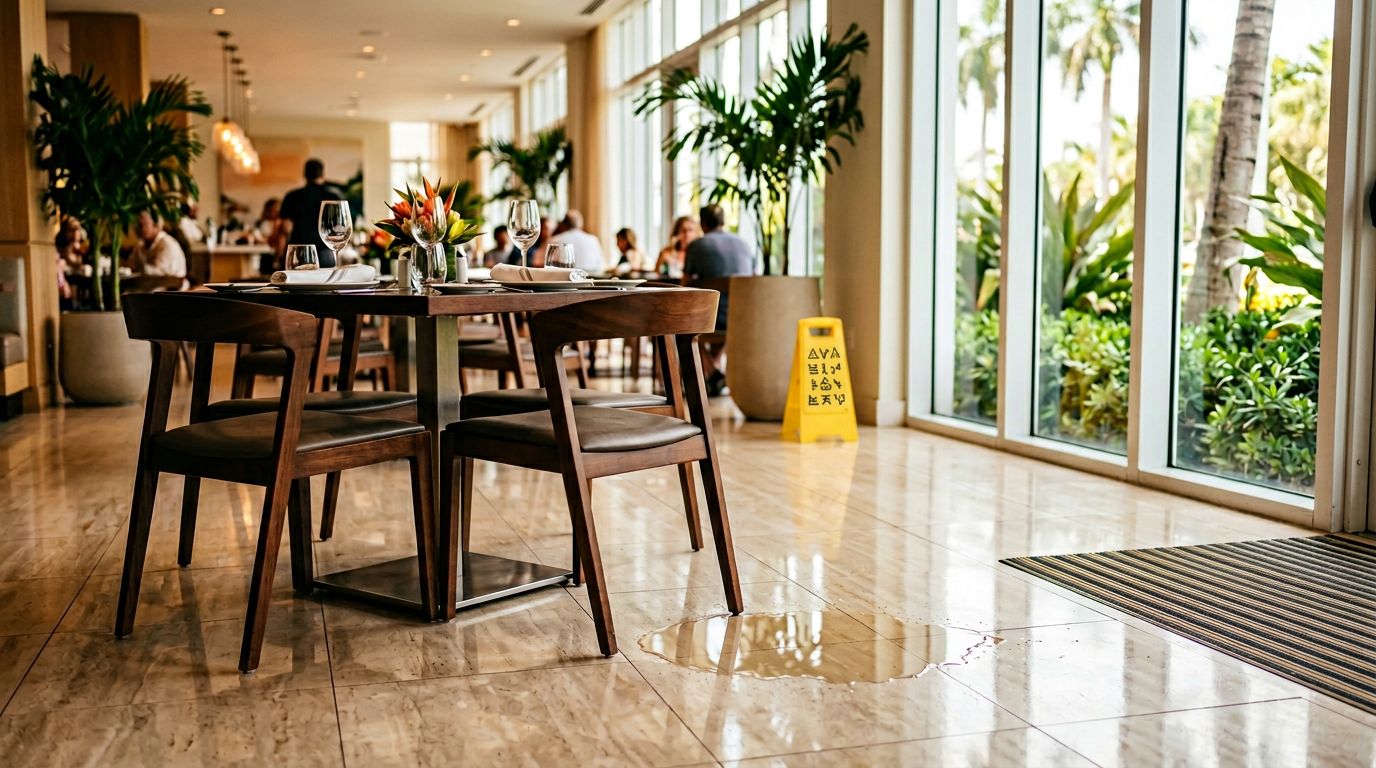
In a restaurant, a spill can appear in seconds and cause serious harm just as fast. In a Florida restaurant slip and fall claim, though, the hard part usually isn’t proving you fell. It’s proving the business knew, or should have known, the hazard was there before you hit the floor.
That point is called notice, and it often decides whether a case moves forward or falls apart. In Florida, restaurants count as business establishments. Under current law, the injured person must show actual or constructive notice, plus causation and damages. By March 2026, those notice rules have stayed the same, but deadlines and fault rules still shape every case.
Why notice drives restaurant slip and fall claims in Florida
Florida doesn’t make restaurants automatic insurers of every customer’s safety. Still, customers are invitees, so the business must use reasonable care to inspect, clean, and warn. Avard’s guide to Florida premises liability duty of care explains the broader property-safety rules that apply.
Most restaurant falls involve a transitory foreign substance, such as water, grease, dropped food, or a tracked-in drink. In those cases, Florida Statute § 768.0755 requires proof that the business had actual or constructive knowledge of the danger and failed to act.
This quick comparison shows the difference:
| Notice type | What it means | Common proof |
|---|---|---|
| Actual notice | Staff knew about the hazard | Employee reports, witness statements, video |
| Constructive notice | Staff should have known | Old spill marks, dirty liquid, recurring hazard |
Actual notice is the cleaner path. Maybe a server saw soup on the floor, or another customer warned the host stand a few minutes earlier. Constructive notice is more common. It can be shown when the spill sat long enough that staff should’ve found it, or when the same hazard kept happening in the same spot.
Think of notice like footprints in wet paint. The restaurant may deny it knew about the mess, but the surrounding signs can tell a different story. A sticky puddle with dirt tracked through it suggests time passed. So does a leak near an ice machine that employees have handled before. On the other hand, a spill created seconds before the fall may not support a claim, unless an employee created it or ignored it.
What evidence helps prove actual or constructive notice
In these cases, timing is everything. Video may be erased within days. The spill gets mopped. Witnesses leave. That’s why early proof matters more than later guesses.
Start with photos and video of the floor, lighting, nearby mats, warning signs, and the substance itself. Color, size, and tracked footprints can help show how long the hazard sat there.
Next, report the fall right away. A manager’s report can lock in the place, time, and what staff saw after the incident. Avard’s guide on obtaining property incident reports after a fall explains how to secure that paper trail before it disappears.
Four kinds of proof often carry the most weight:
- Surveillance footage: Shows whether the spill sat there, and whether staff walked past it.
- Witness accounts: May confirm prior complaints, repeated leaks, or no warning signs.
- Cleaning records: Gaps, missing checks, or backfilled logs can support constructive notice.
- Employee statements: Staff sometimes admit the area had been slippery for a while.
Constructive notice doesn’t always require a stopwatch. If the same slick spot forms near a drink station, restroom, or kitchen door, a pattern can show the hazard was foreseeable. Florida law allows notice to be proven through regularity, not just elapsed time.
A clean floor after the fall doesn’t erase what staff knew before it.
Sometimes notice is even simpler. If an employee drops ice, tracks grease from the kitchen, or places a curled mat in a walkway, the restaurant can’t hide behind ignorance. Also save your shoes, clothing, receipt, and medical records. They help tie the scene to the injury, especially when the defense claims you slipped for some other reason.
Restaurant defenses, deadlines, and what can reduce a claim
Even with strong proof, restaurants and insurers push back hard. Their first argument is often that the hazard appeared too recently to detect. Their second is that you weren’t watching where you were going.
Florida now uses a modified comparative fault rule. If you were partly at fault, your recovery drops by that percentage. If you are found more than 50 percent at fault, you recover nothing. So simple facts matter, such as poor lighting, blocked views, crowding, or a missing warning cone.
Restaurants also argue the danger was open and obvious. That defense doesn’t always end a case. A visible spill can still be dangerous when customers carry trays, move through a narrow aisle, or walk through dim lighting and heavy foot traffic. The real question is whether the restaurant still acted reasonably under the conditions. A warning cone helps, but only if staff place it where people can actually see it before stepping into danger.
The filing deadline matters too. After the 2023 law changes, most negligence claims in Florida must be filed within two years. Waiting is risky because the legal clock keeps running while video, receipts, and witness memory fade.
Damages can include medical bills, lost income, future care, and pain and suffering. Avard’s overview of Florida slip and fall damages shows how these losses are usually documented and valued.
A strong case usually rests on a short chain of proof: a dangerous floor, notice, no timely fix or warning, and a clear injury. Break one link and the claim weakens. Keep the chain intact, and the case becomes much harder to dismiss.
The bottom line on notice
A Florida restaurant slip and fall case turns on more than a wet floor. It turns on notice, and notice is proven with timing, patterns, records, and witness proof. If you were hurt in a restaurant, act fast, preserve what you can, and get legal advice before the evidence gets wiped away. In these claims, the floor dries quickly, but the right evidence can keep the truth in plain view.