
Florida Hospital Visitor Fall Claims and Proving Notice
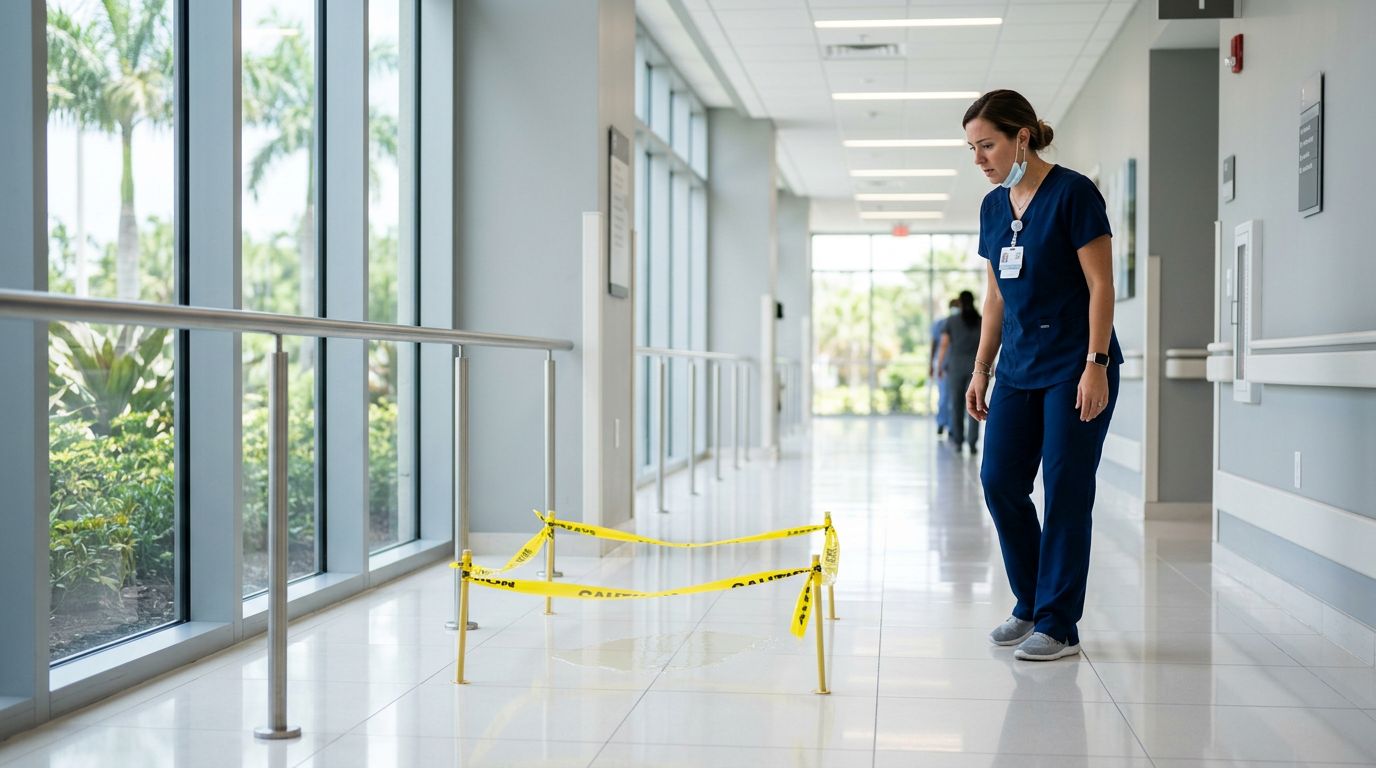
Many Florida visitor fall claims turn on one hard issue, notice. The fall may be obvious. The injury may be serious. Still, if you can’t show the hospital knew, or should have known, about the danger, the claim often stalls.
Hospitals look closely managed, yet slick floors, loose mats, and leaks still happen. The law cares less about surprise and more about what the hospital knew before the fall.
Why hospital visitor falls usually follow premises liability rules
When a family member, friend, or guest falls in a hospital lobby, hallway, cafeteria, restroom, or parking area, the case is usually premises liability, not medical malpractice. Most visitors are invitees. That means the hospital must use reasonable care to inspect the property, fix hazards, or warn people in time.
A hospital is not automatically liable because someone fell. Florida law asks whether staff had notice of a dangerous condition and failed to respond.
As of April 2026, the main rule for spills and other short-term hazards still comes from Florida Statute 768.0755. The statute covers “transitory foreign substances,” such as water, spilled drinks, tracked-in rain, or leaked cleaning solution.
Hospitals also create a setting where notice can be easier to prove than people think. They have shift logs, housekeeping schedules, security cameras, and repeated traffic through the same entrances. A wet lobby floor near the ER on a rainy day is not a random event. It is a risk the hospital should expect and plan for.
Visitor claims also differ from patient claims. If the injured person was admitted for care, the case may move into medical negligence. Avard’s Florida hospital fall lawsuit guide explains why patient falls can follow a different path. For visitors, the property rules usually control, and Avard’s Florida premises liability duty of care guide gives useful background.
In most hospital visitor cases, the main fight is not whether the fall happened. The fight is whether the hospital knew, or should have known, the area was unsafe before the fall.
What proves notice in Florida hospital visitor fall claims
Notice comes in two forms, actual notice and constructive notice. Actual notice means the hospital knew about the hazard. Constructive notice means the facts show it should have known, even if no one admits it.
This is the proof pattern courts often look for:
| Type of proof | What it can show | Example |
|---|---|---|
| Actual notice | Staff knew before the fall | An employee saw the spill or created it |
| Constructive notice by time | The condition sat long enough to be found | A puddle with footprints, dirt, or drying edges |
| Constructive notice by pattern | The problem happened often in that spot | Rainwater pooling at the same entrance |
Actual notice can come from witness testimony, incident reports, staff comments, or video. If a worker says housekeeping was already called, that matters. So does footage showing employees walking past the hazard without fixing it.
Constructive notice often decides Florida visitor fall claims. A jury may infer notice from the condition itself. Liquid with track marks, dirty edges, or partial drying suggests it sat there for a while. Inspection gaps matter too. If the hospital says it checks floors every 15 minutes, the records should match that claim.
Recurring hazards can be just as important. A lobby that gets slick every time it rains, a restroom sink that repeatedly overflows, or a leaking machine near a waiting room can support notice even when no one knows the exact minute the hazard formed.
Good proof usually includes photos, witness names, incident reports, surveillance footage, cleaning logs, maintenance records, and prior complaints. One piece may not be enough. Together, they can show the hospital had time or reason to act.
The defense may argue the condition was open and obvious. That argument does not always end the claim. Under Florida Statute 768.81, shared fault can reduce damages. Still, a visible hazard does not erase the hospital’s duty when the risk was foreseeable, especially in a busy setting where visitors are focused on a loved one, not the floor.
How to protect the claim before the evidence disappears
Evidence in hospital fall cases can disappear fast. Floors get cleaned, video gets overwritten, and staff memories fade. Because of that, the first day or two matters more than many people expect.
Take photos if you can do so safely. Get the floor, the lighting, any warning signs, and a wider shot of the area. A close photo of water helps, but a wide shot showing no cone or caution sign can help even more. If anyone saw the fall or the hazard before it happened, get a name and phone number.
Report the fall to the hospital right away. Ask for an incident report, or at least the name of the person who prepared it. Avard’s Florida slip and fall incident report guide explains how to secure that first paper trail before details fade.
If the injuries are serious, ask in writing that the hospital preserve video from the area, along with cleaning logs and maintenance records. Surveillance systems do not keep footage forever. A prompt request can stop key proof from disappearing before anyone reviews it.
Medical care matters too. If you wait days, the defense may argue something else caused the injury. Even a fall that seems minor at first can lead to a fracture, head injury, or back problem that worsens later.
Keep your shoes and clothing in the same condition. Don’t wash away water, residue, or dirt marks if they may help show what caused the slip. Also, write down the timeline while it’s fresh, including when you arrived, where you walked, what the floor looked like, and anything staff said after the fall.
Be careful with casual statements and guesses. “I’m okay” and rough estimates about how long a spill was there can come back later in the claim. Facts carry more weight than guesses.
Falls in hospitals feel shocking because people expect safety there. Yet a strong claim still depends on notice, not assumption. That is why early photos, witness names, and records often matter as much as the medical bills. When the evidence shows the danger was known, ignored, or repeated, the case has a much stronger foundation.