
Florida Bicycle Crosswalk Crashes: Proof Checklist for Riders
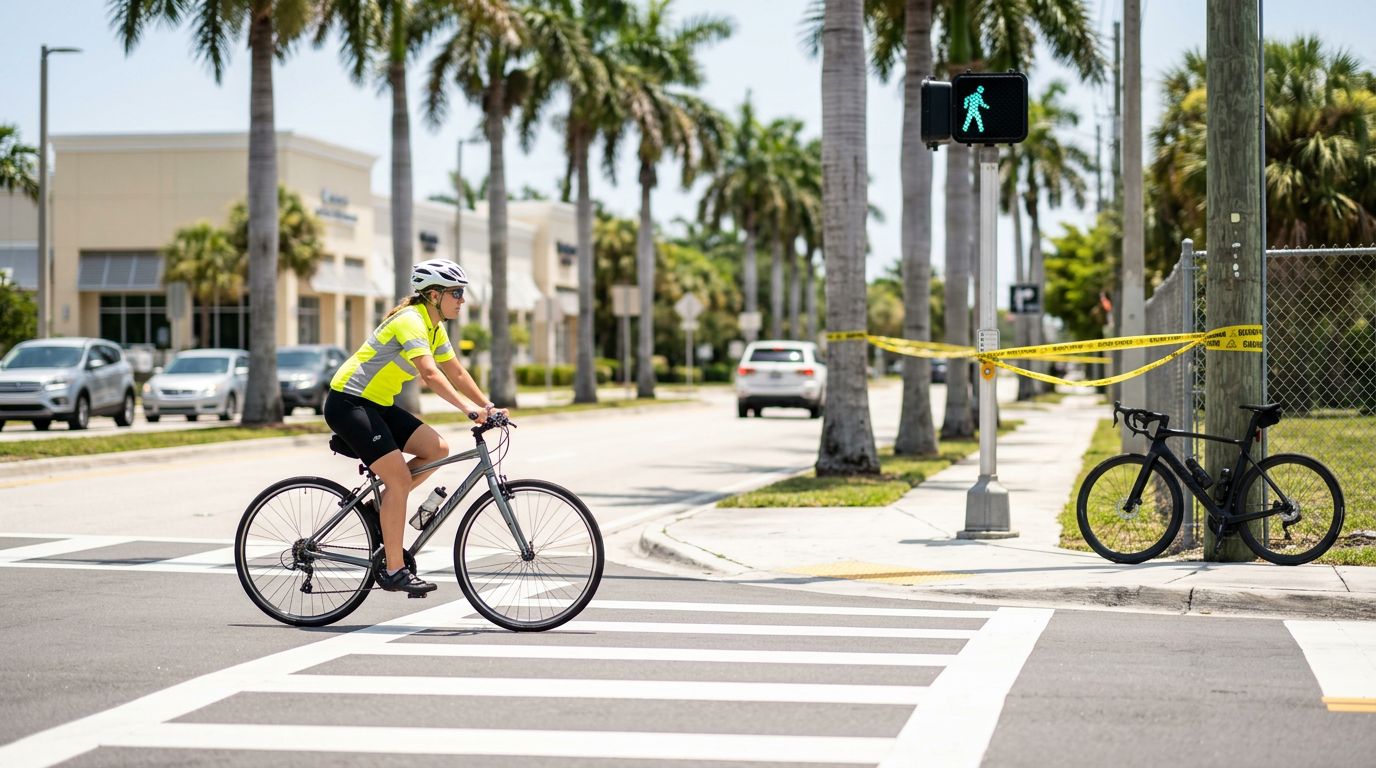
A driver says you darted out. You know you had the right of way. In Florida bicycle crosswalk crashes, that gap between truth and proof can decide the whole claim.
Crosswalk bike wrecks get messy fast because the scene changes in minutes and the blame game starts on the curb. If you’re a not-at-fault rider, the goal is simple: lock down the timeline, preserve the bike, and build records that match what happened.
Why Florida bicycle crosswalk crashes turn into blame fights
A bike crash in a crosswalk looks simple from far away. Up close, it’s a knot of timing, signal phases, and bad assumptions. The driver says you came too fast. The insurer says you should’ve walked the bike. A witness remembers only the sound.
Florida law adds another layer. A bicycle is usually treated as a vehicle. Still, a rider on a sidewalk or in a crosswalk can take on pedestrian-like duties. That is why signal lights, walk symbols, curb ramps, and lane position matter so much. For a plain-language refresher, review these Florida bicycle traffic laws.
Most cases turn on a short sequence. Did the driver turn right on red without looking? Did a left-turning car cut across the crosswalk? Were you already in the marked crossing when the vehicle moved? Think of the claim like a movie clip, not a still photo.
Drivers also lean on the same defenses. They say you appeared out of nowhere, wore dark clothes, or crossed against the signal. Sometimes they claim the impact happened outside the marked crosswalk. Each defense points back to the same need, photos that show the paint lines, signal heads, and your path of travel.
Public data is limited. As of March 2026, statewide reporting still does not break out bicycle crashes in crosswalks as a separate category. Still, the larger pattern is serious. A report on Florida bicycle deaths highlighted how dangerous Florida roads remain for cyclists.
That matters because insurers know these cases can be hard to reconstruct. If they can blur the timeline, they can push shared blame. So the best response is objective proof, gathered early and kept organized.
The first-hour proof checklist for not-at-fault riders
The scene after a bike crash is like wet chalk on pavement. Traffic, weather, and tow trucks erase details fast.
If you remember one thing, document the crosswalk control before anyone moves the vehicles.
Start with a slow phone video. Capture the crosswalk, the traffic light, the walk signal, lane arrows, and the vehicle positions. Then take wide photos first, close-ups second.
This is the evidence that usually matters most:
| Evidence | What it helps prove |
|---|---|
| Crosswalk markings, walk signal, and traffic lights | Who had the right to enter, and whether a driver ignored the control |
| Wide shots of the intersection | Sight lines, turn lanes, curb ramps, and where each person came from |
| Damage to the bike and vehicle | Angle of impact, point of contact, and who moved into whom |
| Witness names and camera locations | Independent proof when stories conflict |
| Helmet, clothing, phone, and body photos | Injury severity and the force of the hit |
The takeaway is simple. You are not just photographing damage. You are preserving the story of the crash.
A few more steps can protect the claim right away:
- Get witness contact info before people drive off. A neutral witness can end a blame fight.
- Photograph the bike before repairs. Bent wheels, scraped pedals, and crushed lights often show impact direction.
- Note the environment. Sun glare, rain, blocked signs, and parked vans can explain why the driver failed to see you.
- Save nearby camera leads. Gas stations, stores, condos, and buses may have video, but many systems overwrite quickly.
- Watch your words. Don’t guess, apologize, or say you are fine if you are not sure.
If police respond, ask how to get the report number. If EMS evaluates you, keep every paper they hand you. Those early records build the foundation for everything that follows.
The records that decide the claim after the scene is gone
Once the intersection clears, the case becomes a paper trail. This is where good claims stay strong, and weak ones shrink.
First, get medical care quickly. Even a low-speed crosswalk impact can cause a wrist fracture, knee injury, concussion, or neck pain. Tell the provider how the crash happened, in plain words. “A car turned into me while I was in the crosswalk” is better than “bike accident.” Specific notes link the injury to the event.
Next, preserve every record. Save discharge papers, imaging reports, prescriptions, therapy bills, ride-share receipts, and proof of missed work. Also keep a short pain log. A few lines each day can show how the injury changed sleep, walking, lifting, or riding.
Also request the crash report as soon as it’s ready. The report can help, but it isn’t the last word. Officers may miss a camera, misread the signal phase, or rely on the driver’s version before all witnesses are found. Use the report as one piece of the file, not the whole file.
Fault arguments keep coming after the crash. The adjuster may say you entered too fast, ignored the signal, or came from the sidewalk without warning. Those are timing disputes. The same proof logic used in a four-way stop crash checklist often applies here too. Photos, witness statements, and damage patterns beat opinions.
Be careful with recorded statements and early settlement forms. A property-damage payment can sound harmless, but broad release language may hurt a later injury claim. Also, don’t let the bike get discarded or heavily repaired before it is fully documented.
When liability is disputed, or injuries are more than minor, legal help can make the difference between a fair recovery and a stalled file. Working with Florida bicycle accident attorneys can help preserve video, secure witness statements, and push back when the insurer tries to rewrite the crash.
Conclusion
In Florida bicycle crosswalk crashes, the strongest claim usually belongs to the rider who preserved proof, not just the rider who knew they were right. Lock down the signal, the scene, the bike, and your medical timeline as early as possible. When the other side starts shaping a shared-fault story, clear evidence is what brings the case back to the facts.