
Florida Left-Turn Crash Claims Proof Checklist For Not-At-Fault Drivers
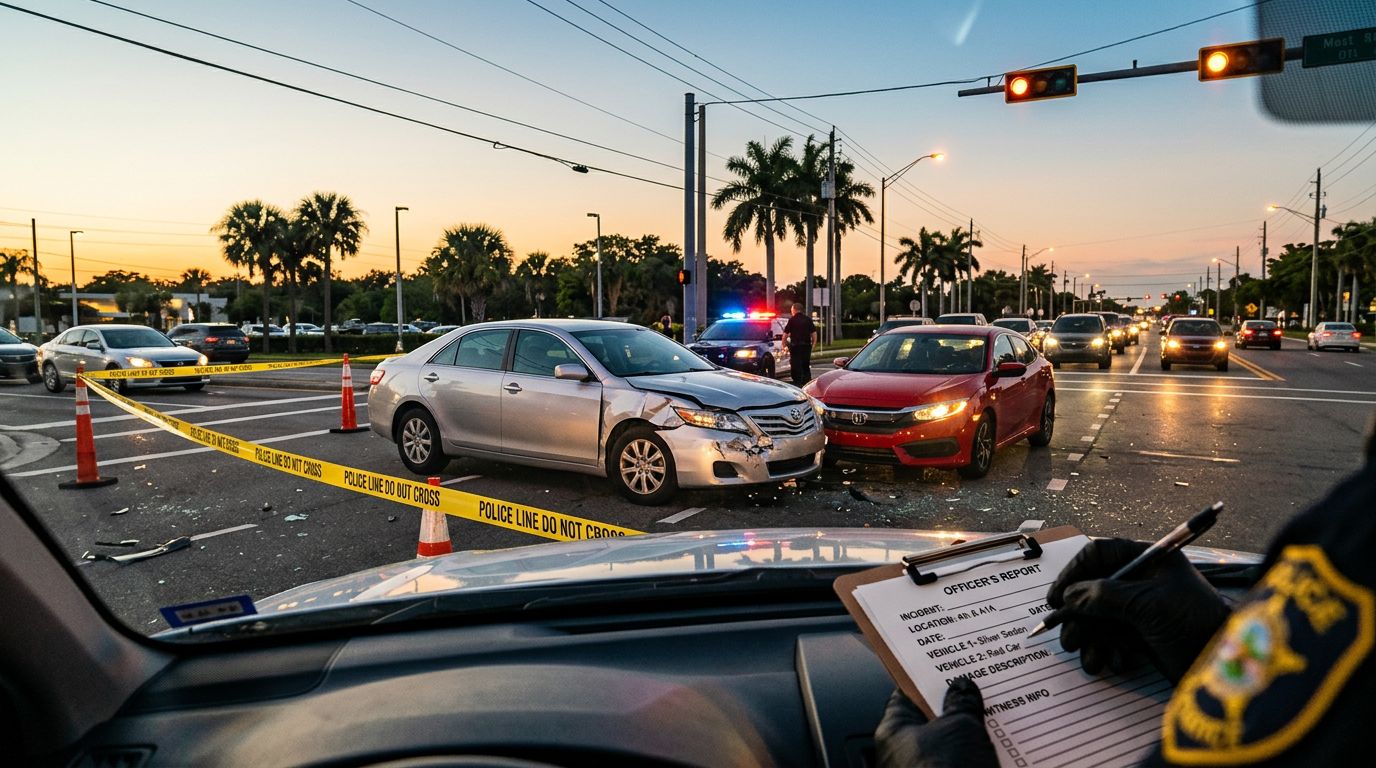
A left turn can feel routine until metal folds and airbags pop. Then the blame question hits fast, and it often feels unfair. In a Florida left-turn accident, insurers may assume the turning driver caused the crash, even when you did nothing wrong.
If you’re a not-at-fault driver, your best protection is proof. Not opinions, not anger, not a long story. Just clean, early evidence that shows who had the right-of-way, what each driver did, and how the impact happened.
Below is a practical proof checklist you can use after a Florida left-turn crash, plus the legal points that make certain items matter more than others.
Why Florida left-turn crashes trigger quick blame (and how to push back)
Florida law puts a heavy duty on drivers who turn left. Under Florida Statute 316.122, a driver turning left must yield to oncoming traffic that’s close enough to be a hazard. That rule is why adjusters often start with, “Left-turn driver is at fault.”
Still, that’s only the starting point. The real question is whether the oncoming driver created the hazard. Speeding, running a red light, distracted driving, and lane violations can flip fault, or at least share it.
Fault sharing matters more in 2026 than many people realize. Florida uses modified comparative fault rules for many negligence cases, and being more than 50 percent at fault can block recovery from the other driver. You can read the framework in Florida Statute 768.81. As a result, insurers often hunt for “shared fault” angles even when the other driver clearly caused the crash.
Then there’s the no-fault layer. Your own PIP coverage may pay initial medical bills and some lost wages, regardless of fault. However, serious injury claims often require much more than a PIP file. If you want a plain-language refresher, see Avard Law’s explanation of Florida no-fault law after a car accident.
The fastest way to lose ground is to treat a left-turn crash like it’s “obvious.” In Florida, you usually have to prove what seems obvious.
The proof checklist that helps not-at-fault drivers win the liability fight
Think of your claim like a receipt. If you can’t show it, the insurer may not “buy” it. Start collecting proof as soon as it’s safe, because intersections change quickly. Debris gets swept, cars get moved, and witnesses leave.
Here’s a quick reference table of the most useful proof items in a Florida left-turn accident claim, and why each one matters.
| Proof item | Why it matters | Best way to get it |
|---|---|---|
| Police crash report and any citations | Sets the baseline facts, diagram, and early statements | Request it promptly through Florida traffic crash reports |
| Intersection photos (wide shots) | Shows lanes, turn arrows, sight lines, and signal placement | Step back and capture the whole approach, not just the damage |
| Close-up photos of damage and debris | Helps show angle of impact and point of contact | Take shots of all corners, not only the biggest dent |
| Video (dashcam, nearby business, doorbell cameras) | Can settle right-of-way disputes in seconds | Ask nearby businesses quickly, many systems overwrite fast |
| Witness names and contact info | Independent witnesses reduce “your word vs theirs” | Get phone numbers, and a one-line summary of what they saw |
| Your medical visit records | Links the crash to injury timing and symptoms | Get checked early, then keep discharge paperwork and notes |
| Your phone call log and screenshots | Helps show you reported promptly and sought help | Save 911 call confirmations, tow receipts, and timestamps |
Two timing points often decide whether this proof helps. First, get medical care quickly. Second, preserve video quickly. Delay on either one gives an insurer room to argue the injury is unrelated, or the crash story is unclear.
Also, be careful with recorded statements. You can report the claim, but don’t guess about speed, distance, or signal timing. “I’m not sure” is better than a confident mistake.
If you’re building your file and want a deeper walkthrough of what insurers look for, Avard Law’s guide on how to prove negligence after a crash breaks down common evidence categories in plain English.
Turning your evidence into a strong Florida left-turn accident claim
Evidence doesn’t help if it stays scattered. Your goal is a clean story that answers three questions: Who had the right-of-way, what rule was broken, and how the impact proves it.
Start with the intersection facts. A wide photo showing turn lanes, a left-turn arrow, and the oncoming lane layout can defeat vague arguments later. Next, pair that with damage photos that match your version. For example, a front corner hit on your vehicle and heavy side damage on the other car can support that they entered your path late, or at a high speed.
Then lock down the “shared fault” attacks adjusters like to use:
- “You turned when it wasn’t safe.” Use video, witnesses, and the signal phase (green arrow versus solid green) to show you had a protected turn, or that the oncoming driver created the hazard.
- “They couldn’t avoid you.” Skid marks, debris location, and impact angle can show late braking, speeding, or inattention.
- “Your injuries don’t fit the crash.” Early medical notes and consistent symptoms matter, even when the vehicle damage looks moderate.
Organizing your claim also helps when you move past basic insurance steps into a demand. The point isn’t a longer letter. It’s clearer proof. If you want a structure that adjusters can evaluate quickly, review Avard Law’s guide to filing a car accident claim in Cape Coral, then model your document gathering around those stages.
Treat every intersection crash like a short story with missing pages. Your evidence fills in the pages before the insurer writes them for you.
Conclusion
A Florida left-turn accident claim can swing on details most drivers don’t think to preserve. Start with the crash report, photos, video, and witnesses, then back it up with prompt medical records and consistent timelines. When fault gets disputed, organized proof is what keeps a not-at-fault driver from being pushed into a shared-blame outcome.
If you’re unsure which items matter most in your specific crash, gather what you can now, because the best evidence is often the evidence you can’t recreate later.