
How To Get Florida Slip And Fall Incident Reports Fast
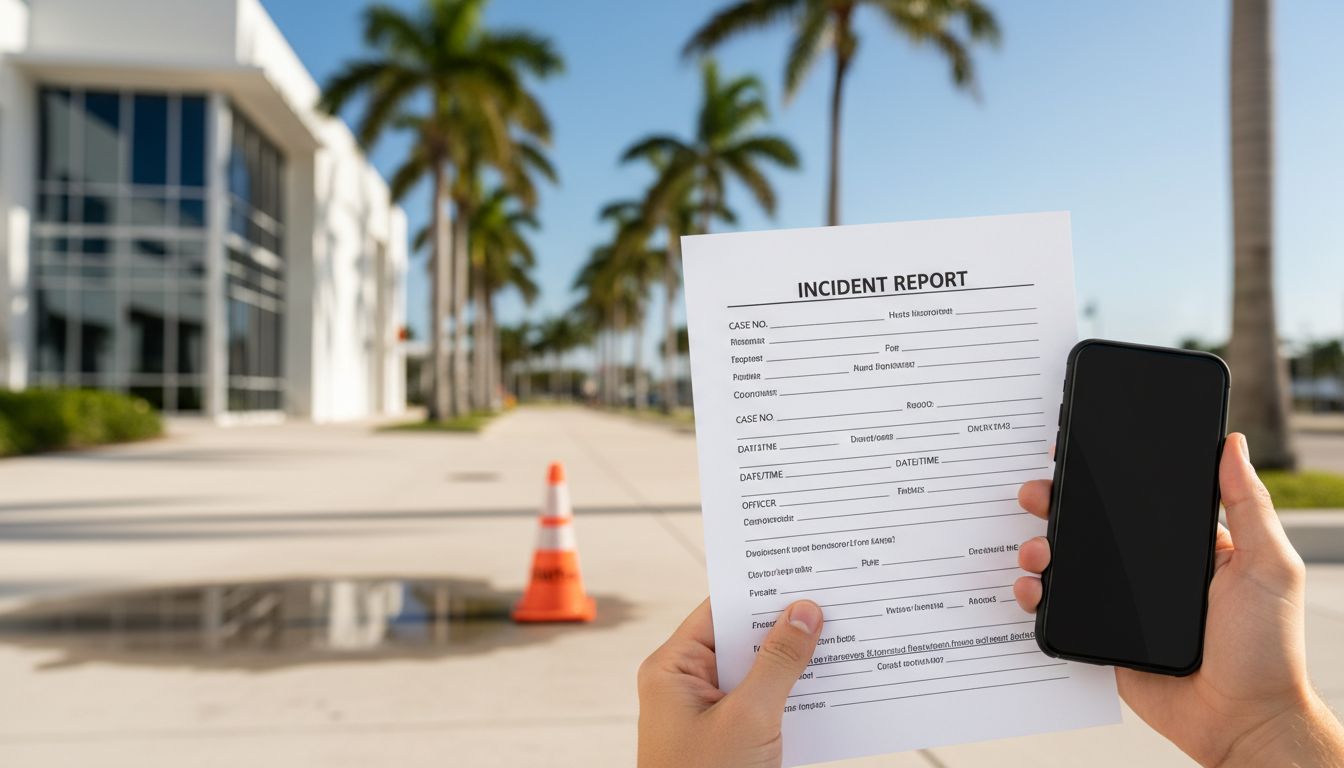
A slip and fall can feel like a blur. One second you’re walking, the next you’re on the ground, embarrassed, in pain, and trying to act “fine.” The problem is that proof disappears fast, sometimes within hours.
If you want a fair chance at compensation, getting the incident report quickly matters. This guide explains how to get a property owner’s report the same day, how Florida public records requests work when police or government agencies are involved, and what details speed everything up. You’ll also learn what to do when someone stalls, dodges, or says, “We don’t give copies.”
Why an incident report can make or break a Florida slip and fall claim
An incident report is like a receipt for what happened. It helps show you reported the hazard and when. It can also lock in details that people forget later, like the exact location, lighting, weather, or what employees did after you fell.
In many cases, the report also becomes your first paper trail. That matters because slip and fall claims often hinge on notice. In plain terms, did the business know, or should they have known, the dangerous condition was there? The sooner a report exists, the harder it is for a property owner to claim they heard nothing until weeks later.
Still, incident reports aren’t “magic.” They can be incomplete, biased, or written to protect the business. That’s why it helps to treat the report as one part of a bigger evidence file, including photos, witnesses, shoes you wore, and medical records.
If you’re unsure what injuries and follow-up steps commonly come up in these cases, read understanding slip and fall injuries. It’s a good baseline for what to watch for after the adrenaline fades.
The best time to ask for the report is before you leave, when staff can’t “lose track” of you.
Getting the property owner’s incident report the same day (fastest option)
For most people, the fastest “incident report” is not a police report. It’s the business’s own internal report. Think grocery stores, restaurants, hotels, theme parks, and apartment complexes. They often have a standard form, and they often want it completed quickly.
Start on-site if you can. Ask for the manager, not a cashier or host. Speak clearly and keep it simple: where you fell, what you slipped on, and that you need a report made right now. If you’re hurt, ask for medical help first, then circle back to the report.
Here’s how to push for speed without turning it into a fight:
- Ask for the report number and the manager’s full name. Write it down.
- Request a copy. If they won’t give one, ask to take a photo of the completed report.
- Check the basics: correct date, time, store address, and the exact spot where you fell.
- Point out witnesses while they’re still nearby. Ask staff to note them.
- Ask about video immediately. Many systems overwrite footage in days, sometimes sooner.
If the manager refuses to give a copy, don’t get pulled into an argument. Instead, ask for something you can keep, like an email confirmation that a report was created. You can also follow up in writing the same day, so there’s a record of your request.
This is also a good time to gather the other documents that tend to decide cases. Avard Law’s checklist on documents for a Florida personal injury attorney lays out what’s worth saving, and what people forget until it’s too late.
One more detail people miss: be careful with “statements.” Some businesses ask you to write what happened on their form. Keep it accurate, keep it short, and don’t guess. If you don’t know how long a spill was there, don’t invent a time.
When you need a police report or government records (and how Florida public records requests work)
Police do not respond to every slip and fall. If there’s no serious injury, many departments won’t dispatch an officer. However, you might have a report if (1) first responders came, (2) the fall happened on public property, or (3) the incident involved a crime or public disturbance.
When a report exists, Florida’s public records rules often allow you to request it. Many agencies now offer online portals, which can be faster than in-person visits.
A few examples of official starting points include:
- The City of Tampa’s page for police records and online reporting, which explains how to request different record types.
- St. Petersburg’s Police Records Division, including hours and request options.
- Homestead’s public records request page, which is useful when the incident involves city departments.
- Neptune Beach Police Department’s FAQ on getting a copy of a police report, which shows the common “records unit” approach many Florida cities use.
To keep expectations realistic, not every record is released instantly. Some reports take time to finalize. Some information may be redacted. Even so, you can usually speed things up by requesting an electronic copy and providing strong identifiers (more on that next).
Here’s a quick comparison of common request paths:
| Request method | Best for | Typical speed | Common mistake |
|---|---|---|---|
| Online portal or email | Most people who want a digital copy | Often fastest | Missing date, address, or report number |
| In-person records unit | Urgent needs, identity checks | Can be same day | Showing up without ID or needed details |
| Mail request | People who can’t use portals | Slowest | No clear return address, no contact number |
The takeaway: online requests usually move fastest, as long as your request is specific.
How to speed up any florida slip fall report request (and avoid delays)
If you’re trying to get a florida slip fall report quickly, speed mostly comes down to two things: detail and persistence. Agencies and businesses handle lots of requests. Vague requests tend to sink to the bottom.
What to collect before you request anything
Try to gather these details while they’re fresh:
Exact location (store name, address, and where inside the property you fell).
Date and time range (even a 30-minute window helps).
People involved (manager name, security guard name, responding officer, or EMS unit if you have it).
Any reference numbers (incident report number, call-for-service number, case number).
Your contact info (phone and email, so they can clarify instead of closing the request).
The fastest way to ask (without over-explaining)
Keep the request short. A good model is:
“I’m requesting a copy of the incident report and any related call notes for a slip and fall on (date) at (location). If available, please send a digital copy by email. I’m the person involved, and I can provide ID if needed.”
That wording works whether you’re emailing a property manager or submitting a city form.
If they stall or say “we don’t give copies”
Businesses sometimes refuse because they don’t want the report used against them. If that happens, pivot to what you can still control:
- Ask for written confirmation that a report exists, with the report number.
- Request the name and contact info for the risk department or claims administrator.
- Send a follow-up email the same day summarizing what happened, including the time and location.
- Preserve your own evidence immediately (photos, shoes, clothing, witness names).
Also, don’t wait on the report to get medical care. Treatment records often become the backbone of the case.
Finally, talk to a lawyer early if the injuries are serious or the property owner plays games. A delay can cost you video, witnesses, and your chance to prove how the hazard formed.
Conclusion
After a fall, getting the incident report fast is one of the smartest moves you can make. Start with the property owner because that’s usually the quickest route. If police or government agencies were involved, use official records pages and submit a detailed public records request. The sooner you act, the less room there is for missing footage, fading memories, and “we never heard about it” defenses.