
Florida Stop-Sign Crash Claims: How Not-At-Fault Drivers Prove Fault
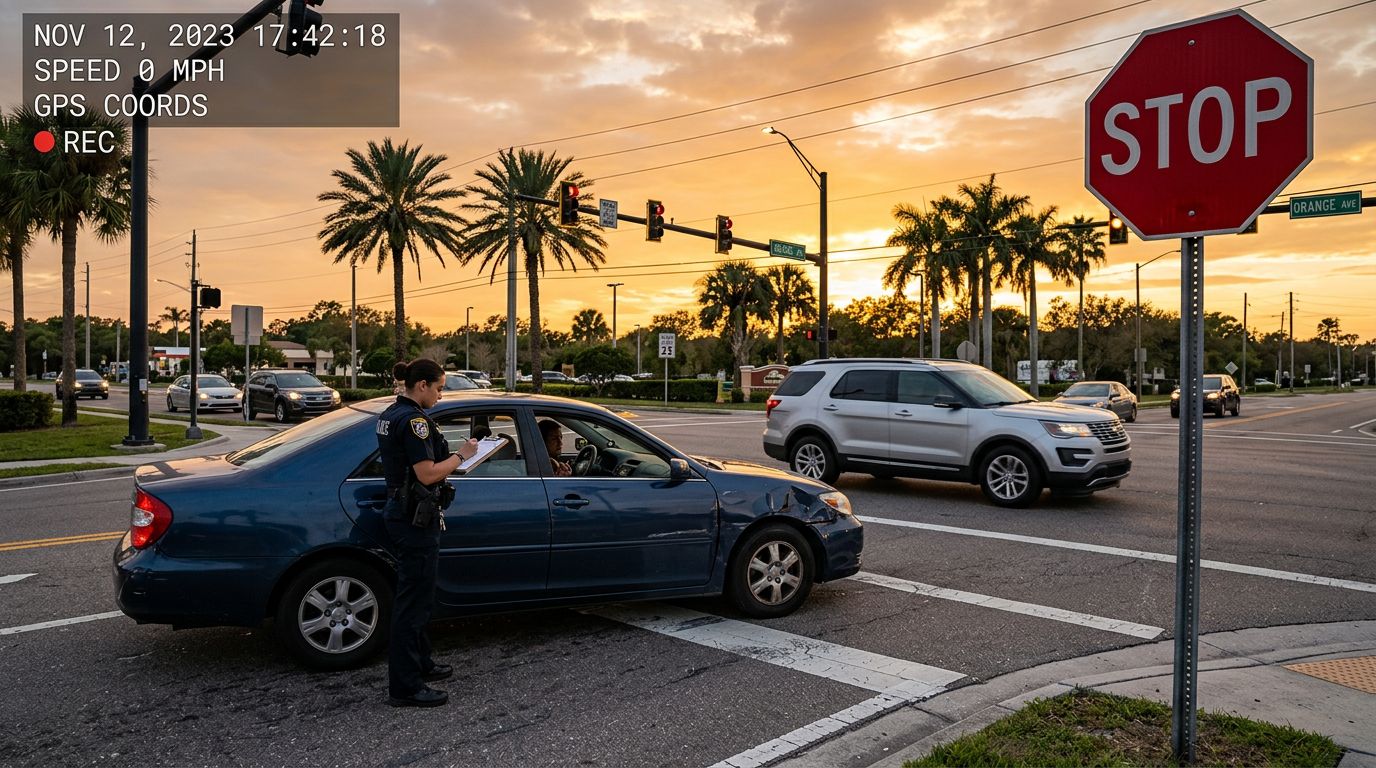
A Florida stop sign accident can feel open-and-shut. You had the right of way, the other driver rolled through, and your car paid the price. Then the insurance adjuster calls and suddenly it’s “unclear,” “shared fault,” or “you came out of nowhere.”
Stop-sign crashes often happen at low speeds, but the arguments get loud fast. The good news is that most fault disputes turn on a few clear facts: who had the duty to yield, where each vehicle was, and what the evidence shows.
Below is how not-at-fault drivers usually prove fault in Florida stop-sign crash claims, and what to do before the best proof disappears.
What Florida stop-sign rules require (and what insurers look for)
Stop signs don’t just mean “slow down.” They create a legal duty to stop and yield when another vehicle has the right of way. In many claims, the key question is simple: did the other driver enter the intersection when it wasn’t safe?
Florida’s traffic statute on vehicles entering a stop intersection is a helpful reference point because it spells out the yield duty after stopping. You can read the full text in Florida Statute 316.123 (vehicle entering stop intersection).
Even when everyone agrees there was a stop sign, insurers still argue the details. For example:
- A “rolling stop” may be treated like failing to stop, but the insurer may claim the driver stopped and you “should’ve waited.”
- At a 4-way stop, the at-fault driver may say they arrived first, or that you waved them through.
- If you were turning left, the other side may claim you cut across their path.
- If the stop sign is partially blocked, they may argue the intersection was “confusing,” so blame should be shared.
Florida also uses a modified comparative fault rule in many cases. That matters because the insurer may try to pin enough blame on you to reduce your payout, or even block recovery if they push your percentage too high. As a result, proving fault is about more than being “right.” It’s about being able to show it.
If you want a deeper walk-through of how liability gets built from real-world proof, see How to Prove Fault in a Cape Coral Car Accident.
The evidence that wins Florida stop-sign crash claims
Think of evidence like wet concrete. It sets quickly. If you don’t capture it early, it hardens into whatever story the other driver tells.
Start with the basics: the crash report, photos, and witness contact info. Then look for the proof that answers the insurer’s favorite questions: Where were the cars before impact, what controlled the intersection, and who entered when it wasn’t safe?
The fastest way to beat a “shared fault” argument is to lock down objective proof before the scene changes and memories shift.
Here’s a quick reference for the kinds of proof that tend to matter most:
| Evidence | What it helps prove in a stop-sign crash |
|---|---|
| Intersection photos (wide shots) | Stop sign placement, sight lines, lane layout, stop bar and crosswalk location |
| Close-ups of the stop sign approach | Whether the sign was visible, and what a driver would see before entering |
| Vehicle rest positions and damage patterns | Angle of impact, who entered the lane of travel, and whether a driver “cut across” |
| Independent witness statement | Confirms rolling stop, failure to yield, who entered first, and who had control |
| Video (dashcam, doorbell, business camera) | Timing at the stop, speed, turn signals, and the moment the vehicle entered |
| 911 call audio and timestamps | Real-time statements and timing that can match video and dispatch records |
Photos are often the difference between “he said, she said” and “here’s what happened.” If you’re unsure what to photograph, this guide is a practical field list: Cape Coral crash scene photos that actually prove your case.
Also, don’t overlook “missing” video. Many intersections and nearby businesses have cameras, but recordings can be overwritten in days. A quick request to preserve footage can protect your case. If you had passengers, get their written notes early too. Friends and family can still help, but insurers value independent witnesses more.
How insurers try to shift blame, and how not-at-fault drivers respond
In stop-sign cases, the other driver’s insurer often uses the same playbook: admit the stop sign exists, then argue you contributed to the crash. The goal is to reduce what they pay.
Common blame-shifting claims include:
They say you were speeding. Even a small speed increase becomes “you couldn’t be avoided.” If there’s video, it can help. If there isn’t, damage photos and scene measurements may still support your version.
They claim you didn’t have your lights on, or you were hard to see. This comes up at dusk, in rain, or when glare is involved. Weather and lighting details from the report and photos can matter.
They argue you “came from nowhere.” That often really means they didn’t look long enough, or they misjudged your distance. Witnesses and camera angles help here.
They push “you should’ve avoided it.” Insurers love this argument because it sounds reasonable. However, drivers with the right of way still can’t predict someone will pull out at the last second.
Just as important, your own actions after the crash can affect how the insurer values your claim. Get medical care quickly, follow up, and keep your records organized. Florida is a no-fault state, so you often start with your own PIP coverage, even when the other driver clearly caused the crash. Deadlines can be strict, including the 14-day rule tied to PIP eligibility. This overview explains how the system affects real claims: How Florida’s No-Fault Law Impacts Your Cape Coral Car Accident Claim.
Finally, be careful with early statements. Stick to the facts. Don’t guess about speed, distances, or what the other driver “must’ve seen.” If an adjuster asks for a recorded statement, get advice first. A single careless sentence can get repeated for months.
Time also matters in a different way. Florida deadlines to file suit can be shorter than many people expect for newer crashes, so it’s smart to talk with counsel sooner rather than later, especially when fault is disputed or injuries are lasting.
Conclusion
Stop-sign crashes often look simple, but insurance companies rarely treat them that way. To prove fault in a Florida stop sign accident, focus on right-of-way rules, fast evidence collection, and clean documentation that matches the physical scene. When the other side pushes “shared fault,” objective proof like photos, video, and independent witnesses usually decides the outcome. If the injuries are serious or the story keeps changing, getting legal help early can protect both your claim and your timeline.