
Minimum Car Insurance in Florida vs. What Cape Coral Drivers Actually Need After a Crash
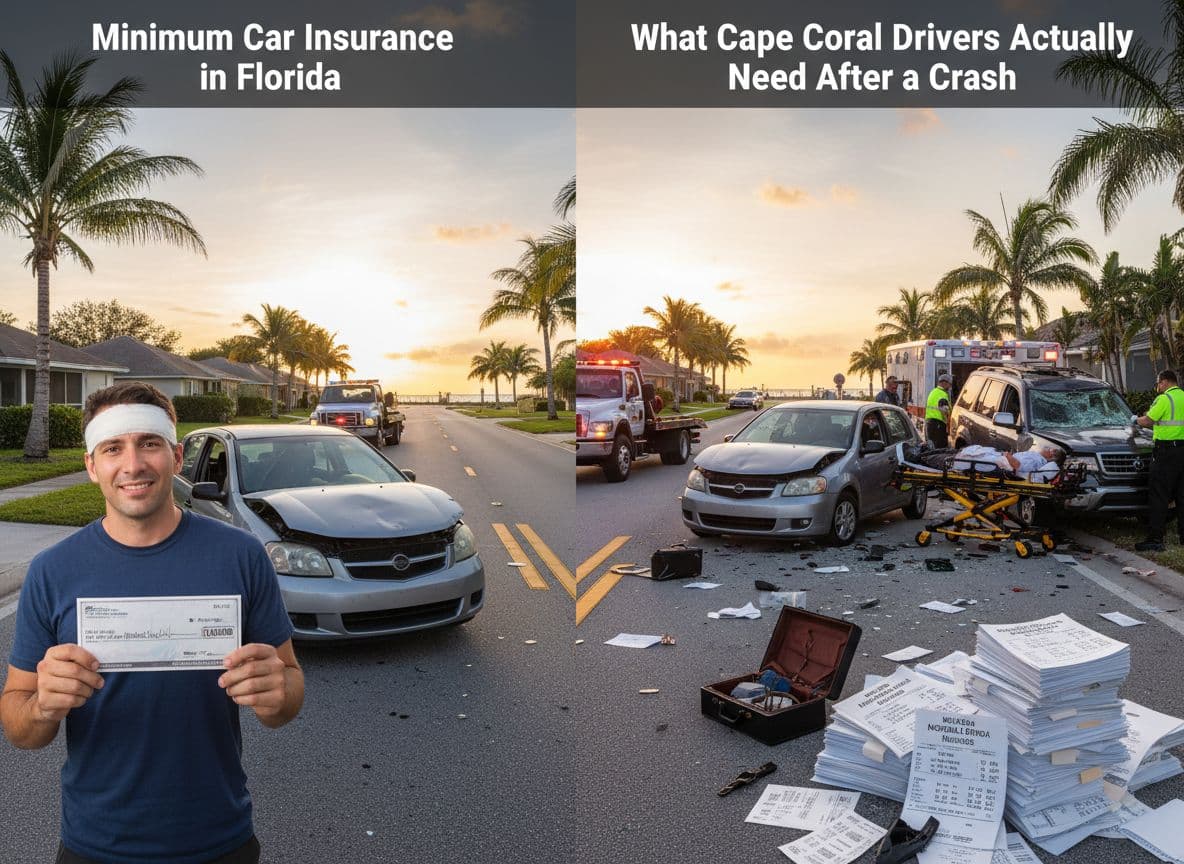
You can follow every traffic rule in Cape Coral and still end up in a wreck on Del Prado Boulevard or Veterans Parkway. When that happens, the question is simple: will your insurance really protect you, or just check a legal box?
Florida law only asks you to carry florida minimum car insurance, not coverage that actually keeps your family financially safe. The gap between those two ideas can be huge after a serious crash.
This guide explains what the law requires, why it often falls short, and what coverage Cape Coral drivers should consider before the next set of headlights appears in their rearview mirror.
What “Florida Minimum Car Insurance” Really Means
As of late 2025, to register a car in Florida you need only:
- $10,000 in Personal Injury Protection (PIP)
- $10,000 in Property Damage Liability (PDL)
PIP pays for your own medical bills and some lost wages, no matter who caused the crash. It usually covers 80 percent of reasonable medical expenses up to $10,000.
PDL pays when you damage someone else’s car, fence, or other property. That is it. The basic law does not require bodily injury coverage for most private passenger vehicles, although lawmakers have debated raising those standards and moving away from the no‑fault system.
On paper, that sounds like a simple, low‑cost way to drive legally. In real life, a single ambulance ride and ER visit in Lee County can nearly wipe out your entire PIP limit. The rest comes out of your pocket, or from whatever claim you can make against the at‑fault driver.
Why State Minimum Coverage Fails Cape Coral Drivers After a Crash
Florida’s minimums were set in a very different time, when medical costs were far lower. Today, the numbers do not match real life.
After a serious collision, even a “simple” case can include:
- Ambulance transport
- Emergency room imaging and blood work
- Follow‑up visits
- Physical therapy
- Time off work
Those bills can climb past $20,000 in a hurry. When PIP stops at $10,000, you are left with medical providers wanting payment and a claims process that often moves slowly.
If the other driver also carries only florida minimum car insurance, there may be little or no bodily injury liability coverage to pay your pain and suffering, ongoing care, or lost earning capacity. That is a common problem in Cape Coral, where many drivers carry the lowest possible limits.
This is where people are surprised. They followed the law, but the law did not protect them from the actual cost of a serious injury.
Minimum vs. Real‑World Protection: A Quick Comparison
A simple way to see the problem is to compare legal minimums with what tends to make sense after a bad crash.
| Coverage Type | Florida Minimum (Typical) | More Protective Levels For Many Drivers |
|---|---|---|
| Personal Injury Protection | $10,000 | PIP plus added Medical Payments, or higher injury limits if laws change |
| Property Damage Liability | $10,000 | $50,000 or more |
| Bodily Injury Liability | Often none for private cars | $50,000/$100,000 or $100,000/$300,000 |
| Uninsured/Underinsured Motorist | Optional | Match your bodily injury limits |
These higher levels cost more each month, but they can prevent six‑figure exposure after a serious wreck.
Coverage Cape Coral Drivers Actually Need After a Crash
Higher bodily injury liability limits
Bodily injury liability coverage pays if you injure someone else and they pursue a claim or lawsuit against you. Even if you see yourself as a careful driver, this coverage protects your savings, your home, and your future wages if something goes wrong.
Many Cape Coral drivers choose at least:
- $50,000 per person and $100,000 per accident, or
- $100,000 per person and $300,000 per accident
If you cause a crash on US‑41 and a family in the other car suffers serious injuries, their medical care, lost wages, and pain and suffering can blow past low limits in days. Without strong bodily injury coverage, you may face personal exposure if a verdict exceeds your policy.
Uninsured and underinsured motorist coverage
Florida has a high rate of uninsured and underinsured drivers. In practice, that means the car that hits you may not have enough insurance to cover your hospital stay, surgery, or long‑term therapy.
Uninsured motorist (UM) and underinsured motorist (UIM) coverage steps into the shoes of the other driver when they have no coverage or not enough. It can pay for:
- Medical bills beyond PIP
- Future medical care
- Lost wages and reduced earning capacity
- Pain and suffering
For many injury victims, UM/UIM is the single most important part of their policy after a crash. A common strategy is to match UM/UIM limits to your bodily injury liability limits, so your own policy protects you as well as it protects others.
Collision, comprehensive, and Medical Payments coverage
PIP was never designed to carry a modern injury case on its own. A more realistic mix for Cape Coral drivers can include:
- Collision: Repairs or replaces your car if it is damaged in a crash, regardless of fault.
- Comprehensive: Covers non‑crash damage, such as theft, vandalism, or storm damage.
- Medical Payments (MedPay): Adds a layer of coverage to help with medical bills, on top of PIP.
MedPay is often available in small increments, such as $5,000 or $10,000, and it can fill early gaps while you and your attorney pursue a claim against the at‑fault driver.
How Insurance Gaps Affect Your Injury Claim
The insurance choices you make before a crash shape your legal options after it.
If the at‑fault driver has low limits and you do not have UM/UIM, your attorney may have to look for other sources of recovery, such as:
- Stacked insurance policies in your household
- An employer’s policy if the driver was on the job
- Personal assets of the at‑fault driver
That process takes time and may not fully cover your losses, especially if the defendant has few assets.
On the other hand, if you come into a case with strong UM/UIM and higher liability limits, your lawyer can build a claim around clear coverage. That often leads to better settlement options and less stress while you heal.
What To Do After a Crash in Cape Coral
Even with good coverage, your actions in the first hours after a crash matter. Simple steps can protect your health and your claim:
- Call 911 and accept medical care if you feel any pain, dizziness, or confusion.
- Take photos of the scene, vehicles, and visible injuries if you can do so safely.
- Get contact and insurance information for every driver and any witnesses.
- Avoid giving recorded statements to any insurer before speaking with a lawyer.
- Follow up with your own doctor, not just the ER, and keep all records and bills.
Talking with a personal injury attorney who understands Florida’s no‑fault rules and proposed law changes can help you understand how your coverage applies and what claims make sense.
Protecting Your Future After a Florida Car Crash
Florida law focuses on the minimum needed to register a car, not the coverage that actually protects a family after a life‑changing wreck. The difference between florida minimum car insurance and real protection often shows up for the first time in an emergency room.
Stronger bodily injury limits, UM/UIM coverage, MedPay, and property coverage can turn a chaotic situation into a manageable legal claim instead of a financial disaster. If you have already been hurt in a crash around Cape Coral, a focused personal injury lawyer can review your policies, identify coverage you may not realize you have, and pursue every source of compensation.
Before the next accident happens, look at your policy with fresh eyes. The right coverage today can decide how secure you feel tomorrow.