
Proving cervical spine injuries with normal MRIs after a Cape Coral crash
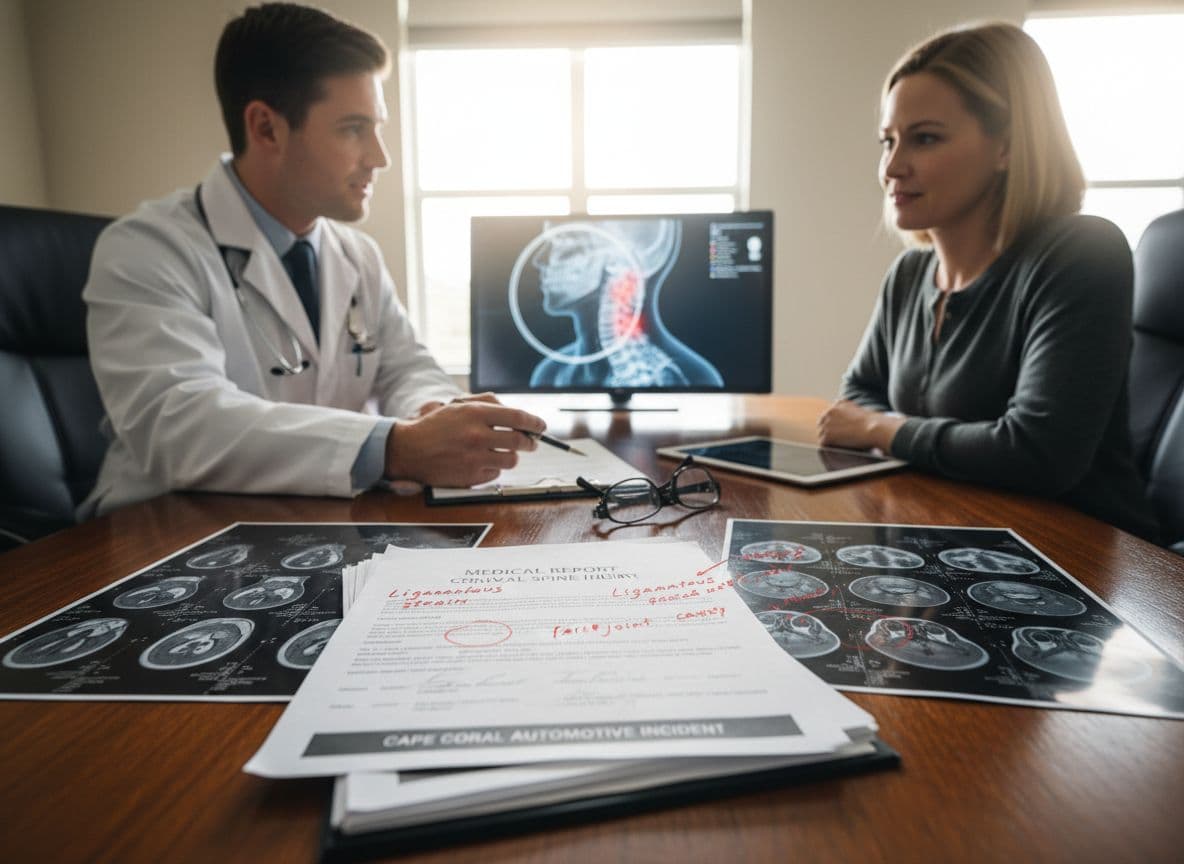
After a Cape Coral crash, you might hear a frustrating line from an adjuster: “Your MRI is normal, so you must be fine.” If your neck still burns, locks up, or sends tingling into your arm, that statement can feel like being told your pain isn’t real.
A cervical spine injury does not always show up on a standard MRI. Some injuries hide in plain sight, not because you’re exaggerating, but because certain structures and pain patterns are hard to capture in a single scan taken on one day.
This article explains why normal imaging happens, what medical evidence can still prove your injury, and how to build a claim that matches what you’re living with.
Why a “normal MRI” doesn’t end the story
An MRI is a powerful tool, but it’s not a truth machine. It captures anatomy at a moment in time, usually while you’re lying still in a neutral position. Many crash injuries involve movement, strain, or inflammation that doesn’t create a clear “here it is” picture on film.
Common reasons cervical injuries don’t appear on MRI include:
- Muscle and soft-tissue strain: Whiplash often injures muscles and tendons. Those can hurt badly without a dramatic MRI finding.
- Ligament injury and micro-tears: Small ligament damage can cause lasting pain and instability, yet still read as “unremarkable.”
- Facet joint injury: Facet joints in the neck can be a major pain source after a rear-end collision. MRI findings can be subtle or absent.
- Nerve irritation without compression: You can have numbness and radiating pain even if the MRI doesn’t show a nerve being pinched.
- Early inflammation: Timing matters. Swelling and irritation can evolve over days or weeks.
Think of MRI like a photo. A photo can’t show speed, force, or the moment your neck snapped forward. Your symptoms and exam findings supply what the picture can’t.
The medical building blocks that support a cervical spine injury claim
When imaging looks normal, the goal is to prove two things: (1) the injury exists, and (2) the crash caused it. That’s done through consistent, credible medical documentation.
1) Symptoms documented early and consistently
If your first medical record mentions neck pain, stiffness, headaches, shoulder pain, or arm tingling, that helps connect the dots. Waiting weeks to get checked can give the insurer room to argue you were hurt somewhere else.
If you’re unsure what to do right after a wreck, follow a clear checklist like this guide on what to do immediately after a car accident in Cape Coral. Early steps often shape the entire claim.
2) Physical exam findings that don’t depend on MRI
Doctors and therapists can document objective, repeatable findings, such as:
- Reduced range of motion (difficulty turning your head)
- Tender points and guarding
- Spasm noted on exam
- Positive orthopedic tests (tests that reproduce pain with specific movements)
- Strength, reflex, or sensation changes in the arms
Insurance companies like imaging because it looks “clean.” Strong exam notes push back because they show your body isn’t functioning normally.
3) Treatment course and response
A short course of rest might be enough for a mild strain. Persistent pain that requires weeks of physical therapy, medications, or pain management is harder to dismiss, even with a normal MRI.
Gaps in treatment can hurt credibility. A steady timeline shows you didn’t just “get sore,” you stayed injured.
Tests that can support neck injury claims when MRI is normal
A normal MRI doesn’t mean “no more testing.” It means your doctor may need a different angle, a different tool, or more time.
Here’s a quick view of evidence types that often matter in cervical injury cases:
| Evidence type | What it can show | Why it helps your claim |
|---|---|---|
| Follow-up clinical exams | Pattern of pain, limits, nerve signs | Builds a consistent medical story over time |
| Physical therapy notes | Functional limits, progress, setbacks | Tracks real-world impact week to week |
| EMG/NCS testing | Nerve irritation or radiculopathy | Supports radiating pain even without MRI compression |
| Flexion-extension X-rays | Instability that neutral imaging can miss | Documents abnormal movement in the cervical spine |
| Diagnostic injections (doctor-directed) | Pain source like facet joints | Can confirm a specific injury generator |
| Medication and activity limits | Sleep disruption, work restrictions | Shows your injury affects daily life |
Not every person needs all of these. The right workup depends on symptoms, exam results, and how you respond to conservative care.
How insurers attack “normal MRI” neck claims, and how to counter it
Insurance companies see “normal MRI” cases every day. Their playbook is predictable. Knowing the usual arguments helps you and your providers document the right details.
Common insurer arguments include:
“It’s just soreness.” Counter with consistent treatment records, therapy notes, and functional limits (driving, lifting, sleep, work).
“This is pre-existing.” Counter with a before-and-after comparison: prior records, symptom changes, and a doctor’s opinion on aggravation. A crash can worsen an old problem.
“If it were real, imaging would show it.” Counter with clear medical explanations: soft-tissue strain, facet injury, nerve irritation, and why MRI can miss these.
“You waited too long.” Counter with early symptoms, urgent care visits, or a reasonable explanation (you tried to push through, pain increased, symptoms spread).
If your case involves recent changes to Florida injury rules, deadlines, or fault arguments, learn how they may affect value and timing. This overview of how Florida’s tort reform changes car accident settlements for Cape Coral drivers helps explain what’s different and why delays can cost real money.
What “proof” looks like in a Cape Coral cervical spine injury case
Proof usually isn’t one magic record. It’s a chain that holds together.
Strong cervical spine injury cases often include:
- A clear crash history: rear-end impact, side impact, airbag deployment, head position, and immediate symptoms.
- Prompt medical evaluation: even if symptoms felt mild at first.
- Consistent complaints: the same core symptoms repeating across records.
- Function loss: missed work, restricted lifting, limited driving, trouble sleeping, difficulty caring for kids.
- Medical causation opinions: a treating doctor tying the injury to the crash, in plain language.
- A clean timeline: fewer gaps, fewer “I stopped for two months” breaks.
If you’re also trying to estimate how neck injuries are valued in local claims, this resource on Cape Coral car accident settlement amounts by injury type can help you understand why documentation and lasting limits matter.
When to involve a personal injury attorney
If your MRI is normal and the insurer is refusing to take your injury seriously, a personal injury attorney can help gather the evidence that tends to move the needle, such as full medical records, therapy notes, wage documentation, and opinions that explain why the injury still counts even without a dramatic scan.
This also matters because time is not on your side. Evidence fades fast, and legal deadlines can be shorter than many people expect.
Conclusion
A normal MRI after a Cape Coral crash can be misleading. It doesn’t cancel your pain, and it doesn’t cancel a cervical spine injury. What matters is the full story: symptoms, exams, treatment, function limits, and medical opinions that connect your condition to the wreck.
If you’re being dismissed because imaging looks “fine,” focus on building real-world proof. Your case shouldn’t hinge on one scan when your daily life tells a different, documented truth.