
Florida Roundabout Car Crashes: How To Prove Failure To Yield
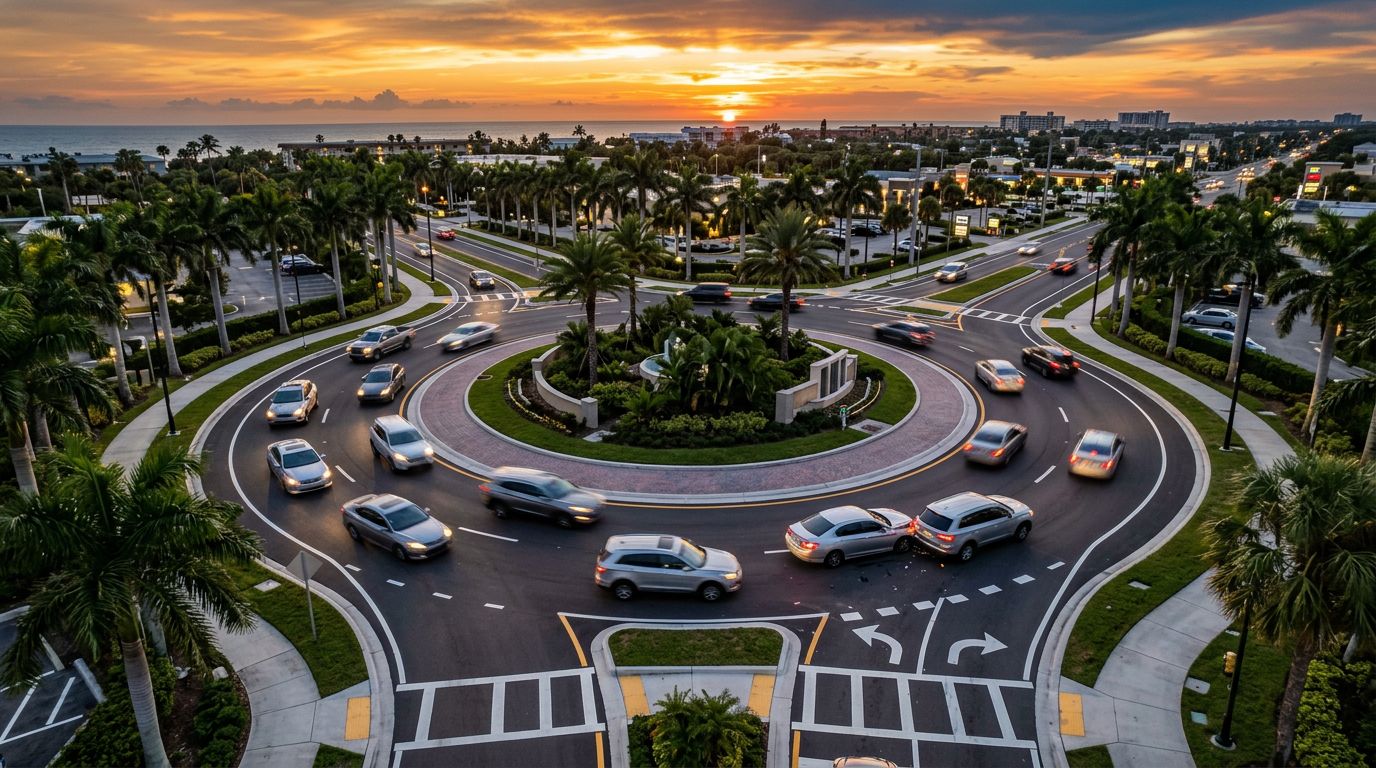
A roundabout is supposed to keep traffic moving. Yet when one driver forces their way in, it can turn into a violent, confusing crash in seconds. If you’re dealing with a Florida roundabout accident, the big question often becomes simple: who failed to yield?
The good news is that failure to yield is usually provable. The hard part is knowing what evidence matters, how to preserve it, and how insurers try to flip blame back on you. Below is a practical guide to building a strong case.
The right-of-way rules that control roundabouts in Florida
Roundabouts run on one core rule: drivers entering must yield to drivers already in the circle. Think of it like merging onto a highway. The car already in the lane shouldn’t have to slam the brakes because someone decided to squeeze in.
Florida agencies explain this idea clearly. The Florida Department of Transportation describes how roundabouts work and why yielding before entry is required in its Florida roundabouts FAQ. The state’s driver guidance also covers roundabout basics, including yielding and safe entry, in the Official Florida Driver License Handbook (PDF).
Even with clear rules, roundabouts produce a familiar set of crashes:
- Entry collisions: A driver enters without yielding and strikes a car already circulating.
- Sideswipes inside the circle: A driver changes lanes mid-roundabout and hits a vehicle beside them.
- Rear-end crashes: A driver follows too closely, then can’t stop when traffic slows.
- Exit conflicts: A driver cuts across a lane to reach an exit at the last moment.
A yield case often comes down to timing and positioning. Were you already in the roundabout? Did the other driver cross the yield line when no safe gap existed? Those are proof questions, not guesswork.
In addition, injuries from roundabout impacts can be serious because the contact is often angled and unexpected. If you’re tracking symptoms or diagnoses, it helps to understand how insurers view common trauma patterns. This overview of common car crash injuries in Florida can help you connect the medical dots early.
What “failure to yield” looks like in a Florida roundabout accident case
“Failure to yield” sounds obvious until the other driver denies it. Insurers love the phrase “shared fault,” especially in a roundabout where lanes curve and memories blur.
Here are the most common ways failure to yield shows up, in plain terms.
Unsafe entry when you’re already circulating
You’re moving through the circle, and another driver enters from the right (or sometimes from another approach) without waiting. The impact is often to your passenger side or front quarter panel. Drivers who enter late will often claim you were “speeding,” even when you weren’t.
Entering from the wrong lane or drifting across the entry
Some roundabouts have two lanes at the entrance. A driver may enter from the outside lane but immediately drift into the inside lane (or the reverse). If your lane choice followed the markings, that drift can support a failure to yield argument because they created the conflict.
Cutting across lanes to exit
A classic roundabout mistake is the “panic exit.” The driver realizes they’re about to miss the exit, then swings across lanes. That move can trigger a sideswipe or a T-bone style impact near the exit.
Ignoring crosswalk yielding duties near the roundabout
Many roundabouts have crosswalks set back from the circle. If a crash happened because a driver rushed entry or exit and ignored a pedestrian crossing, the timeline matters. Even if your collision wasn’t with a pedestrian, that unsafe rush can help explain why the driver acted recklessly.
If the other driver “had to go” and forced the gap, the evidence usually shows it. Yield crashes leave patterns on the road, on vehicles, and in video.
Evidence that proves failure to yield (and how to secure it fast)
A strong Florida roundabout accident claim is built with objective proof. Statements matter, but physical and digital evidence often decide the case.
Video is king, but you have to act quickly
Look for cameras in these places near the roundabout:
- Gas stations and convenience stores
- Banks and retail plazas
- Neighborhood entrance cameras and HOA systems
- Traffic or city cameras (availability varies by location)
Many systems overwrite footage in days, sometimes in 24 to 72 hours. A prompt request can make the difference between clear proof and nothing.
Photos that tell the roundabout story
If you can safely do it, photograph:
- The yield line and any yield signs at the entry
- Lane arrows and lane-use signs before entry
- Your final rest positions and the other vehicle’s position
- Debris fields, gouge marks, and scuff marks
- Any sight obstructions (trees, parked trucks, construction barrels)
Wide shots matter, because they show angles and distances. Close-ups matter, because they show impact points and paint transfer.
Witnesses who saw the “gap”
In a roundabout, the best witness often isn’t the person behind you. It’s the person waiting to enter who watched the other driver jump the line. Get names and phone numbers at the scene if possible.
Vehicle damage patterns and crash reconstruction
Damage location often matches the failure:
- Your side damage plus their front damage often supports unsafe entry.
- Long scrape marks along doors often support a lane change inside the circle.
- Rear-end damage can shift the analysis toward following distance, not yielding.
When liability is disputed, a reconstruction expert can map the roundabout geometry, vehicle paths, and likely speeds. This type of work can also counter the common insurance claim that “you came out of nowhere.”
The police report helps, but it’s not the final word
Officers may issue a citation, note a driver’s admission, or diagram positions. That’s useful. Still, reports can be incomplete, especially if drivers give conflicting stories. Treat the report as one piece of the file, not the whole case.
If you want a deeper look at how fault is built in real-world crash claims, this breakdown of proving fault in Cape Coral crashes lays out the same evidence logic insurers use across Florida.
How fault and compensation work after a roundabout crash in Florida
Even when the other driver failed to yield, the insurance company may argue you share blame for speed, lane position, or signaling. That matters because Florida uses a modified comparative fault system for most negligence cases. If you’re found more than 50 percent at fault, you can be barred from recovering damages from the other party.
Insurance also adds another layer. Florida’s no-fault system means your own policy’s PIP coverage may pay first for medical bills and lost wages, up to policy limits, regardless of fault. Then, depending on injury severity and other factors, you may pursue a claim against the at-fault driver. For a practical explanation of this structure, see Florida no-fault law after car accidents.
One more issue comes up often in roundabout crashes: work vehicles. If the other driver was on the job, a separate insurance policy may apply, and evidence collection becomes more urgent. This guide on Florida company vehicle accident claims explains why employer involvement can change the process.
Conclusion
Proving failure to yield in a Florida roundabout accident isn’t about arguing louder. It’s about building a clean timeline with video, photos, witnesses, and damage patterns that match the right-of-way rules. Move fast to preserve footage, get medical care, and document the scene while details are still fresh.
When insurers try to split blame, strong evidence makes it harder to distort what happened. If your crash file feels messy, that’s often the moment to get help and protect your claim before key proof disappears.